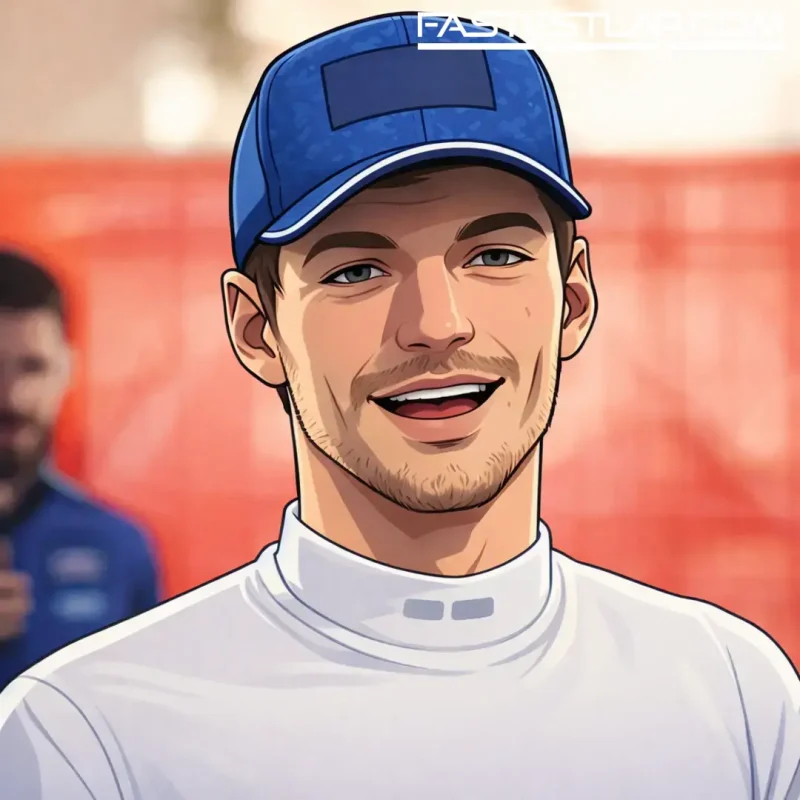
Max Verstappen has spent most of his Formula 1 life being described in absolutes: flat-out, ruthless, always on the edge. Yet, on the eve of a new season and a new rules era, he’s offering a far more interesting explanation for the thing his rivals complain about most — that infuriating, repeatable ability to live on the limit without ever seeming to fall off it.
Speaking on the *Up To Speed* podcast alongside David Coulthard and Naomi Schiff, Verstappen didn’t dress it up in mystique or pretend it’s all instinct from another planet. He framed it as a practical skill built over years of variety — and, crucially, a conscious refusal to drive like every lap is an audition.
Coulthard, trying to put language to something drivers recognise but rarely can quantify, asked the obvious question: when Verstappen nails corner after corner, is he actively processing the sequence — brake, turn, throttle — or is it simply “seat of the pants”?
Verstappen’s answer split into two strands. The first was background: “From a young age, trying a lot of different kinds of racing helps in different kinds of conditions,” he said, explaining that bouncing between machinery and disciplines leaves you with a mental toolbox you can reach for when the car does something unexpected. “I grew up racing basically whatever had an engine. I love driving all different kinds of cars.”
That line matters because it undercuts the tidy narrative that elite F1 drivers are built in a lab: karting, junior single-seaters, then the big show. Verstappen’s point is that the value isn’t just the hours, it’s the variety within them — different weight transfers, different tyre behaviours, different ways a car warns you it’s about to bite. The by-product, in his telling, is adaptability: “There’s always some technique… that makes you a bit more of an all-rounder driver that you can use.”
He also nodded to the modern driver’s not-so-secret training weapon: simulator time at home. “Constantly practicing as well online… it’s a bit of muscle memory,” he said. Not a revelation, perhaps, but a reminder that at this level the difference is often in the unglamorous repetition — the endless rehearsal of scenarios so that when a real car snaps at 290km/h, you’re reacting before you’ve even finished thinking.
Then came the second strand — the one that will make a few engineers smile and a few rivals bristle.
“Most of the time when you are in the car, you’re not driving at 102 per cent,” Verstappen said. “Where a lot of drivers I see are constantly on… constantly trying to go as fast as they can, where probably, I’m not doing that.”
It’s a deceptively sharp observation, because it’s not a claim about raw speed. It’s a claim about control — about having enough margin in hand to manage tyres, manage risk, and still deliver the lap time when it counts. Anyone can light up a purple sector in a moment of overcommitment; the hard part is building a weekend around repeatability, particularly when the car isn’t perfect and the track is evolving.
In F1 paddocks, “overdriving” is one of those phrases thrown around as both diagnosis and insult. Verstappen is essentially saying he’s made a habit of not living in that state. The subtext is obvious: the limit isn’t a single line you either cross or don’t, it’s a moving boundary, and the best drivers are the ones who can hover right on it without constantly leaning over.
There’s also a psychological edge to his framing. Drivers who feel they must be “on” all the time tend to create noise — little corrections, little spikes of aggression — and that noise compounds over a stint. Verstappen is describing a calmer default mode, one where the lap time comes from accuracy rather than constant escalation. It’s not less intense, just less wasteful.
The timing is notable, too. Verstappen arrives at the start of 2026 with something to prove by his own standards. He’s a four-time world champion, but his title streak ended in 2025 when Lando Norris took the crown. Despite that, Verstappen was still voted the best driver of the season by his fellow racers and the team principals — a detail that speaks to how the paddock separates “championship outcome” from “week-in, week-out level”.
Now he begins the chase for a fifth Drivers’ Championship as the new season launches in Melbourne, with all the usual early-year unknowns and a grid full of teams convinced the off-season has moved the needle. Verstappen, for his part, sounds like someone who isn’t interested in theatrics — not in testing, not in interviews, and certainly not in driving at “102 per cent” just to prove a point.
If anything, his explanation is a reminder that the Verstappen myth has always been slightly miscast. The headline moments are aggressive, sure. But the foundation, the thing that keeps showing up across different conditions and different weekends, is discipline — the kind that allows a driver to be brutally fast without needing to look brutal every second he’s in the cockpit.