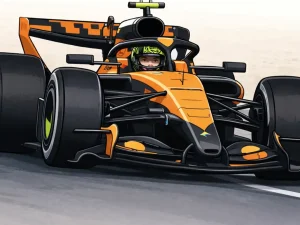
Max Verstappen didn’t say he’s done. He didn’t need to. Over the Japanese Grand Prix weekend, the three-time world champion again let the paddock hear the subtext that’s been humming in the background since the 2026 rules came into focus: if he’s not enjoying what Formula 1 has become, he’s not going to hang around out of habit.
The new battery-heavy flavour of racing clearly isn’t landing with him. Verstappen was unusually candid about his headspace, stressing he’s no longer getting “upset” or “frustrated” by what he sees happening in the sport, because he’s already moved on emotionally to a more existential question: is it worth it?
A day later he doubled down, talking openly about weighing life inside the paddock against being at home, seeing family and friends, and the basic idea that if you’re not enjoying your sport, why force it.
Then, in a detail that’s hard to ignore, he went straight back to doing the thing he actually likes. While others were occupied with a Pirelli tyre test at Suzuka, Verstappen was lapping the Nürburgring in a GT3 car — a Mercedes GT3, no less — and by all accounts “enjoyed it out there”. It was a neat little snapshot of where his motivation seems to sit right now: not in the politics or the optics, but in driving something that feels more like driving.
Red Bull, of course, has Verstappen contracted through to the end of 2028. On paper, that’s security. In reality, contracts only protect you from drivers who want to be there. If Verstappen decides he’s finished with F1, Red Bull aren’t going to chain him to the pitwall and pretend it’s fine. The bigger question is what Red Bull become without him.
Because for all the talk of “the next one”, Verstappen isn’t just a fast driver. He’s the reference point the entire operation has been built around. He’s the ability to rescue mediocre weekends, bend strategy windows, and still make a race look like a private test. You can’t replace that with a promising name and a good PowerPoint.
Yes, Red Bull have options in-house. Isack Hadjar has been “solid” in his first season at the senior team — competent, steady, credible, and also, as the article of faith goes, “no Max”. Arvid Lindblad, meanwhile, has shown signs that he could be a star in the making. But if Verstappen genuinely walked away, Red Bull would be staring at an uncomfortable reality: potential is not a plan when you’re trying to stay at the sharp end of a championship.
That’s why Johnny Herbert’s suggestion is provocative, even if it lands like classic paddock bar-stool logic at first: go and get Mercedes’ Kimi Antonelli.
For years, Mercedes were the ones casting glances at Red Bull’s driver line-up while trying to map out a future after Lewis Hamilton. Herbert’s point is that the dynamic could flip. If Verstappen vacates the seat that defines modern Red Bull, then the team should go shopping for a driver who can carry the same sense of inevitability — and Antonelli, in Herbert’s view, is the obvious “next generation” candidate.
“There’s always the next one. And who is the next one at the present time? Kimi,” Herbert said, arguing Antonelli has the upside to become the sport’s next “wow” driver — the kind who doesn’t merely arrive in F1, but resets expectations.
Herbert’s framing is telling: he sees the sport in eras of performance jumps — from Ayrton Senna to Michael Schumacher to Hamilton to Verstappen — and suggests Antonelli could be the next step in that line. It’s a bold claim, but it reflects the way a certain type of driver gets talked about in the paddock once the hype hardens into belief.
And there’s another layer here that makes the idea more than a headline-grabber. Antonelli is currently going up against George Russell inside Mercedes, with the natural tension that comes when two drivers both see themselves as the long-term leader. We’ve all seen how that usually ends: either one becomes the clear number one, or the team eventually chooses for them.
At Red Bull, the pitch would be simpler. If Verstappen leaves, there’s no established king on the throne. Antonelli wouldn’t be signing up to play the supporting role; he’d be walking into a team that would need him to be the face, the benchmark, and the centre of gravity. For certain drivers, that’s a burden. For others, it’s the whole point.
Still, it’s one thing to muse about “the next Max”. It’s another to prise a driver out of Mercedes and drop him into a Red Bull structure that has been engineered around Verstappen’s habits, feedback, and demands. Red Bull’s immediate safety net is that it wouldn’t have to reach outside at all: Hadjar and Lindblad give them continuity and a clear ladder. But continuity isn’t the same as deterrence. If Verstappen exits, rivals will smell vulnerability — and Red Bull know it.
Herbert, for his part, is clear about what he actually wants: Verstappen to stay. Not because it’s good for Red Bull, but because it’s good for the show — and because Verstappen still does things behind the wheel that make even former F1 drivers sit back and admit they couldn’t do it.
“Yes, he’d be missed, absolutely,” Herbert said. “I don’t want him to leave because I love what he does. He’s got that ‘wow factor’ about him.”
That’s the push and pull Red Bull are living with in 2026. They’ve got the biggest star of this era under contract, but they’re also watching him talk like someone mentally unhooking himself from the grind. When a driver starts openly measuring joy against obligation, the clock is already ticking — even if nobody knows how loud it is yet.
And if Verstappen does decide that the Nürburgring and a GT3 car is more his future than another season of battery-dependent compromise, Red Bull’s next move won’t be about replacing lap time alone. It’ll be about replacing gravity.