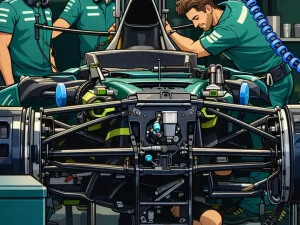
McLaren will park Oscar Piastri for the opening hour at the Hungaroring on Friday, handing his MCL40 to Leonardo Fornaroli for FP1 as the 2026 rookie-session quota starts to bite.
It’s Fornaroli’s second official taste of a Grand Prix weekend this season after his debut outing for McLaren in Barcelona, and another reminder that the Friday-morning “mandatory rookie” runs are no longer a box-tick exercise teams can leave until the last minute. With four FP1 sessions per car now effectively ring-fenced across the year, teams have to decide whether to spend them on pure compliance, on tyre and aero housekeeping, or on something more strategic: stress-testing a potential future asset when the driver market turns.
For Fornaroli, this is exactly the kind of shop window he needs. The Italian is 21, highly rated, and has spent this season out of full-time racing after winning the Formula 2 title last year. That’s a slightly awkward place to be in modern F1: talented enough that people in the paddock know the name, but without the weekly visibility that keeps momentum alive. The way back into the conversation is mileage in current machinery, credible feedback, and a clean session that doesn’t complicate the team’s weekend.
“I’m looking forward to driving the MCL40 in this weekend’s Free Practice 1 at the Hungaroring,” Fornaroli said, framing the opportunity as both development and contribution. He’s been preparing at McLaren’s Woking base, combining simulator work with sessions at the Optimum Nutrition McLaren Performance Hub, and he’s keen to build on what he and the team learned in Barcelona.
That “contribute to the programme” line matters. McLaren won’t treat FP1 at Budapest as a joyride: the Hungaroring is a set-up sensitive circuit and, with track time always at a premium, the engineers will still want usable data. Fornaroli’s job is to hit the run plan, keep the car intact, and speak the same technical language as the race crew. The more seamless he looks, the more he stops being “a rookie obligation” and starts looking like a driver a team might actually want to keep close.
There’s a longer game here too. Fornaroli is eyeing a route onto the grid for 2027 and has been broadening his résumé accordingly, including Testing of Previous Cars running with McLaren and Haas. That sort of cross-team mileage doesn’t happen by accident; it happens because people are curious, and because driver programmes are increasingly happy to share a look at a prospect when the alternative is watching someone else sign them.
Haas, meanwhile, is also using Friday morning in Hungary to fulfil its own needs, confirming Ryo Hirakawa will take Ollie Bearman’s VF-26 for FP1.
Hirakawa’s situation is different, but the motivation is similar: maximise a rare, valuable hour. The two-time World Endurance Champion and Toyota GAZOO Racing factory driver has been juggling sports cars with Super Formula in Japan in recent years, and he’s no stranger to F1 weekends either — he’s previously logged FP1 outings with McLaren and Alpine before his Haas link-up. Hungary will be his eighth FP1 appearance in total, and his second run in the VF-26 after an Austrian Grand Prix session he described as compromised by aero tests and a red flag.
“Next week I’ll have the chance to do some push laps, which is very exciting,” Hirakawa said. “The track is really challenging, it’s quite small, narrow and has a lot of low- and medium-speed corners.”
That’s the key difference between Budapest and some of the more forgiving venues: there’s nowhere to hide. If Hirakawa gets clean laps and can offer clear direction on balance and traction — precisely the areas a “stop-start” FP1 in Austria would’ve left fuzzy — Haas can feed that straight into a more productive FP2 for Bearman, and into a better baseline for the rest of the weekend.
For Piastri and Bearman, the immediate inconvenience is obvious: a missed hour at a circuit where rhythm counts and the track evolves quickly. But teams are getting sharper about where they place these sessions, and Hungary has become an increasingly popular candidate precisely because it puts a premium on driver feedback and slow-corner execution — the kind of environment that quickly tells you whether a junior can operate at the level expected.
And in a paddock already looking beyond the present, FP1 isn’t just practice anymore. It’s auditions, engineering exercises, and — for a driver trying to force his way into 2027 — a rare chance to look like he belongs.