Andrea Stella isn’t taking the Bahrain timing sheets at face value — but he’s also not pretending he hasn’t noticed what’s been going on in the longer runs.
While much of the paddock chat has orbited around Red Bull and the early whispers of an engine advantage, the McLaren team principal has quietly pointed the finger elsewhere when asked who looks most “ready” as Formula 1 beds in its all-new 2026 cars: Mercedes and Ferrari.
That’s a notable stance in itself because Stella doesn’t dismiss Red Bull as a factor. He simply doesn’t put them at the very front of his initial shortlist when it comes to performance indications. In his view, the two teams that have caught the eye — particularly once fuel loads rise and the tyres are asked to live — are the ones wearing silver and red.
McLaren, for its part, has walked away from the first Bahrain test block with something teams value more than a flattering lap time: a functioning programme. Oscar Piastri’s 161 laps on day three underlined that point, setting a new record daily tally for the test and giving McLaren the sort of data stack engineers crave when they’re still signing off a brand-new concept.
Stella framed it in those terms. The mileage, he stressed, is a vote of confidence in reliability and basic functionality — no small thing when these 2026 machines are “a completely new project” and, as he put it, the packaging has been pushed hard enough that it can cost teams half a day when something needs attention.
McLaren had to work for its momentum too. Stella acknowledged Barcelona’s opening days were heavy going before the project began to flow, but by the time Bahrain arrived, the team felt it had moved into a more productive rhythm: less firefighting, more learning.
Then comes the tricky part — the one everyone tries to dance around until Melbourne. Stella is happy to warn against over-interpreting test pace, pointing out the obvious 2026 variables that can swing lap time dramatically: power unit modes, car weight, and all the usual sandbagging games that testing encourages.
Yet when he started listing the teams that “seem to be very well equipped” — fast over a single lap and in race simulations — he put Red Bull, Ferrari and Mercedes together as the familiar big beasts still looking like big beasts.
And then he narrowed it further.
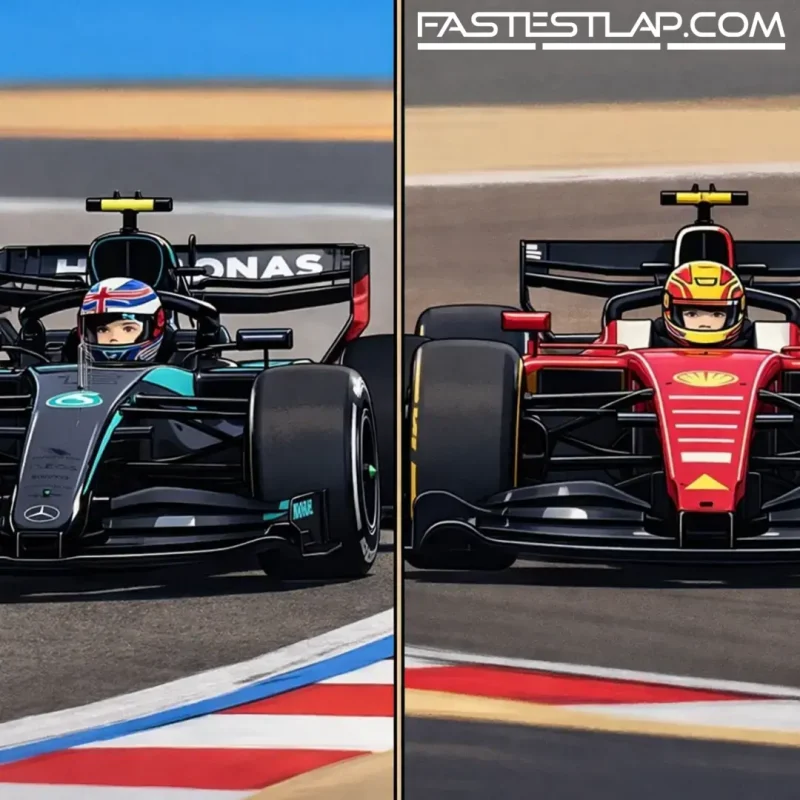
From a performance point of view, Stella said Ferrari and Mercedes are the standouts so far. The context matters: Kimi Antonelli’s Mercedes topped a one-two on the final day, and Lewis Hamilton — now in Ferrari colours — got through 150 laps before the SF-26 ran out of fuel and stopped on the exit of Turn 4. Neither moment, on its own, tells you much. But Stella’s interest is in the long runs that sat behind the headline times.
He referenced Hamilton’s race simulation as “pretty competitive”, and also noted that, when he compared the key long-run stints running in the same window — Antonelli, Hamilton and Piastri — the Ferrari and the Mercedes were the quicker cars on the day. Stella also pointed back to Charles Leclerc’s running the previous day, suggesting Ferrari’s long-run picture has been consistent rather than a single-session illusion.
That is, in some ways, the more intriguing read than who popped up P1 at the end of a low-fuel run. The first proper competitive lap in 2026 will still land with a thud when it arrives, but long-run pace is where teams reveal their baseline: how stable the car is, how it treats its tyres, how quickly it can repeat lap time without the driver constantly catching slides or managing temperatures.
McLaren doesn’t sound panicked — the tone is more measured than that — but it does sound like a team that’s paying attention. Piastri’s mileage spree may have been the day’s most impressive statistic, yet Stella’s remarks make it clear that, on pure pace, McLaren doesn’t currently assume it’s the class of the field.
There’s also an interesting psychological undertone here. The story around Bahrain has been noisy: Lando Norris has talked up Red Bull’s engine; George Russell has labelled Red Bull the team to beat. Stella’s view cuts across that chatter without turning it into a public argument. He’s essentially saying: yes, Red Bull will be there, but if you’re asking me who looks most “ready” right now, it’s Ferrari and Mercedes.
He did add one important caveat — and it’s the one that will linger until the cars line up for real. Stella wouldn’t be drawn on comparative reliability beyond McLaren’s own encouraging run plan. Others may look quick, but whether they can do it repeatedly, weekend after weekend, is another matter.
Testing always leaves you with a half-built picture. This year, with a regulation reset, it’s even more impressionistic. But paddock people don’t make comments like this without reason. Stella has watched the same fuel-corrected patterns everyone else has been staring at in the garages, and Bahrain’s early message from the McLaren pit wall sounds clear enough: if you’re looking for the early benchmarks, start with Ferrari and Mercedes.
The second Bahrain test follows on 18–20 February, before the season gets properly underway at the Australian Grand Prix, with Friday running beginning on 6 March. That’s when the paddock stops guessing and starts keeping score.