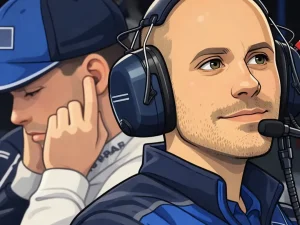
Red Bull is staring down the kind of loss that doesn’t show up on a timing screen, but always leaves a mark: Gianpiero Lambiase is set to join McLaren as its future chief racing officer.
The move isn’t imminent — it’s understood it may not happen before 2028 — yet the significance lands now. Lambiase isn’t just Max Verstappen’s voice in his ear; he’s been one of the key operators in the modern Red Bull system, and since 2025 he’s carried the additional weight of head of racing while still engineering Verstappen from the pit wall. When someone like that commits to another project, even on a longer runway, it changes the temperature around everything from succession planning to driver confidence.
Lambiase, 45, is a British-Italian engineer from Bedford who has done the long, unglamorous climb through multiple team identities. He arrived in F1 in 2005 with Jordan and stayed as “Team Silverstone” morphed through Midland, Spyker and Force India — the sort of CV that tends to produce calm heads on Sundays. His reputation started to travel well before Red Bull came calling; he was on the radio with Giancarlo Fisichella when Force India grabbed that shock pole and podium at Spa in 2009, a weekend still spoken about with a particular fondness in the paddock because it simply wasn’t supposed to happen.
By the time Red Bull hired him in 2015, Lambiase had already worked with a spread of drivers — Vitantonio Liuzzi, Paul di Resta, Sergio Perez — and knew how to steer a weekend without making it about himself. At Milton Keynes he initially engineered Daniil Kvyat, then stayed in place when Verstappen arrived. The partnership’s first race together ended with Verstappen winning on debut for Red Bull at the 2016 Spanish Grand Prix, a result that now reads like the opening scene of a very long film.
Since then, “GP” has become one of the most recognisable voices in Formula 1 — partly because the Verstappen/Lambiase dynamic is so functional, and partly because it’s so blunt. They’re excellent at disagreeing quickly and moving on. Even Verstappen has framed the friction as a feature, not a bug.
Back in 2021 he described their working relationship as “very good and honest”, adding that moments of disagreement are useful because “you want to make each other better, and you want to make the car faster.” Two years later he leaned into the joke: “Oh yes [we disagree], a lot. But that’s also part of the kind of marriage we’re in.” Christian Horner, for his part, once likened the pair to an “old married couple” — which felt less like a gag and more like a scouting report.
That’s what makes the McLaren move so intriguing. Lambiase has previously suggested his next step would be tied to the day the Verstappen chapter ends. In 2023 he told De Telegraaf: “The day Max and I stop working together in this set-up will be the day I’m keen to take on a new challenge,” adding that it wouldn’t be fair to another driver to try to replicate what he’s done with Verstappen since 2016. In the same breath, he said he hoped to continue “until at least 2028. Unless he or the team decides otherwise.”
Those quotes read differently once you know McLaren has his signature for the future.
There’s also the wider context Red Bull can’t ignore. Verstappen, by the account provided here, has not been enjoying the new regulations to the point of contemplating quitting, even though his Red Bull contract runs to the end of 2028. Against that backdrop, the departure of his closest operational ally — not tomorrow morning, but soon enough to have a countdown attached — is exactly the sort of thing rival teams file away as “worth monitoring”.
From McLaren’s perspective, it’s a statement hire from a position of strength. They’re described as the reigning double champions, and the team’s rise under Andrea Stella has turned it into a destination again for senior talent. Lambiase would arrive as chief racing officer, a role McLaren says already exists within its structure with overall leadership of the race team — duties Stella currently covers alongside being team principal.
McLaren has been careful to close off the obvious line of speculation: Lambiase is not being brought in to replace Stella. The team has explicitly said he will report into Stella, and it also underlined that Stella and CEO Zak Brown are both on long-term contracts — a pointed clarification given the earlier noise suggesting Stella could be Ferrari-bound.
There’s an extra layer here too: familiarity. Lambiase’s McLaren move would put him back in the same organisation as Rob Marshall, now McLaren’s chief designer, and Will Courtenay, its sporting director — both with Red Bull pasts. That doesn’t mean McLaren is building “Red Bull 2.0”, but it does suggest a deliberate attempt to import proven working habits and Sunday decision-making standards from a team that has lived under the sharpest kind of pressure.
For Red Bull, the issue isn’t simply replacing a race engineer — they’re not short of bright engineers. It’s replacing a relationship and an authority figure rolled into one, while also managing the optics around Verstappen’s long-term contentment. Lambiase has been embedded in the Verstappen project for a decade by the time this move is expected to happen; that sort of continuity is rare in modern F1, and you don’t swap it out without consequences.
The timing might buy Red Bull space, but it also invites a question the paddock loves to ask: if one pillar of the Verstappen era is already planning his next life, how stable is the structure by the time 2028 actually arrives?