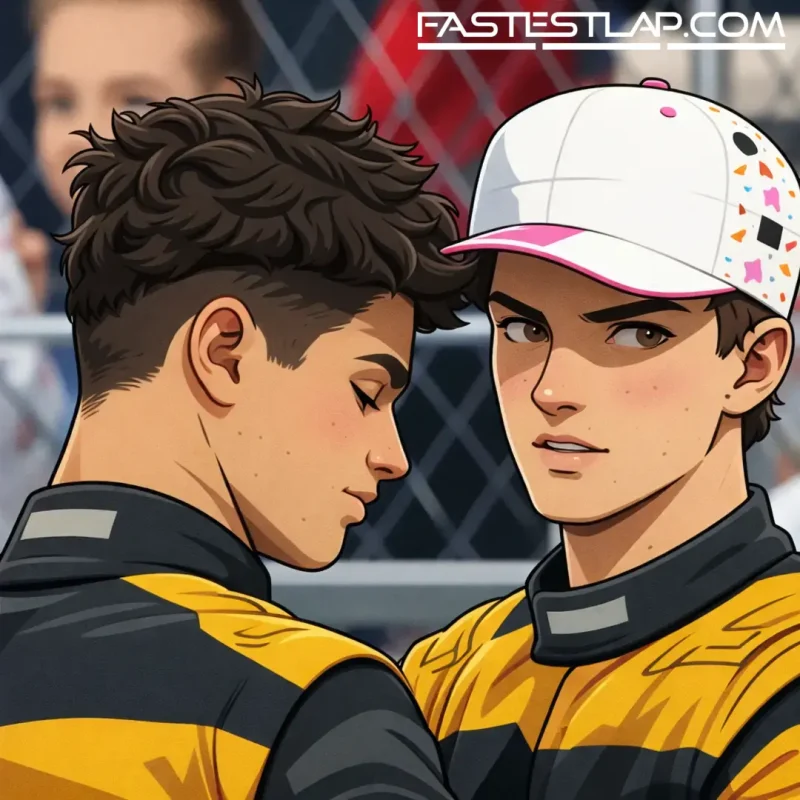
McLaren could’ve taken the easy option heading into 2026: crown Lando Norris as undisputed number one, point the operation at defending his title, and sell it as simple pragmatism in a new-regulation year. Instead, Woking is doubling down on the very thing that made its 2025 campaign so noisy inside and outside the paddock — the so-called “papaya regulations” that insist Norris and Oscar Piastri race on broadly equal terms.
Andrea Stella has been clear that McLaren has revisited its internal racing principles over the winter and, after plenty of discussion, hasn’t found any great philosophical pivot it wants to make. The language he’s using matters: “fairness, integrity, equal opportunities, sportsmanship” isn’t corporate wallpaper, it’s McLaren putting a stake in the ground when most title-winning teams eventually drift towards hierarchy.
And yes, that’s a choice — one with consequences.
Last season was the proof of concept and the warning label rolled into one. McLaren spent much of 2025 looking like it was in a straight fight between its own two drivers for the championship, until Red Bull’s late charge complicated the picture. Norris, strong early, was then reeled in by Piastri, who surged ahead and at one stage held a 34-point advantage over his team-mate.
Then came Monza, and the moment that still hangs over any conversation about “equal opportunity”. After a slow McLaren pitstop dropped Norris behind Piastri, the team made the call that Piastri should surrender second place to Norris. It was framed as damage limitation, a way of righting an operational wrong and managing a championship situation — but the optics were brutal. McLaren had spent months telling everyone its drivers were free to race, only to intervene at the point when a title battle needed clarity.
Piastri’s season never really recovered. He’d already won seven grands prix before Monza; he didn’t win again afterward. Norris overhauled him, Max Verstappen got by too, and Piastri ended up third in the standings. He later acknowledged that “obviously what happened with the pitstops” played a role in the slide.
That’s why McLaren’s 2026 stance is so interesting. It’s not simply a feel-good recommitment to letting them fight — it’s a signal that the team believes its identity is part of its competitive edge, even when it makes life harder.
Stella admits as much. He’s described a thorough review process, with feedback collected through last season, post-season conversations, and continuing discussions in the present. The conclusion, though, is that the fundamentals stay. If anything, they’re “confirmed and consolidated”.
Where McLaren does see room to change is in the mechanics of how it manages the internal fight. Stella acknowledged the workload created by running a team without a conventional pecking order — not just on the pit wall, but for the wider group and “to some extent even for the drivers” as well. He wants the operation “simpler” in execution, with “fine-tuning” and some streamlining. But he also says that, looking back at “most of the cases”, McLaren would do the same thing again.
That’s a pretty blunt message: don’t expect a quiet rebrand into a traditional champion’s team.
For Piastri, it’s an immediate shot of credibility. The easiest way for a team to soften the blow of a contentious call is to quietly shuffle the deck afterward; McLaren hasn’t. Norris may arrive as reigning champion, but Piastri has been told, in public, that he’s still getting an equal crack at 2026.
Piastri’s own tone on the subject has been telling. He’s insisted the “papaya rules” are talked about far more outside the team than within it, and that the reality is a constant review rather than a fixed constitution. His view is that the intentions were right, and that tweaks — if they happen — will be about making life easier rather than rewriting the premise.
That squares with what Stella is saying: the ethos stays, the process gets tidier.
There’s a competitive risk here, of course. The fastest way to bleed points in modern F1 is through hesitation, and internal “fairness” policies can introduce exactly that at the sharp end of races. McLaren lived it in 2025 — the sport doesn’t need reminding how quickly a title fight turns into a post-mortem when both cars are in the mix and Red Bull, Ferrari or anyone else is waiting to capitalise.
But there’s also a strategic upside. Keeping both drivers fully engaged matters in a long season, and McLaren clearly values the performance lift it gets from letting Norris and Piastri push each other without feeling like one is driving with an invisible ceiling. It also protects the team culturally: once you declare a number one, you’d better be certain you’re not creating the next problem — especially when your “number two” has already shown he can take chunks out of a championship lead.
So McLaren heads into 2026 with the sport’s most combustible luxury: two drivers who both believe they should be champion, and a team insisting it can manage that without resorting to rigid team orders. It’s brave, it’s messy, and it’s very McLaren.
Whether it’s the smartest way to defend a title is the part that will only be answered when the first real pressure hits — not in pre-season conversations, but at 300kph with a championship swinging on a pit wall decision.