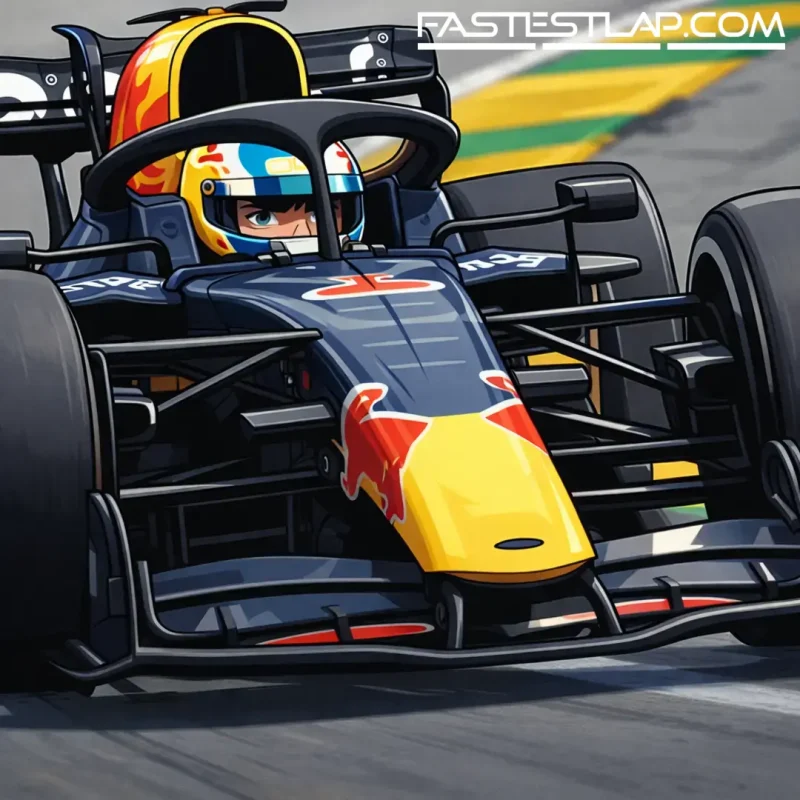
Max Verstappen arrived in Melbourne already simmering about Formula 1’s 2026 direction. He left it having dragged a bruised Red Bull from the back row to sixth — and sounding even less convinced the sport has nailed the brief.
The four-time world champion’s weekend unravelled early when an unusual rear-axle lock pitched him out in Q1, leaving him 20th on the grid for the Australian Grand Prix. But the most jarring moment came when the lights went out.
“Terrible. I had no battery,” Verstappen said afterwards. “Somehow, on the formation lap, it drained all the battery. I have no idea. I launched and, I mean, I had zero battery, so no power.”
In the new era, energy management isn’t some abstract talking point confined to simulator debriefs and technical briefings; it’s now the axis the race can turn on. Verstappen’s start was essentially compromised before it began, and it wasn’t an isolated Red Bull headache either — Isack Hadjar had similar trouble getting his car off the line from the other side of the garage.
From there, Verstappen’s race became what he could do best: survive the messy bits, then carve. He stayed out of trouble early, picked off midfield cars with relative ease once the pace advantage arrived, and eventually settled into a rhythm that hinted at a car with real underlying speed — even if it wasn’t the straightforward kind.
His tyre read was telling. Red Bull rolled the dice on the hard compound, but Verstappen said it simply didn’t behave as expected.
“I think it was quite clear that we had a lot of degradation and a lot of graining on the hard compound, which we thought was going to be better,” he said. “But, unfortunately, it looked like the medium was the better tyre today.”
Despite that, and despite running a two-stop, he still ended up just behind Lando Norris — the reigning world champion and the driver who has been Verstappen’s reference point for the past two seasons. There was no late lunge, no decisive moment where Verstappen could muscle his way past. The opportunity never quite presented itself, and perhaps more importantly in this new landscape, the race rarely offered the kind of sustained, predictable performance window you’d want to plan something like that.
Verstappen struggled to even characterise the grand prix. “Chaos,” he called it, before admitting he didn’t know what word really fit.
And that’s where Melbourne felt less like an opening round and more like a case study in why Verstappen has been so vocal about 2026. The new regulations, with their emphasis on managing energy deployment to extract lap time, have left him openly cold. The bluntest line from his weekend wasn’t about tyre wear or strategy; it was about what he wants Formula 1 to feel like.
“I think it’s better for the sport, because I do care about it. I do love racing, and I want it to be better than this,” he said. “So let’s see what we can do. I hope that, even during this year, maybe we can come up with some different solutions so it becomes more enjoyable.”
There’s a tendency in the paddock to treat driver pushback as code for “my car isn’t good enough.” Verstappen pre-empted that, and he did it with a nod to the people around him.
“I’m very negative about the rules, but I do feel really proud of the team and the engine side as well. The guys have really done an amazing job,” he said, praising the RB11 and Red Bull Powertrains’ DM01 unit. “So, from that side, I’m very happy to be working with them. I just wish that I enjoyed it a little bit more driving-wise.”
He went further, insisting his criticism isn’t an attention-grab or a personal crusade — and suggesting it’s now too widespread to dismiss.
“I love racing, but you can only take so much, right?” Verstappen said. “It’s not like little tweaks for sure. I mean, I think they’re willing to listen, the FIA and F1, but I just hope that there is some action because I’m not the only one saying it.
“Whether it’s drivers, fans, we just want the best for the sport. It’s not that we are critical, just to be critical. We are critical for a reason. We want it to be Formula 1 proper, F1 on steroids. Today, that was not the case.”
What makes Verstappen’s Melbourne weekend intriguing isn’t just the recovery drive — it’s the contrast between the competitor and the critic. He can still do the hard parts: avoid trouble, find pace, pass quickly when the speed is there, and limit damage on a day that could’ve been a write-off. Yet he’s also plainly wrestling with a version of F1 that asks him to drive with one eye on the dashboard and another on the bigger picture.
And despite all the frustration, he didn’t paint Red Bull’s prospects as bleak. If anything, he sounded faintly relieved the problems are at least tangible.
“We have potential in the car for sure. We know that, engine side, I think we’re not too bad,” Verstappen said. “At the moment, I think where our pace is lacking is half-half, so half-car, half-engine, which is not bad. I mean, those are things that can be overcome. It’s not shocking.”
Sixth from 20th is damage limitation on paper. In practice, it was a reminder that Verstappen’s baseline is still brutally high — and that if the sport wants its biggest names fully on board with 2026, it might need more than polite listening. Melbourne, with its drained battery at the start and its “chaos” in the middle, didn’t exactly make the sales pitch.