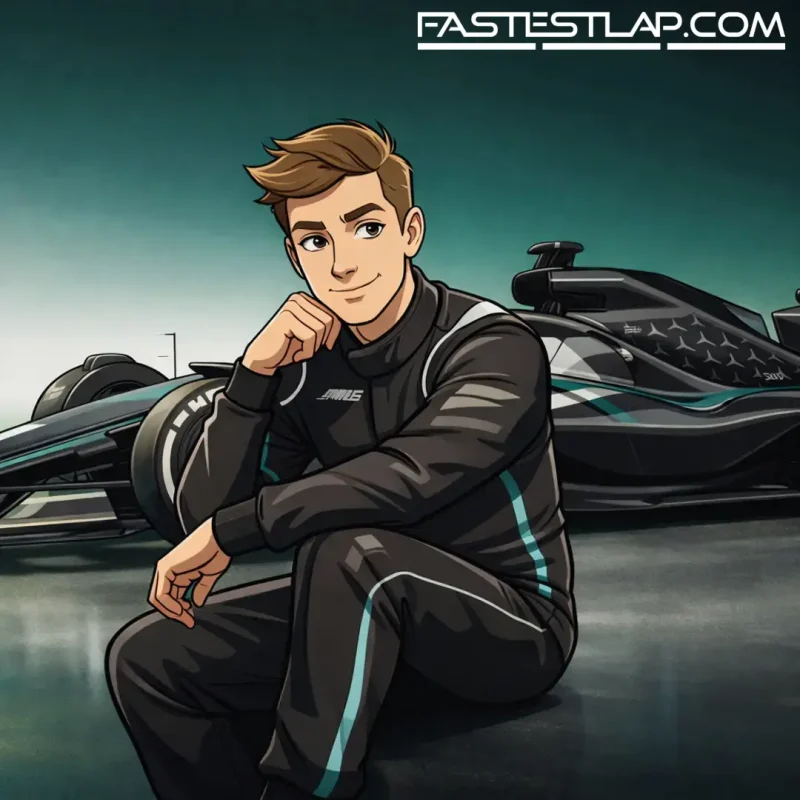
Mercedes has pushed the first W17 images out into the wild, and while a launch gallery never tells you the full story in this era of carefully managed reveals, the subtext is hard to miss: Brackley is treating 2026 as a hard reset, not a gentle evolution.
The timing matters. Formula 1’s rulebook takes a proper swing this year, with the sport moving to 50 per cent electrification, fully sustainable fuels and active aerodynamics. That mix doesn’t just change how the cars look and behave; it changes how you build lap time, how you manage energy, and how you organise an entire programme across chassis, power unit and fuel development. Mercedes wants the paddock to know it’s ready for that kind of fight.
It’s also a moment of opportunity for a team that, by its own standards, has spent too long trying to solve the ground-effect puzzle. Across the 2022–2025 regulations cycle, Mercedes managed seven wins. In most garages that’s a respectable haul; in Brackley, it’s the kind of number that gnaws away all winter. The new rules offer an escape hatch from the compromises of the current generation, and rivals have been openly tipping Mercedes to re-emerge as a title-level force once the slate is wiped clean.
There’s precedent, too. The last time F1’s engine regulations underwent a major overhaul, Mercedes didn’t just get it right — it built an era-defining advantage. Nobody at the team will say “2014” out loud as a target, but you don’t have to read between many lines to understand why the paddock keeps circling back to that comparison.
The W17 will be raced by George Russell and Kimi Antonelli, a pairing that underlines Mercedes’ broader shift from transition to commitment. Russell is now the senior hand in the team’s driving group, and 2026 is his chance to anchor a championship campaign rather than just lead development and salvage weekends when the car isn’t quite there. Antonelli, meanwhile, becomes the next big bet — a driver Mercedes clearly believes can grow into the front-line job quickly as the sport enters a new technical era.
Team principal Toto Wolff framed the launch in those terms: less about the glamour shot, more about the scale of the project behind it.
“Formula One will undergo significant change in 2026, and we are prepared for that transition,” Wolff said. “The new regulations demand innovation and absolute focus across every area of performance.
“Our work on the new car, and the long-term development of the Power Unit and advanced sustainable fuels with PETRONAS, reflects that approach. Releasing the first images of the W17 is simply the next step in that process.
“It represents the collective, sustained effort of our teams in Brixworth and Brackley. We will continue to push hard in the months ahead.”
That last line is doing a bit of heavy lifting. “Months ahead” is where 2026 will be won or lost, because the teams that align their power unit, energy deployment philosophy, aero platform and fuel characteristics earliest won’t just start the season well — they’ll set the development direction that everyone else spends a year chasing. Mercedes is emphasising the Brixworth–Brackley collaboration for a reason: this is one of those regulation changes where any disconnect between chassis and power unit isn’t a small inconvenience, it’s a fundamental performance ceiling.
And then there’s the PETRONAS thread. Sustainable fuels are a headline item across the championship, but Wolff’s choice to highlight “advanced sustainable fuels” is a reminder that the fuel conversation in 2026 isn’t a feel-good add-on — it’s performance-critical. With the power unit landscape changing alongside electrification, any marginal gain in combustion efficiency, consistency, or how the package behaves across race conditions becomes brutally valuable.
Mercedes won’t be alone in believing it can strike early. But the feel around the paddock is that the teams who were stuck in the mud during the latter part of the ground-effect cycle see 2026 as their cleanest route back to the front, and Mercedes fits that description as neatly as anyone. Seven wins across four seasons tells you the operation never forgot how to compete — only that it hasn’t consistently had the tool for the job.
Now it’s showing you the tool it hopes will change that. The W17 images are just the first public marker, but the real statement is this: Mercedes is acting like a team that expects to matter again, quickly, in the new Formula 1.