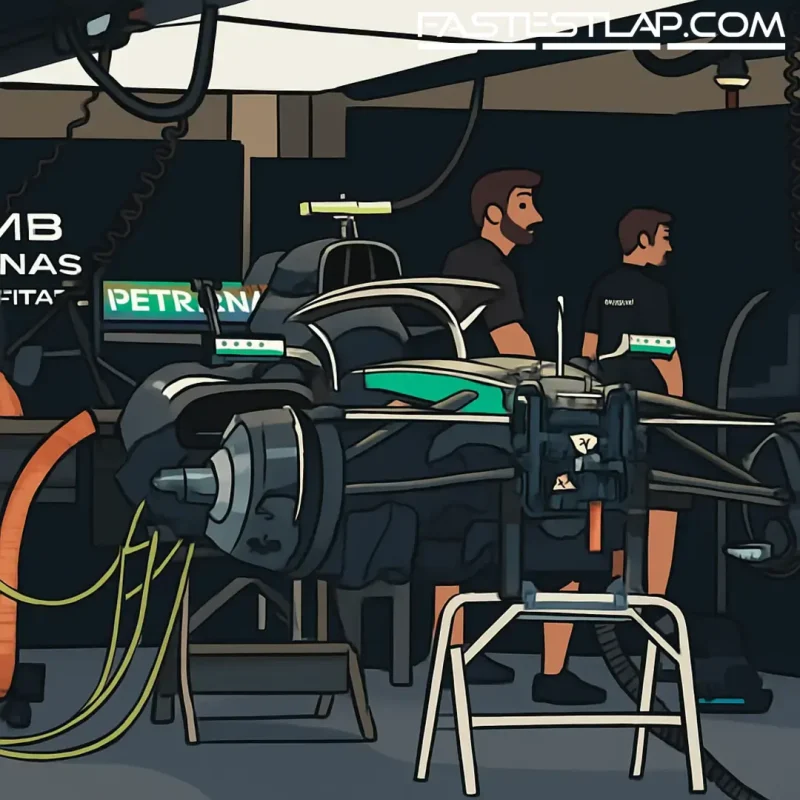
Mercedes’ W16 sat bare on the stands, floor and sidepods off, the front brake drums off too. All the plumbing and carbon that usually stays hidden was out in the open. Fitting, really, for a year that left Toto Wolff and his team feeling remarkably exposed: second in the Constructors’ Championship, but a long, long way from the standard-setters.
McLaren owned 2025, taking 12 of the first 15 races and clinching the title in Singapore with six rounds to spare — matching the early-season stranglehold we last saw from Red Bull. Mercedes, meanwhile, pinched P2 late with a well-timed surge: podiums in São Paulo and a Las Vegas double swung the balance in the Brackley squad’s favor. The final math read 469 points for Mercedes, 18 clear of Red Bull and 71 ahead of Ferrari. The gap to McLaren? A bruising 364.
Wolff didn’t sugarcoat it. “I’m a little bit in two minds, because in 10 years, you look back at the stats and you can see a vice-world champion, P2,” he admitted in the team’s end-of-season review. “But the reality is that we didn’t achieve our goals. We want to win. We want to win races. We want to be in the hunt for a World Championship and hopefully win. And we didn’t. And that is the pain of the moment that it just wasn’t good enough.”
That “pain” was visible across the year. There were bright spots — the car came alive at circuits where the W16’s balance window was easier to hit, and race-ops sharpened as the season wore on — but the package lacked the week-in, week-out authority needed to lean on a title fight. P2 is a platform, not a trophy.
So, change is coming. Not just at Brackley, but across the whole sport. 2026 brings the deepest reset F1 has faced since the advent of the V6 turbo-hybrids. Active aerodynamics arrive, with drivers adjusting front and rear wing states for corners and straights. Power units shift into what Wolff called the “real hybrid era,” with a roughly 50% electric component and sustainable fuel. And there’ll be new tactical toys: Overtake Mode restricted to former DRS zones, plus a separate Boost Mode for attack.
“We had a very successful spell over those years,” Wolff said of the last decade. “We won eight championships, but we had difficult years that followed. And so this one era ends, an era that we will be looking back on with a lot of positive memories, mostly positive memories. But now we are starting in the real hybrid era… and that almost gives it one notch of innovation more. And I just came out of the simulator watching the car drive; it’s going to be fascinating.”
Mercedes hasn’t pinned a public date on the W17’s launch, but the plan is clear. The new car will run in late January at a behind-closed-doors test alongside rivals. Teams are slated for three outings: Barcelona from January 26–30, Bahrain from February 11–13 (open to fans and media), and a third from February 18–20. After that, it’s wheels-up for Melbourne and the season-opening Australian Grand Prix.
If there’s optimism inside Mercedes, it comes less from 2025’s scoreboard and more from the engineering chalkboard. The last era reset delivered an unprecedented run of success. No one at Brackley is banking on history repeating itself — McLaren’s momentum is real, Red Bull’s floor is still frighteningly high, and Ferrari won’t stay out of the conversation for long — but Mercedes knows exactly what P2 really was this year: a warning shot, not a banner.
The W16 heads into storage having done its job of stabilizing the program. The W17 will decide whether Mercedes can turn “pain” into pressure on the teams ahead.