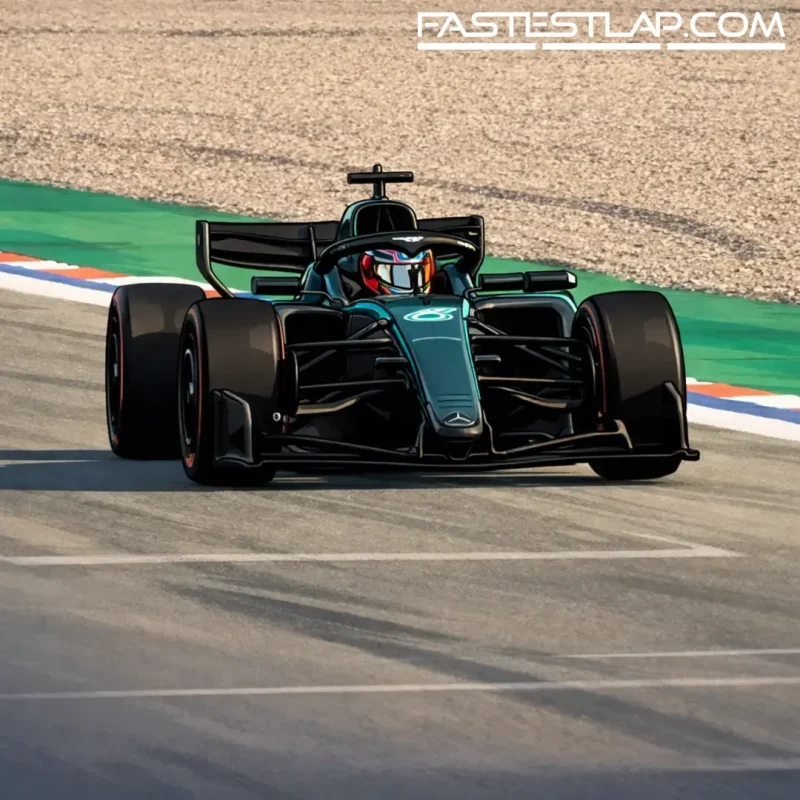
Mercedes won’t pretend a busy shakedown week in Barcelona tells you where the W17 sits on the 2026 pecking order. But in a winter defined by brand-new chassis rules and brand-new power units, it’s hard to overstate how valuable it is simply to have a car that behaves like a car.
By the time the shutters came down at the Circuit de Barcelona-Catalunya, Mercedes had piled on around 500 laps across its three days of running, split between George Russell and Kimi Antonelli. That kind of mileage doesn’t make headlines the way a purple sector does, yet it’s the sort of foundation teams crave when they’re trying to understand unfamiliar systems, new electronics and fresh packaging philosophies all at once.
Andrew Shovlin, Mercedes’ trackside engineering director, didn’t dress it up as anything other than what it was: a project that’s started cleanly, with the basics firmly under control.
“It’s been really impressive from a reliability point of view,” Shovlin said after the running. “There are all new systems on the car. It’s worked brilliantly. We finished a day early, but part of that is that the car’s just allowed us to run the programme day by day as we planned it.”
Finishing early is rarely a coincidence. It’s usually one of two things: either you’ve hit a wall and you’re going home to fix it, or you’ve simply burned through your checklist quicker than expected because the car hasn’t put up a fight. Mercedes is clearly positioning this as the latter — the W17 letting the engineers do their jobs rather than dragging everyone into the garage to firefight.
That, more than a lap time, is the real story of Barcelona. The early part of any new regulatory era is brutal on operational rhythm. It’s not just the headline items — power unit integration, cooling demands, and the inevitable sensor and control-system gremlins — but the small stuff that erodes days: software quirks, calibration issues, unpredictable component temperatures, or basic access problems that turn a simple swap into an hour-long wrestling match.
Shovlin’s point about “new power units, new electronics” is a reminder that the 2026 reset isn’t one single change; it’s several at once, stacked on top of each other. The fact Mercedes could focus on “understanding the new systems” rather than surviving them is the kind of early win that doesn’t show up on a timing screen but absolutely shows up in the quality of your data.
And data is the currency right now. Even if Barcelona’s cold conditions limit what you can really learn about setup direction, a trouble-free run still gives aerodynamicists correlation, gives the vehicle dynamics group real traces to compare to simulation, and gives the power unit engineers a clean read on how their hardware behaves over distance. Every lap you don’t do in February is a lap you wish you’d done in March.
Russell and Antonelli hovered towards the top of the times during the week, though everyone in the paddock knows better than to take those numbers at face value. Fuel loads, run plans and engine modes are still the soft underbelly of winter testing. What’s more telling is that Mercedes sounded like a team able to move from “Does it work?” to “How do we make it better?” within a matter of days.
“Obviously, the regulations are all new on the chassis side, but all of the areas that weren’t great on day one, we’ve made good progress,” Shovlin said. “That’s very encouraging — and that progress is actually making us quicker day by day.”
There’s a subtle confidence in that: not that the W17 is quick in absolute terms, but that the team is already finding a direction that responds when they pull on it. In pre-season, responsiveness matters. A car that improves when you change things is a car you can develop; a car that shrugs its shoulders at setup changes is the one that keeps you awake at night.
Mercedes had already completed a successful shakedown at Silverstone before arriving in Spain, and Shovlin’s view was that between the two events the team had “ticked all the boxes”. Again, that’s not a lap-time boast — it’s an operational one. New cars can be fast and still be a nightmare. The W17, at least so far, sounds like it’s giving Mercedes the space to think.
The next step is to get out of Barcelona’s winter chill and into conditions that actually resemble a grand prix weekend. That’s where Bahrain comes in.
“In Bahrain, we’re going to move more to setup exploration, trying to work out how you get the car in the right window,” Shovlin explained. “Whilst you can do setup here, it’s so cold, it’s not really relevant to any race track, so Bahrain is going to be a much better place to check that the car runs well at temperature… but also just to the systems running effectively.”
That’s the key line: “at temperature”. Plenty of cars behave politely on cold tyres and cold brakes; fewer keep their manners when everything is stressed. Bahrain tends to expose cooling sensitivity, drivability issues and the sort of knock-on effects that only appear when you’re doing longer runs in heat — exactly the stuff you want to flush out before the season starts.
Mercedes’ stated aim is to make that final Bahrain running about race preparation: qualifying simulations, race situations, and the procedural grind that turns winter promise into points. The first official pre-season test is scheduled for 11–13 February at Sakhir, followed by a further three days from 18–20 February.
For now, Mercedes has done the unglamorous part well. In 2026, with everything new and the margins likely to be tight, simply having a car that lets you work might be the first competitive advantage of the year.