Mercedes can talk up the W17’s underlying pace all it likes, but George Russell has landed on a more immediate problem in Bahrain: if the car keeps stumbling off the line, none of that speed is going to matter when the lights go out for real.
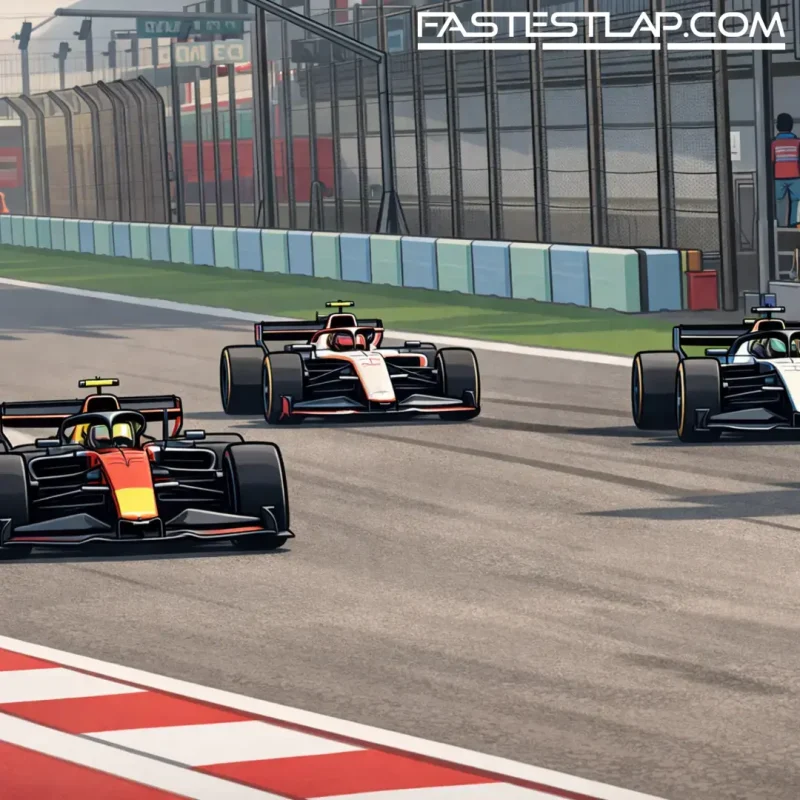
The first proper taste of 2026 race-start chaos came via the FIA’s practice grid launches at the end of Thursday and Friday running, and the session that will stick in most minds wasn’t flattering for Brackley. Russell’s launch sequence went wrong quickly — wheelspin, a moment of sideways correction, and positions bleeding away before the field had even properly funnelled towards Turn 1. Lewis Hamilton, by contrast, made it look brutally simple, slicing through from behind and effectively winning the “race” within the first few car lengths. Oliver Bearman’s Ferrari-powered Haas also edged ahead of the Mercedes in the same drill, compounding the impression that Russell’s issue isn’t just driver feel — it’s system behaviour.
Russell didn’t sugar-coat it afterwards. He pointed out that the two practice starts he’d done this week were worse than his worst start in Formula 1, and that Hamilton — starting deep in one of the drills — still ended up first. The frustration in Russell’s tone was telling, not least because he sounded like someone who knows the lap-time potential exists but can’t access it when it counts.
“I think we’ve got a lot of potential beneath us,” Russell said. “But to win a race, you’ve also got to get off the line quite well… At this stage, I don’t think it matters how quick you are, the thing that’s going to trip you up is going to be that tallest hurdle, and that’s what we’re trying to get our heads around right now. And yeah, we’re stumbling on some at the moment.”
That “tallest hurdle” line cuts to the heart of early-2026 reality. The new cars have forced everyone to relearn a chunk of the start procedure because the MGU-H is gone. For years it did more than just tidy up the power unit’s efficiency story — it helped mask turbo lag and smoothed the torque delivery during the delicate moment when drivers are balancing bite point, clutch release and throttle. Remove that crutch and suddenly the build-up to the ideal launch state is less forgiving, more variable, and far more exposed to small differences in calibration.
It’s why the FIA has already been reacting. After safety concerns from drivers and team principals, a new “blue lights” process was introduced on Thursday: the lights flash a few seconds earlier to warn drivers the start sequence is about to begin, giving them more time to stabilise the power unit and prepare the launch procedure. It’s a sensible tweak, but it’s not a magic fix — Russell still came up short even with that extra preparation window.
What made the optics harsher for Mercedes is that Hamilton wasn’t merely competent; he was the standout. In one of Thursday’s practice starts he jumped from third to first before Turn 1, capitalising on Russell’s messy getaway. Later he produced another eye-catching launch, carving through to lead into Turn 1 again, this time getting the better of Kimi Antonelli and making progress past a small cluster that included Liam Lawson and Max Verstappen. Practice start or not, the message was clear: some packages are already closer to nailing the new-start complexity than others.
Bearman, for his part, sounded like someone who knows he’s sitting on a valuable early-season advantage — and also knows it could disappear the moment rivals catch up. He joked that his launch was “better than my best ever start,” but then got into the detail: the procedure is longer, the spread between good and bad starts is bigger than before, and the handover from internal combustion power to when the ‘K’ element contributes is now a critical moment that needs careful optimisation. Haas, he said, made a “big step” from the previous test to this one, yet it’s still “up and down”.
That variability is exactly what Russell is worried about. The W17 might be quick over a lap — Russell’s convinced there’s “potential beneath us” — but if Mercedes is playing roulette with its starts, it risks turning a decent qualifying into an average race before the first braking zone. In this rules era, where the competitive order can compress and track position remains king, you don’t get to treat the first 50 metres as an afterthought.
There’s also a subtle strategic consequence. If a team can’t trust its launch, it affects everything around it: tyre choice aggressiveness, willingness to start on a riskier compound, even how hard a driver can commit to the first lap knowing they might be forced into avoidance rather than attack. It’s not just losing one place — it’s losing control of your race.
Bahrain is also a place that exposes hesitation. The run to Turn 1 is long enough that a bad initial bite becomes public, and the field is still bunched enough that any instability becomes costly. A small stumble isn’t a small problem here; it’s an invitation.
For Mercedes, the encouraging part is that Russell’s language suggested this isn’t being ignored or brushed away — “we’re trying to get our heads around” it — and the team has time between now and the first race to improve. But the early picture is uncomfortable: in a year where everyone’s relearning the basics, Ferrari-powered cars looked sharper in this specific, high-impact area, and Hamilton’s drills only underlined how much damage a poor start can do.
If Russell’s right — that raw pace won’t matter if you can’t launch — then Mercedes’ first real 2026 upgrade might not be a floor or a wing. It might be the first two seconds of the race.