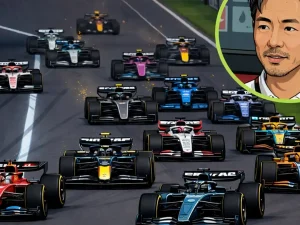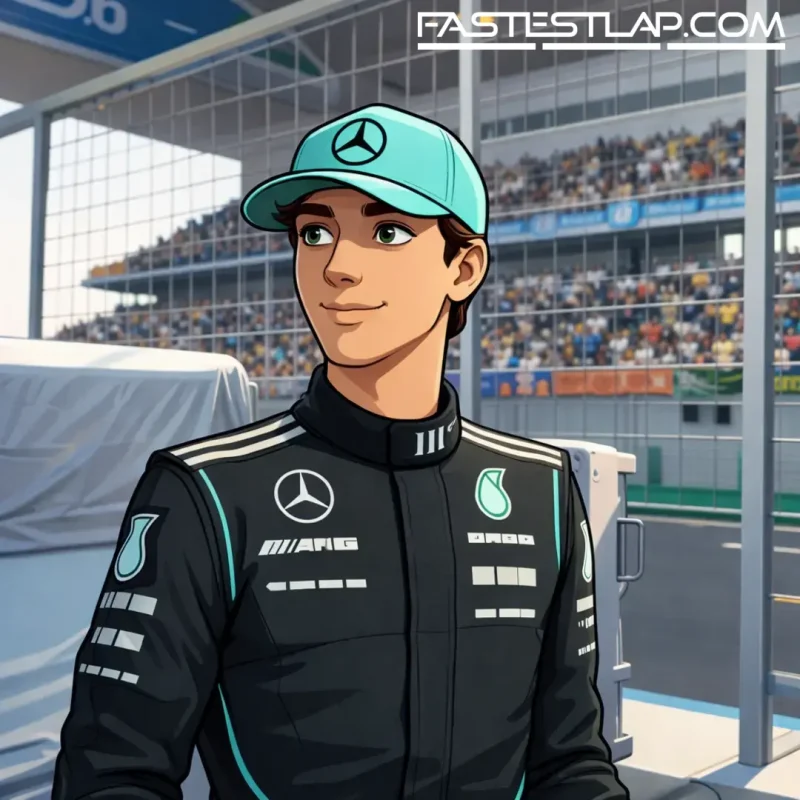
Shanghai’s sprint Friday rarely gives anyone time to breathe, but Mercedes barely looked like it needed oxygen. With only a single practice session to calibrate for a weekend that immediately pivots into Sprint qualifying, George Russell carried the momentum straight to the top again — and in a format designed to punish hesitation, that kind of composure is worth more than a few tenths.
Russell has now made a habit of arriving at Sprint qualifying with the car already in the window, and in China it showed. Mercedes topped every meaningful beat of the day and then converted when it mattered, Russell sealing Sprint pole in a session where traffic, tyre timing and track evolution were doing their best to trip people up. Behind him, Kimi Antonelli kept the second Mercedes squarely in the picture, ahead of Lando Norris, Lewis Hamilton and Oscar Piastri.
Antonelli’s position wasn’t just about pace, either. He came through an impeding investigation that, on another day, could’ve shifted the front of the Sprint grid. Norris felt he’d been blocked in SQ2, while Max Verstappen raised a similar complaint about Pierre Gasly. The stewards ultimately took no action in either case, and the Antonelli/Norris moment had an unusual twist: Norris’ own description of the situation helped defuse it.
The FIA noted Norris said he was on a “pushing warm-up lap” — a detail that mattered because it framed how compromised he’d actually been. Strip that away, and Antonelli was suddenly far more exposed to a penalty that would’ve directly benefited McLaren. It’s not often you see a driver’s testimony effectively shielding a rival from the kind of procedural penalty everyone insists they “just want applied consistently”, but that’s what happened here. Whether you call it sportsmanship or simply accuracy, it stopped Shanghai’s first big talking point from becoming a grid reshuffle.
If Mercedes’ day was about clean execution, Ferrari’s was a study in reality checks. The team arrived in China with an updated rear wing concept it had intended to debut later in the season — a bold move in a weekend where there’s almost no time to properly map correlation and set-up direction. But by Sprint qualifying the Scuderia had already reverted to its previous configuration, a quiet admission that the timing might’ve been too aggressive.
Hamilton didn’t duck it. He suggested bringing the new wing to Shanghai was, in hindsight, “a little premature” — not a criticism of the idea so much as a nod to how little bandwidth a sprint weekend provides. New aero parts don’t just need bolting on; they need understanding. And Shanghai, with its one-shot practice and immediate competitive running, isn’t a place that forgives uncertainty.
The bigger issue for Ferrari, though, wasn’t the wing itself. It was the speed — or the lack of it — when the car stopped turning and started accelerating. Both Hamilton and Charles Leclerc were candid about a straight-line deficit to Mercedes. The SF-26, by their own read, looks competitive in the corners, but the Silver Arrows appear to be pulling away when it’s time to deploy power and efficiency down the straights.
Hamilton, who knows exactly what Mercedes tends to look like when it’s got its homework done early, made it clear there’s work to do back at Maranello if Ferrari is going to match that. Leclerc was equally direct, suggesting Mercedes is “a step ahead” in qualifying trim — and in a sprint format, qualifying trim is half the weekend.
There was also a quieter anxiety bubbling away further down the pitlane. Fernando Alonso acknowledged Aston Martin is operating with limited Honda power unit spares in Shanghai, admitting: “we don’t have any more stock on the power unit” for the remainder of the weekend. Mike Krack, Aston’s chief trackside officer, wouldn’t be drawn on whether spare batteries were available, but Alonso’s tone made the situation plain: any reliability wobble here risks becoming more than an inconvenience.
In a weekend this compressed, the margins are thin and the consequences are immediate. A minor procedural call can change a grid. A new part can become a distraction. A small reliability issue can swallow the whole programme.
For now, though, the picture at the front is clean: Mercedes arrived ready, Russell executed, and everyone else is already talking about how to close a gap that’s showing itself in the least forgiving place — the stopwatch at the end of the straight.