Mercedes didn’t just turn up in Melbourne with a quick car; it arrived with a statement. The first qualifying session of 2026 had carried that familiar paddock hum — rivals wondering whether the silver cars were holding something back — and then George Russell went and removed the doubt in one lap.
Russell put his Mercedes on pole for the Australian Grand Prix, sealing a front-row lockout as Kimi Antonelli backed him up in second. The margin told its own story: three tenths between the two Mercedes, and a yawning eight-tenths to the best of the rest. In a new season, on a circuit that can expose any early weakness in balance and tyre use, it’s the kind of gap that makes other teams’ engineers go very quiet and start re-checking their assumptions.
Third belongs to Red Bull rookie Isack Hadjar, the highest-placed non-Mercedes starter after a lap that, in the context of the deficit, probably felt more like damage limitation than celebration. Charles Leclerc will line up alongside him in fourth for Ferrari, giving the second row a bit of edge — a pair of drivers who’ll have little interest in politely watching the silver cars disappear into Turn 1.
McLaren start with a clean third-row sweep: Oscar Piastri in fifth and Lando Norris in sixth, Norris rolling into his first grand prix as the reigning World Champion. It’s a grid spot that keeps him in the conversation early, but it also means he’s going to need to be sharp immediately: Melbourne’s opening lap can be generous one minute, cruel the next, and the cars ahead aren’t exactly known for leaving doors open.
Ferrari’s other big storyline sits a little further back than the team would’ve wanted. Lewis Hamilton takes seventh, with the Racing Bulls duo of Liam Lawson and Arvid Lindblad lining up eighth and ninth, and Audi’s Gabriel Bortoleto rounding out the top 10.
Bortoleto’s Saturday continues with at least one small consolation: he’s ahead of his teammate. Nico Hülkenberg starts 11th, first in line on the sixth row, with Oliver Bearman alongside in the Haas. Behind them it’s Esteban Ocon (also Haas), Pierre Gasly (Alpine), Alex Albon (Williams) and Franco Colapinto (Alpine) — a midfield spread that suggests Sunday could quickly turn into a strategy chess match, especially if the front stabilises into formation.
Aston Martin, meanwhile, will take what it can get from a difficult qualifying. Fernando Alonso at least gave them something to cling to by getting into the fight to escape Q1, even if the final result was only P17. He’ll start next to Cadillac’s Sergio Perez in 18th, as Cadillac’s first Formula 1 grand prix begins from the ninth row. Valtteri Bottas is 19th in the other Cadillac, which means their debut will be spent in the thick of the Saturday-night headache zone: traffic, tyre offsets, and the constant risk of being trapped behind the wrong cars at the wrong time.
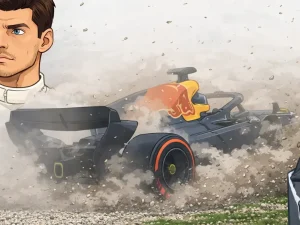
Then there’s the shock that will dominate a lot of the pre-race chat: Max Verstappen out in Q1 after a crash, and down in 20th. Whatever Red Bull’s ultimate pace looks like on long runs, the champion has given himself a mountain to climb on a track that doesn’t always reward impatience. Melbourne can produce overtaking chances, yes — but it also punishes the kind of compromised approaches and half-chances you sometimes have to take when you’re starting that deep.
At the very back, it’s been a rough weekend already for Williams. Carlos Sainz failed to get out of Q1 after his FW48 came to a stop in final practice, and he’s been left on the back row. He’ll share that tail-end real estate with Lance Stroll, who didn’t appear in FP3 or qualifying and will start from the back of the 22-car grid.
So that’s the stage: Mercedes with clear air and control at the front, a hungry pack immediately behind that can’t afford to let Russell and Antonelli settle, and a handful of heavyweight names marooned where they shouldn’t be. If this is what “round one” looks like in 2026, the season hasn’t exactly waited around to get messy.