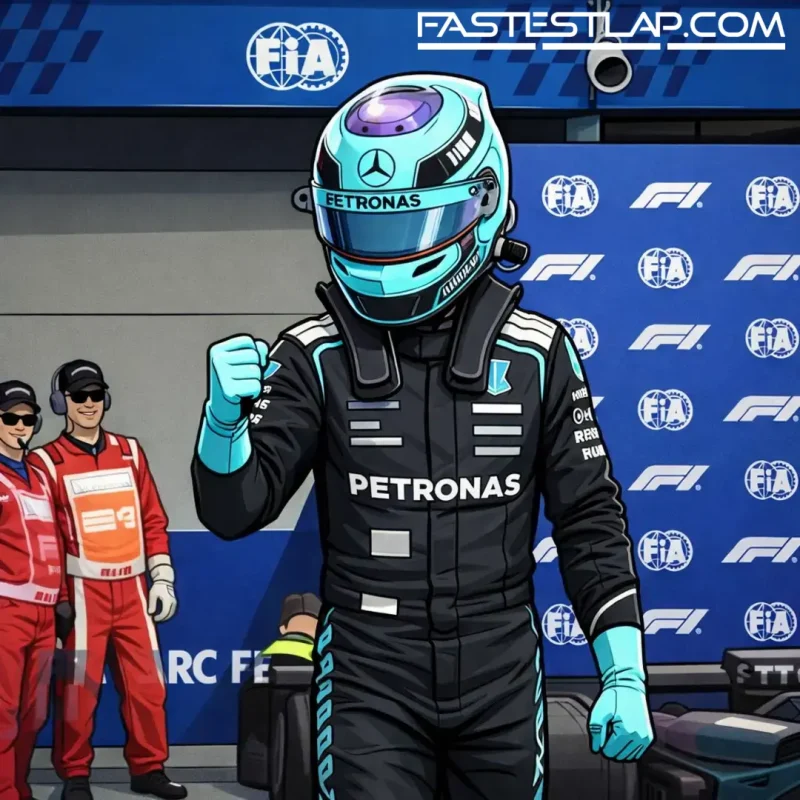
George Russell climbed out of the Mercedes at Albert Park wearing the expression of a man who’s just opened a door he didn’t realise was unlocked. Yes, the paddock chatter had Mercedes pegged as the team to beat at the start of 2026, but the scale of Saturday’s statement still landed with a thud: a front-row lockout, and a gap that made everyone else look like they’d left the handbrake on.
Russell’s pole was emphatic. Kimi Antonelli had briefly set the pace in Q3 with a 1:18.811, only for Russell to respond with a lap three tenths quicker to secure the first pole position of Formula 1’s new era. More telling than the intra-team margin was the one behind them: Mercedes had put roughly eight tenths between itself and the nearest challenger over a single lap. In modern F1 terms, that isn’t an advantage — it’s an entire different conversation.
Russell didn’t try to dress it up as “we expected this all along” either. If anything, his post-session tone suggested Mercedes has arrived with a package that’s even better than its own internal models were brave enough to predict.
“The whole session felt very clean, very tidy, no mistakes, and just how I wanted to start this weekend really,” Russell said. “These new cars are very challenging to drive, they’re very difficult to understand, the energy management and all of the other features we’re dealing with.
“But I think we knew as a team, or we thought as a team, we had a really good package beneath us… but I don’t think we quite thought it was that good. And also, to have Kimi next to me here as well is really great.”
That comment about “energy management and all the other features” is doing a lot of work. Melbourne qualifying is one thing; Melbourne race day in 2026 is another entirely. This weekend is the first proper stress test of the new power units in full racing conditions, and Albert Park is not a gentle venue for systems that need everything in the right window at the right time. It’s an energy-hungry circuit, battery deployment matters, and the margins you find over one lap can evaporate when you’re managing the car across 58 laps, traffic, safety cars and pit sequences.
Russell, who looked in command from Q1 onwards, was notably cautious about what Sunday could deliver — not because he doubts Mercedes’ pace, but because everyone is still feeling out how fragile the operational side of this new era can be when the lights go out.
“I think the goal for us right now is to just try and make the finish line because we honestly don’t know what’s going to happen,” he admitted. “The most simple things that we’ve been dealing with over the past years, such as pit stops, are now really challenging with all the procedures, getting the engine in the right window, the turbo speed spinning enough, the battery not too low but not too high, race starts, we’ve seen our challenge. So, I think the goal for us was just to have a clean weekend.
“Of course we want to win, we want to be on board, we want to dominate the weekend, but it’s a really long season and we need to get through tomorrow and just have a clean race, because at any point you can stumble and that could be the end of your day.”
It’s the kind of quote that sounds conservative until you remember what this opening round represents. Testing gives you a thousand theories; a race gives you hard answers — and sometimes a bill. The sport’s reset hasn’t just changed what the cars do on track, it’s rewritten what teams have to juggle behind the scenes: starting procedures, state-of-charge targets, keeping the hardware in the right operating band, and executing pit stops when the tolerances have moved.
That’s why the Mercedes performance in qualifying feels like only half the story. The other half is whether the Silver Arrows can convert a locked-out front row into a controlled race when reliability, procedure and energy use are all under the microscope for the first time in anger. Russell’s line about simply reaching the chequered flag wasn’t false modesty; it sounded like someone who’s seen enough data to know where the traps are.
As for Antonelli, lining up alongside Russell is a boost Mercedes will quietly relish. It means strategic flexibility, protection from undercuts, and the ability to control the front of the field — the old-fashioned benefits of owning row one. The rookie (or near-rookie, depending on how you frame his rapid ascent) also did his job by setting a benchmark in Q3 that forced Russell to deliver under pressure. He did, and he did it with room to spare.
Sunday, though, is where this new era will start sorting itself out. If Mercedes can translate Saturday’s raw pace into a clean, procedure-perfect race, it won’t just win the Australian Grand Prix — it’ll set the emotional tone of the season. If it stumbles, Russell’s warning will look less like caution and more like a clear-eyed read of the chaos that tends to follow big regulation shifts.
Either way, Melbourne has already sent the first loud message of 2026: Mercedes isn’t merely back at the front. Right now, it’s playing a different game.