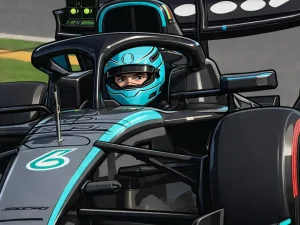
Mercedes walked out of a tidy, productive Saturday morning in Melbourne and straight into damage limitation after Kimi Antonelli’s heavy FP3 shunt left the W17 needing major attention with qualifying looming just a couple of hours later.
Antonelli had just filed out behind George Russell for what looked like a straightforward qualifying simulation when it all went wrong at the Turn 2 sequence. On the start of his flying lap, the Italian clipped the kerb at Turn 2, the car snapped away from him and he was effectively a passenger as the Mercedes speared into the outside wall at Turn 3, then ricocheted back across the track into the inside barrier.
The first impact appeared to be rear-first, violent enough to rotate the car so the nose also made contact, before it slid across for a second rear-end hit. It was the kind of crash that doesn’t just bend wishbones and crack endplates — it raises immediate questions about gearbox, rear structure and the amount of straightening-up a chassis might need, even if the car *looks* superficially repairable.
Antonelli, importantly, climbed out under his own steam and walked back to the Mercedes garage, where he went straight into debrief mode with race engineer Peter “Bono” Bonnington. The physical outcome was the best part of the incident. Everything else, from Mercedes’ run plan to Antonelli’s confidence heading into his first qualifying of the season, suddenly became more complicated.
Kimi Antonelli into the barrier! 😱
Here's the sizeable crash which ended the Mercedes driver's FP3 👇#F1#AusGPpic.twitter.com/ZC1PrM1JE0
— Formula 1 (@F1)March 7, 2026
As the session ticked down, the Mercedes mechanics were already assembling parts and preparing for a fast turnaround, the sort of garage choreography every team practises but never wants to actually need. With the W17 recovered and the clock working against them, this became a straight sprint: assess what’s broken, decide what can be replaced quickly without inviting bigger trouble later, and get Antonelli back out with enough time to at least complete an out-lap system check before qualifying.
Jenson Button, watching the incident unfold, framed it in a way that’ll resonate with anyone who’s driven or analysed Melbourne’s quick direction changes: the corner rewards commitment, but it punishes impatience. Comparing Antonelli’s approach to Russell’s, Button pointed to the fine margin between “attacking” and “overdriving” — and to how Russell’s line and car placement allowed him to get the car rotated early, ready to deploy the power cleanly on exit.
Button’s point wasn’t that Antonelli lacked speed. It was that he asked too much of the car in a section where the fastest route is usually the one that makes the next phase easy — and that’s the trap for a young driver chasing the last few hundredths on a qualifying sim. You turn in a fraction tighter, carry a fraction more entry speed, and suddenly you’re climbing a kerb you only meant to kiss.
There’s also the more uncomfortable subplot Mercedes can’t ignore: the asymmetry this creates across the garage. Russell gets the clean run-up, the completed programme, and the calm headspace. Antonelli, even if the car is rebuilt in time, goes into qualifying with fewer reference points, fewer rehearsals, and that lingering awareness that a similar mistake again would be costly in every sense.
What happens next hinges on two things: how extensive the damage is once Mercedes has the W17 stripped down, and whether the team can put Antonelli back on track with a car that’s not only repaired, but trustworthy. A patched-up car that still feels “off” through the high-speed changes is the last thing a driver needs when he’s already recalibrating his own limits.
For now, Antonelli can at least take the one victory you always want after a big one: he walked away. Mercedes, meanwhile, has to win the next one with spanners, carbon fibre and a stopwatch — because Melbourne doesn’t wait for anyone, and qualifying certainly won’t.