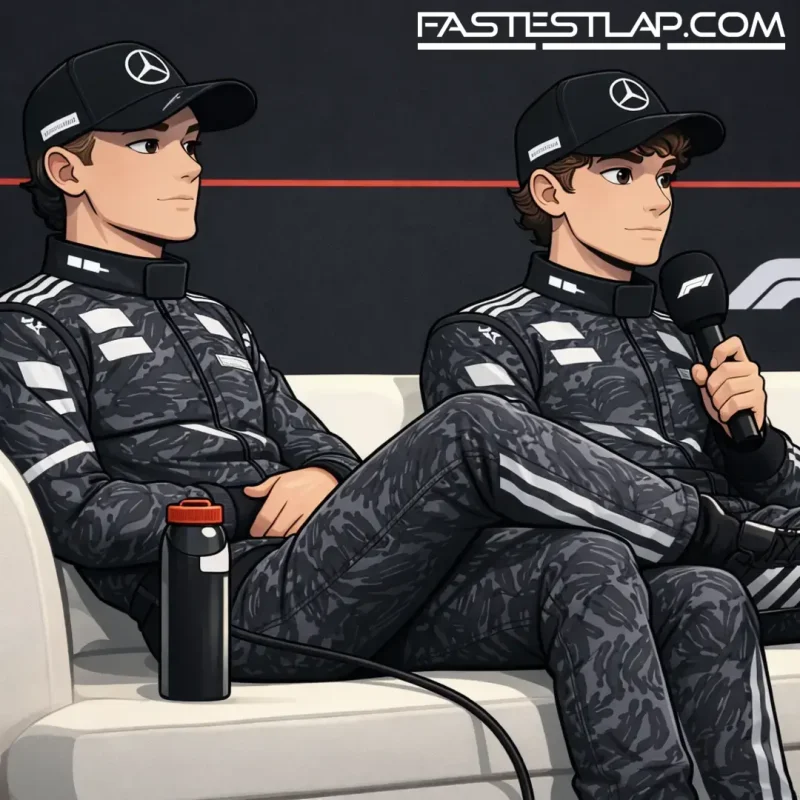
Mercedes has barely had time to breathe since Melbourne, and already the garage is staring down the oldest problem in this sport: what happens when your only real rival is wearing the same overalls.
Three races into 2026, Mercedes has swept the lot. George Russell opened the year by winning in Australia, then Kimi Antonelli hit back in China before making it two on the bounce with victory at Suzuka. The points picture is already tilted heavily in Brackley’s favour — Mercedes sits 45 points clear of Ferrari in the Constructors’ race — and Antonelli leads Russell by nine in the Drivers’ standings, with Charles Leclerc the nearest non-Mercedes driver on 49 points. That’s almost a full win off Antonelli’s tally, and we’re still in April.
So the question arriving early isn’t “can Mercedes do it?”, but “can Mercedes keep it tidy?”
Antonelli, speaking during the unofficial spring break, sounded like a driver who knows exactly what people are waiting for: the first flashpoint, the first awkward radio exchange, the first frosty body language in the pen. He insists it’s not coming.
“The relationship is very strong, and it doesn’t change,” Antonelli told select media. “There’s a lot of respect between us, and we’ve been working very well so far, and there’s a very good dynamic in the team.”
It’s an easy line to deliver when the wins are fresh and the atmosphere is buoyant — but Mercedes’ own history means nobody in the paddock hears it innocently. The Hamilton-Rosberg years are still the reference point any time the silver cars run away with a season, because that partnership didn’t unravel slowly; it soured at the speed of a championship opportunity slipping away.
Antonelli’s framing, though, is interesting. He isn’t pretending he’s there to learn quietly while Russell takes charge. He’s making it clear he sees himself as a genuine title player — while also signalling he understands the political cost if the partnership turns into a civil war.
“Of course, I feel like I can be a challenger, and that’s what I’m here for,” he said. “I want to race to win races and championships. So that’s my goal.
“Definitely, this year, it’s a massive opportunity for all of us, and especially also for George and me, because we have a very strong car… we don’t want to waste this opportunity, so we’re going to do our best.
“But we also [are] very aware that it’s very important to keep a good dynamic in the team… we have our own goals, which is to win and to be the best, but, at the same time, we want to help the team… to win as well the Constructors’ Championship.”
The subtext is the bit Mercedes will like: the constructors’ title is positioned as the shared mission that keeps the temperature down when the drivers’ title starts to feel personal.
That moment is coming. It always does. And Antonelli’s second win of the season in Japan was a reminder of how fine the margins are when you’re racing your teammate rather than chasing cars from other teams. Suzuka turned on a Safety Car window that arrived at exactly the wrong time for Russell and for Oscar Piastri, who’d been leading for McLaren before the timing swing compromised his race. Antonelli did what championship contenders do: he was positioned well enough to profit when the race broke his way.
It’s also worth noting how quickly the narrative has flipped around him. Antonelli’s rookie year was inconsistent, and by his own trajectory it looked, at points, like a young driver carrying the weight of expectation a bit too loudly. This season he’s been composed — the one obvious blot being a crash in FP3 in Australia — and he’s taken opportunities without appearing to force them.
That’s the kind of development that changes a team’s internal balance overnight. Russell is “the experienced one” on paper, but experience doesn’t protect you if the other side of the garage is simply executing better across weekends. If the car remains the class of the field, the pressure won’t come from Ferrari or McLaren first. It’ll come from qualifying sessions where one hundredth becomes leverage, and from strategy calls where the pit wall has to choose which of its two stars gets priority.
Antonelli, for his part, is trying hard not to talk like a man counting trophies in March. He says the mindset hasn’t changed, only the expectations around him.
“It’s been a better start than what we all anticipated and hoped for, at least on my side,” he said. “Expectations automatically… they’re a bit different now, but, at the end of the day, I still try to keep the same mindset… focusing on what I have to do…
“What I don’t want to do is… start to think about the final result, or long-term results. I just really want to focus on the present… focusing on the process… because, obviously, George is super strong, and competitors will get closer.”
That last line is the other reality Mercedes can’t ignore. Miami is next after a five-week gap, the sort of breather that allows rivals to turn over upgrades and re-baseline where they are. There’s also the lingering possibility that regulation changes around energy management could shuffle priorities and, in turn, the competitive order. If Mercedes’ advantage shrinks, the Russell-Antonelli dynamic becomes easier to manage because survival mode tends to unify a team.
If it doesn’t shrink — if Mercedes keeps turning up with the quickest package — then the first genuine stress test won’t be whether Antonelli and Russell “get on.” It’ll be whether they can keep making decisions that hurt the other guy without feeling like they’ve betrayed something. That’s where partnerships fracture: not in the big, obvious collision, but in the accumulation of small moments that feel unfair in the privacy of a helmet.
Antonelli is adamant the foundations are solid.
“I believe that our relationship is strong and will be strong for the rest of the year,” he said.
Mercedes will take him at his word. But everyone else will keep watching for the first time those words have to do some actual work.