Liam Lawson’s near-miss with track marshals in Mexico has taken a twist, with the country’s national sporting authority offering its own account of events—and hinting the Racing Bulls driver could have done more under double yellows.
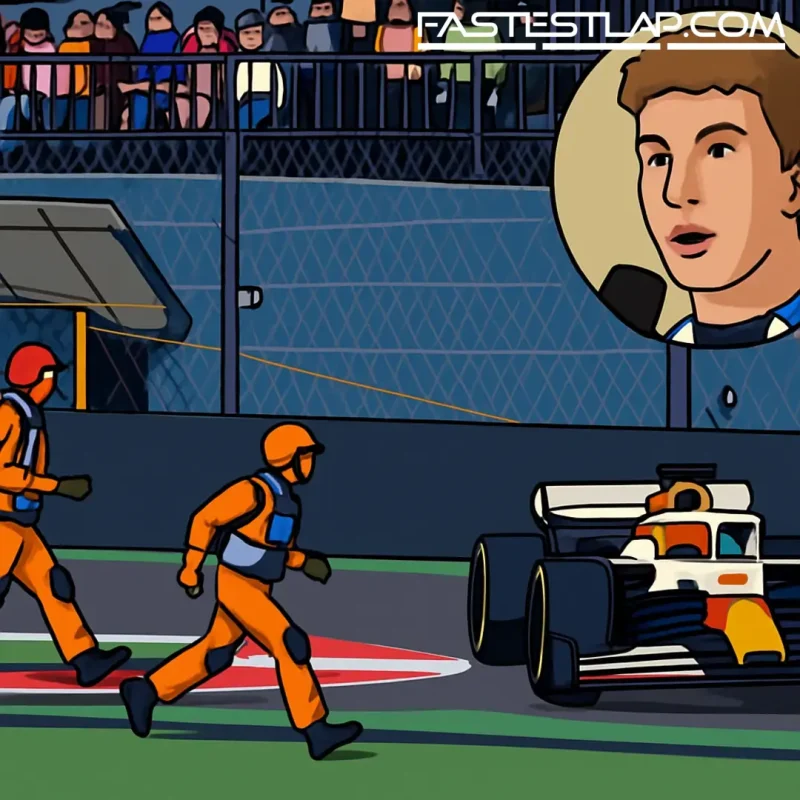
The flashpoint came early in the Mexico City Grand Prix at the Autódromo Hermanos Rodríguez. Lawson, who’d picked up front wing damage in a clash with Williams’ Carlos Sainz at Turn 1, dived into the pits on Lap 3 and rejoined on fresh hards. As he approached Turn 1 again, he found marshals on the racing line clearing debris. Startled, he jinked to avoid them and lit up the radio: “I could have f***ing killed them!” He retired not long after, calling the situation “unacceptable.”
The FIA moved quickly on Sunday night, confirming that a double yellow was displayed for debris at Turn 1, and that marshals had been put on standby to enter once the field had passed. Crucially, race control said instructions to dispatch marshals were rescinded when Lawson pitted—before adding the governing body is still investigating “what occurred after that point.” It also took care to underline respect for the local ASN and marshals, who are volunteers and an essential part of every grand prix weekend.
That might have been the end of it until Wednesday, when OMDAI—the Mexican International Motor Sport Federation, and the national sporting authority for the event—published a multi-page breakdown of the sequence. While not an official FIA communication, OMDAI’s document leaned heavily on onboard and external footage and made clear it believes the double-yellow protocol should have left Lawson in no doubt: slow down, be ready to change direction, and be prepared to stop.
OMDAI’s account set out the timeline: debris after Lawson’s tangle with Sainz, marshals deployed to sweep the racing line, Lawson pitting, then rejoining to find Turn 1 still under double yellow via Panel 3, with the team warning him on the radio. In its analysis, OMDAI said Lawson “maintains the steering angle” and takes the normal line through Turn 1 despite marshals being visible, suggesting he didn’t adjust sufficiently to the hazard. It also noted the green flag came only at Panel 4, beyond the apex of Turn 2—meaning the zone wasn’t clear until then.
In other words: from OMDAI’s point of view, the flags were correct and the driver should’ve been primed to take greater avoiding action.
Lawson, for his part, was adamant he’d encountered a situation that simply shouldn’t happen in modern F1. “I’d never seen anything like it,” he told TV crews after climbing out. “Two guys running across the track. I nearly hit one of them… this can’t happen again.”
This is where the tension lies. Double yellows carry a heavy expectation—drivers must significantly lift, avoid overtaking, and be prepared to stop. But greenlighting any marshal activity on or near a live track is supposed to be watertight. The FIA’s initial wording hinted at a breakdown in that chain: marshals were stood down, yet Lawson still arrived to find people on the asphalt. OMDAI’s emphasis, meanwhile, is that the signals were clear and the driver’s responsibility is absolute.
It’s possible both things are true. If marshals were in the process of clearing the line and the rescind instruction came late or wasn’t uniformly acted on, you’re in the grey zone no-one wants—humans making split-second decisions while a car barrels toward them at race pace. The sport’s protocols exist to keep that from ever happening.
Until the FIA publishes its final findings, there are no winners in this one. Racing Bulls will want to understand exactly what Lawson was told and what the trackside panels were showing at each marshal post. OMDAI, for its part, has made a firm defense of its personnel and procedures. And the FIA will need to stitch together radio traffic, marshalling logs, and GPS to determine whether a call, a timing mismatch, or a driver misjudgment—or a mix of all three—created the near-miss.
What’s not up for debate is the bottom line. Marshals are the backbone of motorsport and deserve absolute protection. Drivers, even in the heat of battle, know what double yellows demand. Somewhere in Mexico City, that balance faltered. The investigation’s job now is to lock it tight before the circus rolls on.