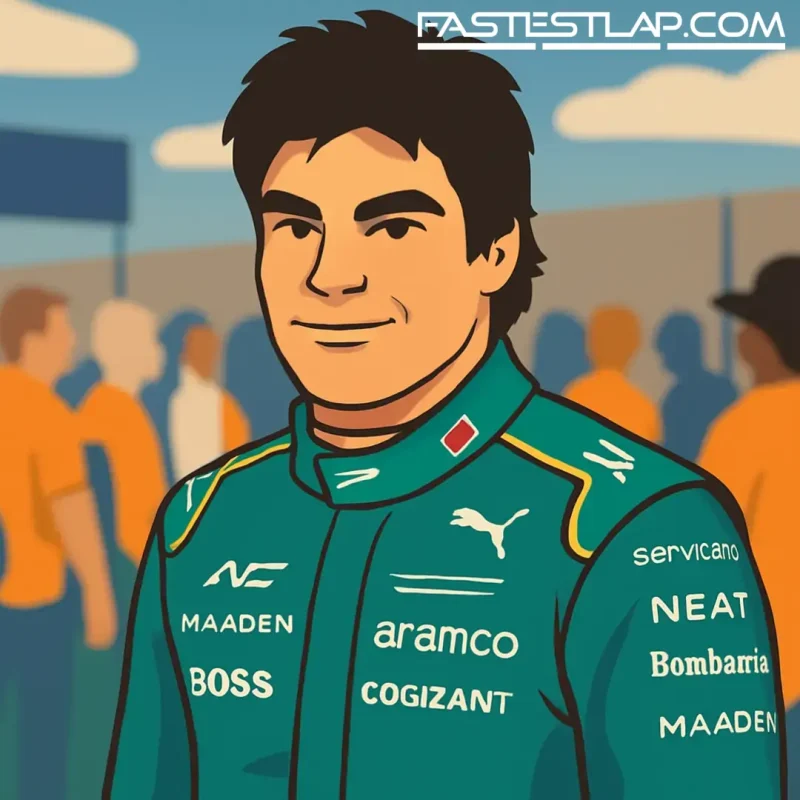
Aston Martin’s 2026 bet looks bulletproof on paper: Honda power returning with a pedigree of four drivers’ titles in the last five, Adrian Newey sketching the future in green, and a two-time world champion in the other car. Which leaves one variable that keeps getting dragged into the spotlight—Lance Stroll.
The Canadian finished the 2025 season 16th with 33 points, while Fernando Alonso logged 56. That gap has fuelled the familiar Stroll discourse heading into F1’s next rules reset: is he the weak link, or just chronically underestimated?
Former F1 driver Christian Danner didn’t hold back in a recent German TV hit, arguing Stroll doesn’t project much enthusiasm for the job. In Danner’s view, the body language reads indifferent, even grumpy, and in a normal team that would’ve had consequences. Aston Martin, of course, is not a normal team environment. It’s family. And that’s always complicated.
Strip the emotion out and Stroll’s record is what it is: 193 starts, three podiums, no wins. Not bad. Not career-defining, either. He’s hovered in that grey zone where his raw speed shows in flashes—especially on chaotic Sundays—but not often enough to tilt a team’s trajectory over a season.
Newey, however, isn’t buying the caricature. Aston Martin’s new design boss believes Stroll “has an unfairly bad rap,” pointing to a long run of heavyweight teammates—Sergio Perez, Nico Hülkenberg, Sebastian Vettel and now Alonso—against whom Stroll has, in Newey’s words, been right there more often than outsiders give him credit for. Coming from the man whose cars have taken 26 world titles (14 drivers’ and 12 constructors’), that’s not a throwaway defense. It’s a framing: if Newey thinks there’s a platform to work with, the team will treat it as such.
Which brings us to 2026. The cars will be lighter, lean on active aero, and marry more electric deployment with smaller internal combustion engines. Honda’s return gives Aston Martin a serious performance ceiling, and Newey’s fingerprints promise an efficient baseline from day one. That combination turns the driver equation into something sharper: can Stroll extract the edge from a brand-new tool kit under pressure?
What makes the question fair isn’t the “pay driver” tag he’ll wear as long as Lawrence Stroll owns the team; it’s the consistency gap. On his best days, Lance is tidy and disciplined, with enough touch in changeable conditions to bank big results. On his off days—too often in 2025—qualifying left him exposed, strategy options shrank, and the narrative wrote itself by Saturday evening.
Danner’s critique about “spark” cuts to the optics—how Stroll carries himself when the heat’s on. That matters in a team gearing up for a title push, because momentum is cultural as much as technical. But there’s another side to it: athletes don’t need to look ecstatic to be effective, and a calmer exterior has fooled paddock watchers before. What will count next year is clarity of execution alongside Alonso and a clean profile of weekends with fewer self-inflicted compromises.
Aston Martin’s leadership has staked a lot on 2026. Facilities, headcount, star hires—the lot. They’ve built a scenario where both drivers will have a car worthy of the front. If Alonso’s baseline remains Alonso, Stroll’s job is simple and brutal: live within tenths of him on Saturdays and turn 6s into 8s into 10s on Sundays. Do that, and the old labels die quickly. Don’t, and no amount of wind-tunnel sorcery will quiet the chorus.
There’s a different angle worth noting, too. Teams that make the biggest leaps across regulation changes tend to be the ones that remove noise. Newey brings an operating model that prizes driver feedback and mechanical sympathy; Honda brings drivability and deployment philosophy that can make or break race stints. Stroll doesn’t have to be transcendent—he has to be aligned, accurate, and hungry enough to mine the car’s window every weekend.
The stakes are high because the opportunity is real. If Aston Martin nails the new rules, this won’t be a midfield argument anymore—it’ll be a title-program conversation. And in a title program, every seat is a performance seat, family name or not.
So yes, 2026 could be the year Lance Stroll proves a lot of people wrong. Or it could be the season that confirms the ceiling. The car will be new, the power unit fresh, and the expectations sky-high. The question isn’t whether Aston Martin has built a platform to win. It’s whether Stroll can meet it at the level it demands.