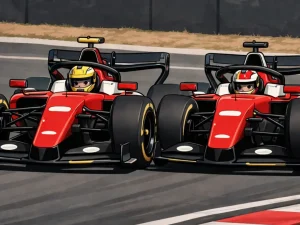
Adrian Newey is cutting it fine at Aston Martin, and that’s exactly the point.
With the AMR26 set to usher in Aston’s Honda era and the 2026 rulebook’s brave new world of 50% electrification, sustainable fuels and active aero, Newey has been in no rush to lock down one of the car’s most defining choices: suspension layout. According to Italian outlet Auto Racer, the team boss delayed the final call “as late as possible” in development — a classic Newey move when a single architecture decision cascades into everything from aero platform to tyre behaviour to packaging around an all-new power unit.
If you’ve watched the early 2026 trend take shape, you can see why the debate matters. Audi’s shakedown car turned up with a double-pushrod solution. Red Bull and Racing Bulls have shown pushrod-based thinking on their showcars and renders. Ferrari is heavily linked to going pushrod at both ends with its SF-26. With ground effect stepping back in 2026, pushrod becomes an easier sell: cleaner airflow paths, stiffer control of the platform, more predictable coupling with active aero. But “easier” isn’t the same as “better” for every concept, and Newey has never been one to pick a layout because it’s fashionable.
He’s also never been shy about getting his hands dirty. He personally drew the front and rear suspension on Red Bull’s RB18 in 2022, the car that swerved the worst of the porpoising chaos while Max Verstappen racked up 15 wins and both titles came back to Milton Keynes. He knows how much is on the line if you get the kinematics wrong — or deliciously right.
There’s another twist inside Silverstone. Enrico Cardile, Ferrari’s former technical director, arrived last summer as chief technical officer. Cardile’s Ferrari stuck stubbornly with a pullrod rear long after most rivals flipped to pushrod, and he insisted during the SF-24 launch that, in their work, the performance delta between pull and push wasn’t decisive. That philosophy now sits across the table from Newey’s. It’s a fascinating internal debate: two strong design minds, two deep libraries of data, one clean-sheet car under rewritten regulations.
Newey’s decision-making cadence hasn’t changed. He’s long liked to sleep on high-impact calls — his “24-hour rule” — to see if an idea still holds water after a day of stew and scrutiny. Then the sketching starts, the CAD takes over, and the tunnel either kisses the idea on the forehead or shows it the door. With 2026 bringing active aero and a new hybrid balance, there’s a reason he’s spent more time squinting at rockers than wings this winter. The suspension isn’t just about compliance; it’s about how the whole car breathes when the flaps start to move.
It’s not all romance and drawing boards, though. Newey publicly called Aston Martin’s simulation tools “weak” last year and said the driver-in-the-loop simulator “isn’t correlating at all.” That stung inside the building, and work began in earnest. Giles Wood — a trusted figure from Newey’s Red Bull years — has been hired as simulation and vehicle modelling director. Marco Fainello, a Ferrari stalwart from the Schumacher era, has been consulting since November. Lance Stroll also struck a realistic tone late last season, admitting the team doesn’t yet have “all the tools to be a top team.” The ambition is clear; so are the gaps they’re trying to close.
Honda, meanwhile, is back full-time and being refreshingly honest about where it stands. HRC president Koji Watanabe recently said “not everything is going well” with the 2026 power unit push, though nothing “fatal” has cropped up. The subtext: they’re deep in the grind, and they’ll bend their development to fit “Adrian’s vision” if it makes the car faster. That alignment matters. The 2026 packaging puzzle is vicious, and a PU that stays nimble in service of the chassis could be worth more than a dyno headline.
All of which puts a bright ring around the first public outing for the AMR26. The car is due to break cover at the opening 2026 pre-season test in Barcelona next week, January 26–30, where each team’s running is capped at three days apiece. The full launch follows on February 9 before the final two tests in Bahrain. It won’t be the place for headline times so much as tealeaves: ride, response, how the car sits through medium-speed corners, whether the platform looks “quiet.” If Newey has got the suspension architecture singing with the active aero and the Honda install, you’ll feel it even before you see it on a timesheet.
This is the first Aston Martin to carry Newey’s fingerprints front to back. It’s also the first to be built in this new partnership with Honda, under the most radical rules shift in a decade. The temptation is to expect fireworks from day one. Newey himself warned against that last year. The car he’s been agonising over might not land with a bang — but if he’s delayed this call until the last responsible moment, it’s because in 2026, getting the bones right is the whole ballgame. The rest follows.