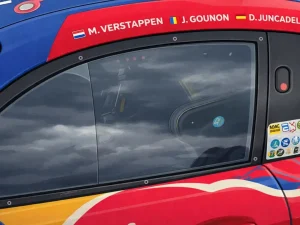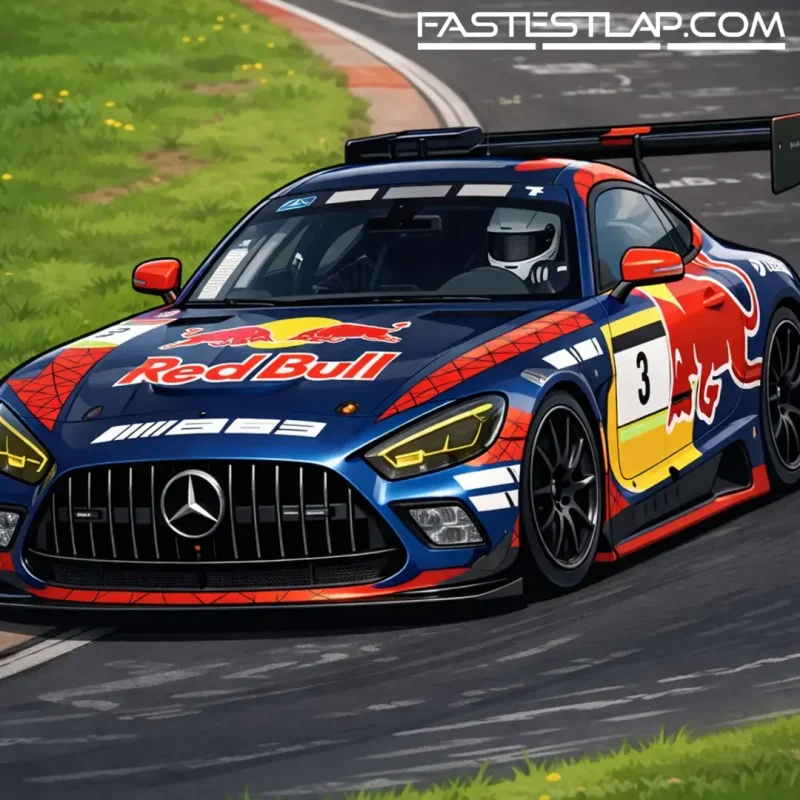
Max Verstappen’s Nürburgring 24 Hours debut has been framed all week around the obvious unknown: what happens when a four-time Formula 1 world champion has to thread a GT3 car through the Nordschleife in the small hours, with only headlights and instinct for company.
Timo Glock isn’t buying that as the real concern.
From Glock’s perspective — and he’s one of the few on this entry list who’s lived both the modern F1 grind and the endurance-racing reality — the darkness is the easy part. The bigger risk is much more mundane, and far more likely to decide whether Verstappen’s weekend ends in a highlight reel or in the barriers: traffic.
Verstappen is in Germany this weekend for his first 24-hour race, lining up fourth on the grid in a Mercedes-AMG GT3. He’s one of three drivers with Formula 1 history taking part, alongside Markus Winkelhock and Glock, who is racing a McLaren 720S GT3 in SP9 with Dörr Motorsport.
In the build-up, Verstappen’s preparation has been relatively orthodox by Nordschleife standards — seat time in shorter races, and plenty of simulation work. The one thing he didn’t get, through no fault of his own, was a clean shot at proper night running ahead of the 24-hour main event. The NLS5 race last month was ended early after the fatal accident involving Juha Miettinen, wiping out a chance to bank experience in the conditions that typically unsettle newcomers.
Even so, Verstappen did at least get a taste of it in Thursday’s second qualifying session, and it wasn’t the gentle introduction rookies dream of: rain and hail made the place look like it was actively trying to throw cars off the island. Verstappen was visibly careful, picking his moments rather than trying to win qualifying in the first sector.
Glock watched all of that and came away convinced the night element isn’t going to rattle him.
“I don’t think he has any problem with that,” Glock said. “I think he had enough laps on the simulator already, which helps a lot.”
That’s the modern wrinkle that makes this story more interesting than the usual “F1 driver tries endurance racing” trope. Verstappen isn’t arriving as a blank slate. He’s spent years taking iRacing seriously — not as a toy, but as a competitive environment — and he’s raced virtual versions of the same marquee endurance events. Glock’s view is that it shows, particularly in the way Verstappen reads situations in mixed conditions and mixed traffic.
“And, as he showed already, he jumped in the car and was straight away, and quick. He reads the traffic super well,” Glock said. “The battle with Christopher Haase was outstanding. Insane racing from these two… Therefore, I don’t think there is any problem for him at night.”
The subtle warning comes next. In F1, Verstappen is conditioned to assume a certain baseline: everyone around him is operating to a very high standard, reaction times and judgement calls separated by fine margins. The Nordschleife in a 24-hour race is not that world. It’s a 160-car ecosystem, ranging from front-running pros to hobbyist entries, and the closing speeds can get cartoonish in the wrong places.
Glock, who is on his second attempt at the Nürburgring 24 Hours after first trying it in 2024, pointed to the unpredictability as the real trap — not because Verstappen lacks skill, but because he’s used to patterns that simply don’t exist here.
“The point is, this can happen to anyone,” Glock said. “There are another 160 cars around us, and there are very slow cars, with very inexperienced drivers in them and maybe something he needs to think about more.
“Because, when he does the sim racing, they have more high-profile drivers, let’s say, so I think that’s something he needs to think about a bit more — that he doesn’t think the guy in front does exactly what he thinks.
“I experienced some of that already today, there are some hobby guys out there who you never know what they’re doing. That’s where he needs to take a bit of precaution.”
It’s a telling point, because it cuts against the assumption that endurance racing is simply about “calming down” compared to F1. Yes, a 24-hour race punishes impatience and over-commitment, but it also forces a different kind of aggression: the constant decision-making around slower traffic, the discipline to lose a second now to avoid losing a lap later, and the humility to accept that sometimes the safest move is the one that feels least natural to an elite single-seater racer.
Glock doesn’t doubt Verstappen will adapt — in fact, he sounded almost certain of it — but the implication is clear. The Nordschleife isn’t going to test Verstappen’s outright ability. It’s going to test his assumptions.
And that’s the part that can bite anyone, regardless of the number of world titles on their CV. In a field this large, on a circuit this unforgiving, the biggest threat isn’t the night. It’s the car you catch at exactly the wrong moment, driven by someone who doesn’t see the same picture Verstappen does.