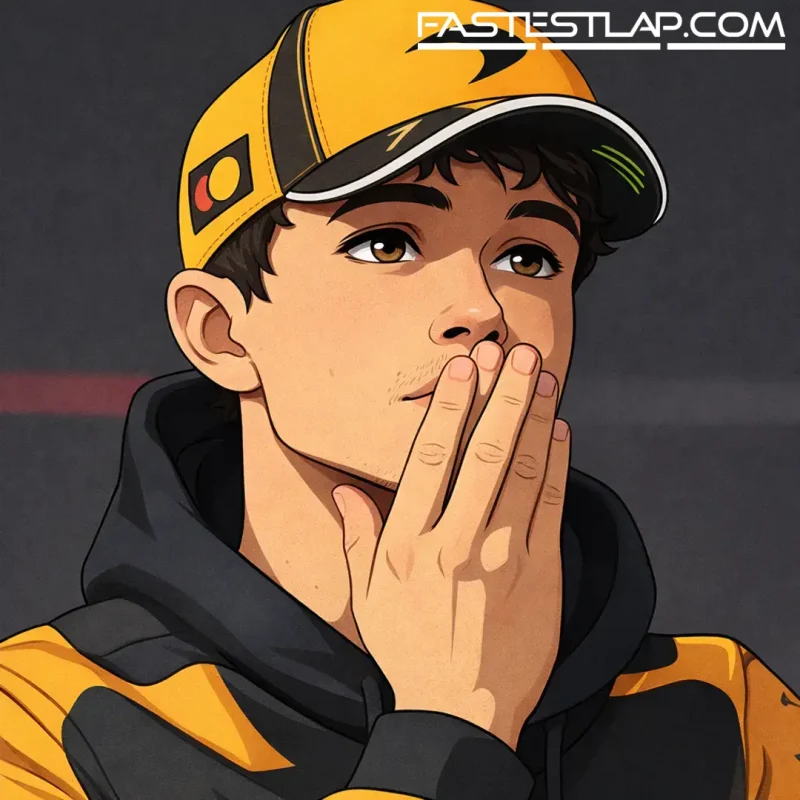
Lando Norris has spent the first proper week of 2026 pre-season doing what Norris usually does: saying something slightly mischievous, watching the paddock bite, then calmly explaining he never meant it in quite the way everyone decided he did.
His throwaway line that Max Verstappen “can retire” if the new rules aren’t to his liking landed with the sort of thud only a comment aimed at a four-time world champion can make. It also cut against the prevailing mood in the Bahrain test garages, where drivers have generally sounded more wary than wide-eyed about what Formula 1’s new-era cars are asking of them.
Now Norris is conceding what most of the grid has been hinting at since the cars rolled out in Barcelona and then arrived in Bahrain: the 2026 machines are a different proposition entirely — and not necessarily in the romantic, “back to driver skill” way some fans hoped the reset might deliver.
“Honestly, I just wanted to say that,” Norris admitted when asked about the reaction his earlier remarks triggered. “I didn’t want to complain about anything. I just wanted to say that and see what the reaction was of everyone.”
He got his wish. The last few days have been full of knowing smiles and pointed questions as drivers have tried to pick their way through the public conversation around the regulations without sounding like they’re lobbying the FIA through a microphone. Verstappen, never one to bother with that dance, has already branded the new direction “Formula E on steroids”, a line that did exactly what it was designed to do: draw a bright circle around the power-unit emphasis and ask whether this is still the version of F1 the drivers signed up for.
Norris’ clarification doesn’t so much walk his earlier comments back as place them where they belong: in that familiar space between driver candour and driver self-preservation.
“The cars are very different,” he said. “Are they enjoyable and as good to drive as last year? Absolutely not. Is it still a challenge and good fun out there? I’m certainly not going to change my job for anything else. I still have fun, and it’s still the job that I love to do.”
That tension — between “this isn’t as nice” and “it’s still my dream job” — is basically the entire 2026 debate in miniature. Yes, the cars are still quick. Yes, they’re still impressive. But the kind of “pure” satisfaction drivers talk about when a car is hooked up, balanced and responsive is harder to access when the big story of a lap is no longer just braking points and minimum speeds.
Energy management is going to be a defining skill this year. With electrical deployment peaking at 350 kilowatts and the emphasis shifting towards making the battery work for you — and not against you — the driver’s mental bandwidth is being pulled in a new direction. It’s not that the job is suddenly easy; it’s that the job is different. And different, for racing drivers, often reads as “worse” until the competitive instincts catch up.
Norris didn’t try to sugar-coat that. If anything, he leaned into what Verstappen has been complaining about — the sense that the driving has become more about system optimisation than wringing a car out by feel.
“Is it as pure? Is it as beautiful to drive as last year? Does it look as incredible? Definitely not,” Norris said, before adding the key line: “And I agree with Max, and a lot of comments, probably most of the comments I agree with.”
That’s the part worth underlining. Norris isn’t positioning himself as the cheerleader for 2026; he’s admitting he played contrarian for a moment because he didn’t want to be the guy moaning into the first microphone of the year. There’s an unspoken etiquette in the paddock that drivers will explore a new set of rules before they eviscerate them — even if they’re already fairly sure where they’ll land.
“I just didn’t want to come out into the media and complain to everyone on the first weekend back,” he said. “I want to still enjoy my time and just say what I feel.”
It’s also a glimpse into how carefully top drivers manage the public temperature. Complaining too early can sound like excuse-building. Praising too loudly can sound like you’ve got something to gain — or that your team’s nailed it and you’re trying to talk everyone else into giving up. So you make a joke, you poke at the biggest lightning rod in the room, and you let everyone else do the shouting.
But Norris’ broader point lands: in 2026, the “driver’s lap” is being rewritten. When he says there’s “less focus on, how can you, as a driver, get everything out of the car”, he’s describing something drivers hate admitting — that a lap can feel like it belongs to the software as much as the person holding the wheel.
That doesn’t mean Verstappen is right to frame it as an existential threat, or that Norris is wrong to keep some lightness in the conversation. It does mean the sport has a genuine balancing act on its hands. Formula 1 can talk about sustainability and road relevance all it likes — and it will — but it still sells an idea: the best drivers on Earth doing something that looks impossibly hard and, crucially, looks *beautiful* when it’s done well.
Norris, in his own slightly teasing way, is warning that beauty is not guaranteed by a fresh rulebook.
And if the drivers — even the ones trying not to complain — are already using words like “not as pure”, the FIA and F1 might want to listen. The test is one thing. The first time a Grand Prix turns into a visible energy-saving exercise, with drivers talking openly about managing rather than attacking, is when the real judgement will arrive.
For now, Norris is still laughing at the uproar he caused. But his conclusion is the same as everyone else’s, including the bloke he told could retire: these cars might be fast, but they’re going to take some learning — and some selling — before they feel like the best version of Formula 1 again.