Oscar Piastri doesn’t sound like a driver panicking after three days of winter running. He sounds like someone looking at the sport’s new 2026 machinery and seeing a few very obvious ways things could go wrong — quickly — if Formula 1 doesn’t tidy up the details before Melbourne.
Bahrain’s first official pre-season test with the new-generation cars delivered the expected split in opinion. Lando Norris, the reigning world champion, came away describing them as “a lot of fun”. George Russell framed it as a “step forward” but with a caveat about how the rules will evolve. Max Verstappen was typically less diplomatic, dismissing the concept as “anti-racing” and likening it to “Formula E on steroids”, while Fernando Alonso and Lewis Hamilton were among those airing concerns of their own.
Piastri’s take is less about whether the cars feel “good” and more about what they demand from a field of 22 drivers who are still learning how to make the regulation set work — particularly when it matters most.
He did his part of the homework in Bahrain, logging a hefty 161 laps on the final day alone, but he left the circuit calling for the sport to get the key players in a room before the Australian Grand Prix. In his view, the risk isn’t theoretical.
“Starts need to be addressed,” Piastri said after testing. “It’s a pretty complicated process now to have a safe start, let alone a competitive one.”
The comment lands with extra weight because the messy practice start that drew attention late on day three wasn’t, according to Piastri, evidence of a power-unit gremlin. It was, simply, a procedural shambles — different instructions being followed by different cars.
“I think the start today was just a mix-up in instructions,” he said. “I got told to wait until whoever was in front of me had gone and then do my own launch, and not do it to the lights. Clearly, some other people had a different idea. So that was nothing to do with the power units.”
That’s almost the point. If teams can trip over something as basic as sequencing during a low-stakes practice, the consequences at a real grand prix start — with cars bunched up, tyres and clutches on a knife-edge, and drivers reacting instinctively — could be ugly.
And Piastri’s not just worried about the odd compromised getaway. He’s warning about the new “bad start” being far more punishing than it used to be. Where last year you might lose a few metres through wheelspin or a sluggish reaction, he suspects 2026 can spit you into something closer to an F2-style nightmare scenario — anti-stall-esque behaviour and a collapse in momentum that turns the opening 200 metres into a positional bloodbath.
“If it goes well,” he said, “you can be losing six or seven spots.”
That’s the competitive angle. Then there’s the safety one — and here Piastri doesn’t mince his words. The cars carry notably less downforce than last year, and he’s uneasy about what happens when you place 22 of them in close proximity, all trying to execute unfamiliar procedures, with new power delivery characteristics and plenty of unknowns still hiding in the system.
“A pack of 22 cars with a couple hundred points less downforce sounds like a recipe for disaster to me,” he said.
It’s not hard to see why this is becoming the nerve centre of the early 2026 conversation. The new power units — with their 50/50 split between electric power and biofuel — have already changed how drivers approach even the most basic parts of a lap. Piastri described the week as “unconventional”, noting that extracting performance now involves behaviours that don’t come naturally to drivers raised on a different set of instincts.
“There’s a lot of things that we’ve never had to do before,” he said. “Some of them are lifting on straights or stuff like that. Obviously, as a driver, you never want to be lifting at any point.”
In other words, F1 has built a car that asks elite racers to do things they’ve spent their whole careers training themselves not to do. That’s manageable over time — drivers adapt — but it’s the transition phase that tends to produce the messy moments.
Overtaking is the other big file on Piastri’s desk. DRS is gone, replaced by electrical boost and overtake modes that require more planning and energy management than the old, blunt инструмент ever did. Piastri’s view is that it will be “different”, and not necessarily simpler — because any advantage now has to be created, banked and deployed within a set of rules that may not always align with what a driver wants in the heat of battle.
“DRS was obviously just a pure advantage used to gain,” he said. “Whereas now, with the energy boost, you’ve obviously got to harvest that extra energy somehow and then deploy it… not always that straightforward.”
He also noted that, in terms of following another car, the experience felt “very similar to last year” — which suggests the aerodynamic wake hasn’t suddenly been cured by the reset. If that holds true once everyone turns the engines up and the track rubber goes down, the racing quality may hinge on how effectively the series calibrates these new attack/defend tools.
For now, Piastri’s immediate ask is refreshingly practical: get the sport aligned on how to start these cars safely and consistently, and do it before the first five red lights of the new era.
There’s also an undercurrent here that F1 will recognise from every major regulation change: if there’s even a whiff that one manufacturer has found a launch trick or a better mapping solution, the debate can turn political in a heartbeat. Piastri doesn’t deny that risk — he just doesn’t think anyone truly has the full picture yet.
“Everyone’s going to need different things for the start,” he said. “And to be completely honest with you, I’m not sure any of us know exactly what we need yet.”
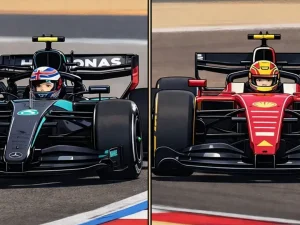
As for McLaren’s competitive picture, Piastri wasn’t playing the guessing game. He expects the same quartet at the top — McLaren, Mercedes, Red Bull and Ferrari — but conceded the order is still anyone’s guess, with testing’s familiar “pacesetter tag” being passed around.
“What we are in the pecking order, I don’t know,” he said.
That might be the calmest part of his debrief. The faster storyline, and the one Piastri is trying to push into the open before Australia, is that 2026 isn’t just a different-feeling car. It’s a different operating system — and right now, the start procedure looks like the glitch most likely to crash the whole programme if F1 doesn’t patch it in time.