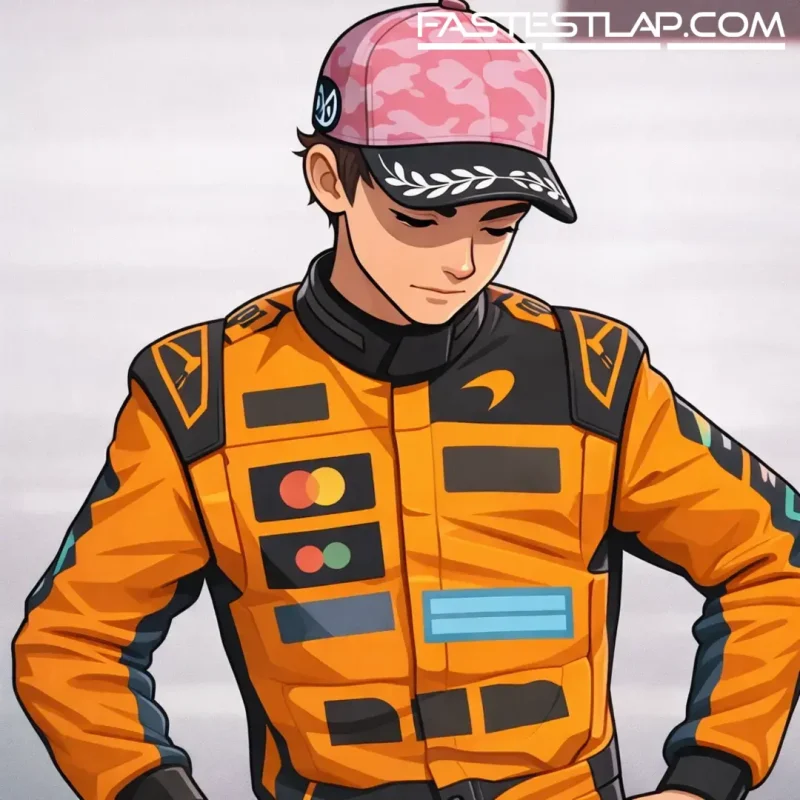
Oscar Piastri has urged the FIA to move quickly on what’s becoming the defining safety question of F1’s 2026 machinery: the closing speeds created when one car is deploying and another is harvesting.
The McLaren driver’s comments at Suzuka came in the immediate aftermath of Oliver Bearman’s heavy crash at Spoon Curve, an incident that left the Haas rookie limping away from the wreckage after losing control on the grass while rapidly closing on Franco Colapinto’s Alpine. In its post-race statement, the FIA pointed to the “significantly increased closing speeds” under the new regulations as a contributing factor — a consequence of cars being in very different energy states at the same point on track. The governing body also confirmed “a number of meetings” are scheduled this month with the aim of refining the rules.
Piastri doesn’t need convincing. He’d already had a reminder of how quickly things can turn awkward in the new era during FP3, when he was given an official warning for an incident with Nico Hülkenberg approaching 130R. Piastri was weaving on the straight, and the Audi arrived far sooner than he anticipated.
“Since these cars were conceptualised, we’ve spoken about that being a possibility,” Piastri said when asked how urgent it is to get on top of the issue before the next round in Miami. “It’s what we’re stuck with, with the power units. There’s no easy way of getting around it.
“From what I saw there was no flashing light from Colapinto, so I don’t even think he was super clipping either, which is obviously a bit of a concern.
“I had a pretty close call in free practice with Nico because he caught me about three times as quick as I expected on the straight and we were both at full throttle.”
That last line is the one that should make everyone sit up. Piastri isn’t talking about a casual misjudgement in mixed conditions or a yellow-flag misunderstanding. He’s describing a moment at full commitment where the mental model drivers have relied on for years — the basic expectation of how quickly a car behind will arrive — isn’t as reliable as it used to be.
And Suzuka is exactly the sort of circuit where that’s uncomfortable. The sport has always had big speed differentials for one reason or another, but they’ve tended to be predictable: tyre offset, DRS, power advantage. What’s different in 2026 is that the delta can appear in places and phases of the lap where drivers don’t expect it, because it’s shaped by energy management modes rather than just raw car performance.
Piastri’s point wasn’t that drivers can’t adapt — more that the adaptation period is going to carry a cost unless the rule set is tightened to reduce the most extreme scenarios.
“I think there’s clearly an element of learning for us as drivers and, where the accident happened, it’s not a place where you expect someone to come from so far behind and have such a big speed difference,” he said. “And whilst we’re learning that, unfortunately things like this are probably going to happen, which is a shame.
“But I think we understand as a sport there’s a lot of things we need to tweak, a lot of things we need to change. And especially on safety grounds, yes, there’s some things that need to be looked into pretty quickly.”
It’s notable that Piastri is framing it as a system problem rather than a Bearman problem. The temptation after any crash is to look for the human error — the fraction too much kerb, the momentary lapse, the wrong decision to stay in it. But when the FIA itself is talking about inherent closing speeds, the conversation moves from blame to mitigation.
Max Verstappen, never one to sugar-coat a structural issue, put it even more bluntly in Japan: incidents like this are baked in if nothing changes.
“It’s what you get with these things,” Verstappen said. “One guy is completely stuck with no power, basically, and then the other one uses the mushroom mode. It can be 50-60 kilometres difference. Really big.”
That’s the heart of it. A 50–60km/h delta isn’t just a spicy overtaking aid — it’s the sort of number that turns a “he’s a long way back” mirror check into a late, hurried avoidance move. And at certain corners, like Spoon, the margin for improvisation is thin.
The FIA’s confirmation that meetings are already planned is encouraging, but Piastri’s concern is the calendar. The sport doesn’t get a long runway to learn these lessons in private; every practice session is live ammunition. If the paddock is already seeing near-misses in FP3 and a big accident in the race weekend, Miami becomes less a standard development stop and more a deadline.
Piastri left Suzuka with a strong result — second place — but his focus was clearly on what F1 is asking its drivers to process at 300km/h. The message from the front end of the grid was straightforward: the sport can’t just tell drivers to “get used to it” and hope the next big delta doesn’t arrive at exactly the wrong moment.