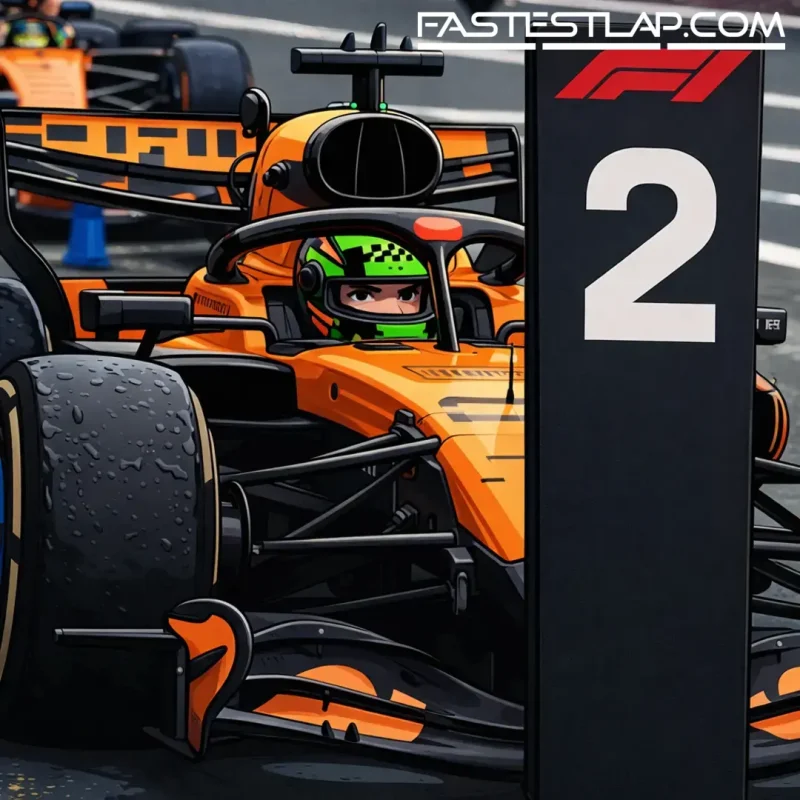
Oscar Piastri climbed out of the McLaren at Suzuka with a podium, a grin, and the slightly exasperated air of a driver who’s just executed almost everything asked of him… and still watched the winner disappear.
Second place in Japan was McLaren’s first top-three finish of 2026, and in a season that’s only just finding its shape, that matters. But it also came with a blunt reminder of where the pecking order sits right now: once Kimi Antonelli got clear air in the Mercedes, the race effectively ended for everyone behind him. The margin at the flag — 15 seconds to Piastri — told the story without needing much embellishment.
What made Piastri’s Sunday intriguing, though, wasn’t the gap so much as the texture of the race before it opened up. He launched superbly and grabbed the lead at the start, then spent the opening stint doing the hard, high-value work: keeping George Russell at bay in dirty air and making his own pace count while the car was still in the fight.
The turning point was the mid-race Safety Car, triggered by a high-speed crash for Haas rookie Oliver Bearman. Antonelli had already stopped, and the neutralisation handed him the kind of strategic gift that’s priceless at Suzuka: track position, and the chance to run at his own rhythm.
When racing resumed, Piastri fought his way back into second, but that was as far as it realistically went. Antonelli, with clean air and a car that looked happier the longer the stint went on, simply edged out of reach — then kept going.
And yet Piastri wasn’t buying the notion that Mercedes has already locked down 2026.
“I think we know from last year, that even when you have the best car you still need to operate it at an incredibly high level,” he said afterwards, pointing to a truth F1 tends to relearn on a loop. A fast car is a weapon, but it’s not an autopilot. “On our side we did a really good job of that… we did everything right this weekend and we still got beaten by 15 seconds, so we’ve got a pretty big gap to fill.”
That’s the key line: McLaren didn’t lose Suzuka by tripping over its own feet. There was no messy strategy call, no needless penalty, no self-inflicted tyre spiral. Piastri actually sounded more encouraged by that than deflated, because it frames the task clearly. The deficit isn’t “stop making mistakes”; it’s “make the car quicker”.
There was even a flash of that dry humour in the midst of it all, with Piastri joking about bolting on “2023-spec upgrades” to the MCL40 — a neat way of acknowledging how often McLaren has leaned on in-season development to transform its year. He’s not wrong to hope the team can find that kind of momentum again, although this time the mountain looks steeper: the Mercedes advantage at Suzuka wasn’t a single-corner party trick, it was a sustained, stint-long edge once the air cleared.
Piastri also didn’t pretend he’d been robbed of a win. Without the Safety Car, the race might have developed into something more complicated — for better or worse. He’d already had Russell in his mirrors, and the question he wants answered is whether Antonelli’s pace was intrinsically stronger than Russell’s or simply easier to deploy from the front.
“I would have loved to have seen how it would have panned out,” he admitted. “I think I need to look back and see whether Kimi was quicker than George or similar pace.”
It’s a fair read. If Antonelli had been on Russell’s pace, Piastri suspected his afternoon might have become “pretty stressful” with two Mercedes cars swarming his gearbox. If Antonelli was always the faster Mercedes on the day — which the post-Safety Car stint suggested — then McLaren probably ends up second regardless, just via a more traditional route.
Either way, Piastri’s wider point lands: Mercedes may have the quickest package right now, but that doesn’t make the season a foregone conclusion. Suzuka was a reminder of how quickly the narrative can sharpen when a team nails execution and still gets beaten comfortably — and how much more satisfying it is, from a driver’s perspective, when the shortcomings are at least the honest kind.
McLaren’s to-do list is obvious and unglamorous. Find lap time. Close the “pretty big gap”. And do it fast enough that the next Safety Car doesn’t feel like the only way into the conversation at the front.
For now, Piastri leaves Japan with points, confidence, and a simple belief that tends to separate contenders from the rest: this isn’t over.