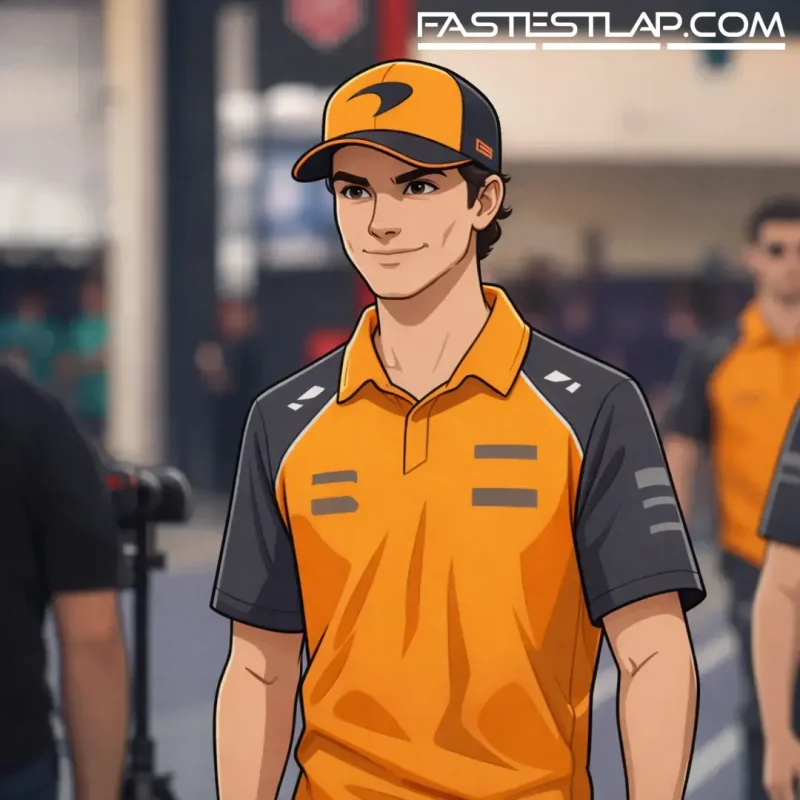
Oscar Piastri has made a small but telling adjustment to how he’ll go about his race weekends in 2026: Mark Webber isn’t disappearing from the picture, but he won’t be a constant presence in the paddock anymore.
Piastri confirmed in Bahrain that Webber remains “very much involved” in his career, yet will attend fewer grands prix this season. In practical terms, that opens the door for former race engineer Pedro Matos — who worked with Piastri during his 2021 Formula 2 title-winning campaign — to become the familiar face trackside across most, if not all, rounds.
The interesting part here isn’t any hint of a rupture. Piastri was at pains to stress the opposite.
“There wasn’t anything specific,” he said. “We made a decision for things to look a bit different.
“Mark is still very much involved, and I’ve been in contact with him a lot over the last few weeks. He just won’t be trackside as much anymore. So, that’s really the extent of it. There’s nothing specific that triggered it.”
In F1, “nothing specific” can often read like code. But this one sounds exactly like what Piastri says it is: a reshuffle of bandwidth rather than a falling-out. Webber has been an unusually hands-on manager for a modern-era driver, present for the majority of races through Piastri’s rise and into his McLaren stint. Dialling that back — while keeping the relationship intact — looks more like a deliberate evolution than a reaction.
Matos’ arrival, meanwhile, has a logic that goes beyond nostalgia. Piastri is heading into a season that will demand clarity and calm, with Formula 1’s regulation reset radically altering the driving experience. Having someone at the track who knows how Piastri processes information, how he likes messages framed, and how he reacts under pressure can be valuable in ways that don’t show up on a timing screen.
It’s also understood Matos is not being employed directly by McLaren. He’ll be working with Piastri, adding experience and support over race weekends, while Piastri continues his work with sports psychologist Emma Murray. Again, it’s a very modern high-performance setup: tight circle, minimal noise, and support tailored to the driver rather than the team’s org chart.
All of this lands against the backdrop of a year where Piastri will be keen to tidy up the one part of 2025 that hurt him: the finish.
He mounted his first genuine title challenge last season and, at the two-thirds mark, held a 34-point lead before his form dipped late on. That slide opened the door for Lando Norris, with Max Verstappen also ultimately ahead. The details of why don’t need rehashing here — anyone who watched the back end of 2025 could feel the momentum turning — but the takeaway is straightforward: Piastri’s ceiling looks championship-high, and his next step is proving he can carry it over a full campaign when the pressure becomes repetitive rather than novel.
Bahrain testing has at least given McLaren plenty of mileage to work with. Across the six days of running at the Bahrain International Circuit, McLaren logged 817 laps — a mountain of data ahead of the season opener in Melbourne.
That doesn’t guarantee anything when the lights go out, and even within McLaren there’s caution about where they truly stand. CEO Zak Brown has suggested Ferrari and Mercedes could start the year ahead. But on workload and preparation alone, McLaren will feel it’s done the unglamorous part properly.
For Piastri, the focus has been less on headline lap times and more on recalibrating instincts for the new generation of car.
“It’s definitely been a learning curve,” he said. “There are still some things that we need to do as drivers that are certainly very different to what we had to do last year.
“But… firstly, as drivers, I think we’re getting our heads around the new things we need to do. And as teams, [we are] making accommodations for having to drive a certain way now.”
That’s been a recurring theme up and down the pitlane since the reset: not just faster or slower, but different. Different energy management demands. Different approaches to corner entry and exit. Different compromises in traffic and in qualifying. Different “comfort”, as Piastri put it — and in a season that’s likely to be decided by fine margins and adaptation speed, comfort matters.
“I think it has improved,” he added. “It still is very different to what we have before, but I think, naturally, we’ve all probably found performance, and just with performance, it’s made some creature comforts a little bit nicer as well.
“I think we are making progress. Let’s see what Melbourne’s like.”
That last line is doing a lot of work. Melbourne will be the first true read on where McLaren sits relative to the paddock — and, just as importantly, the first glimpse of whether Piastri’s off-track recalibration has sharpened the weekends as intended.
Webber stepping back from constant paddock duty doesn’t mean Piastri is moving on from him. It suggests Piastri is moving forward — building a slightly broader structure around himself at exactly the moment his career demands he becomes even more precise about the details. In 2026, the margins will be brutal. The best drivers won’t just be the quickest; they’ll be the ones with the cleanest weekends, the clearest heads, and the fewest wasted decisions.
Piastri seems determined to make sure the support around him reflects that.