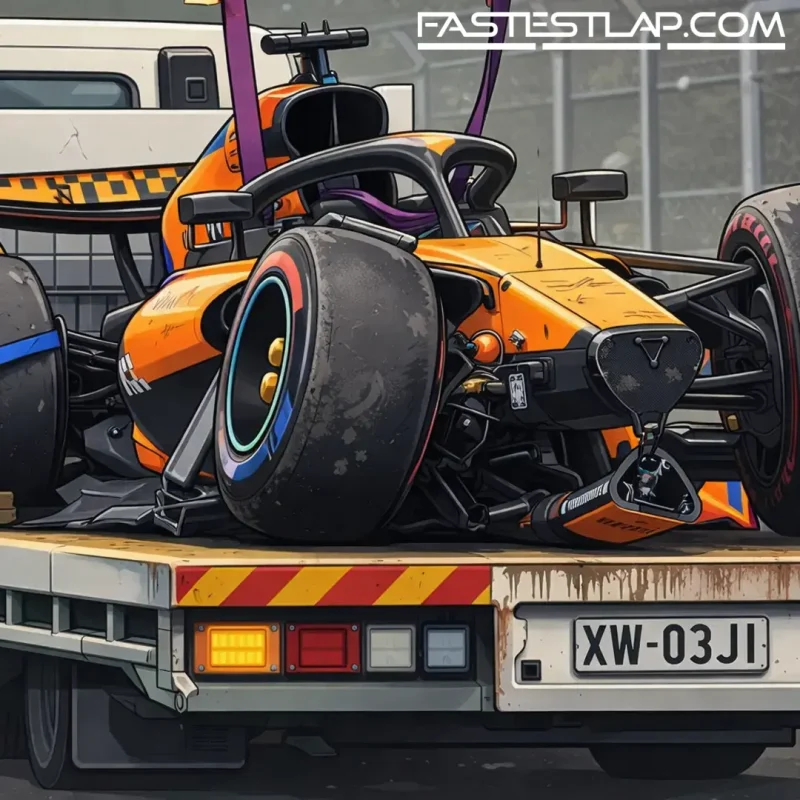
Oscar Piastri didn’t even make it to the grid at Albert Park, and that’s the bit that stings. A hometown Grand Prix, the build-up all week, the familiar walk through Melbourne’s paddock — and then it’s over on a reconnaissance lap, the McLaren rotated at the exit of Turn 4 and slammed hard enough to destroy the front-right corner and end his Sunday on the spot.
McLaren team principal Andrea Stella wasn’t interested in dressing it up as anything other than a gut-punch. But when he spoke after the race, his emphasis was less on the embarrassment of the moment and more on what it reveals about the sharper edges of the 2026 cars — and why he’s confident Piastri will park the disappointment quickly.
“Oscar, very unfortunate, definitely a tough moment for him in front of the Australian crowd,” Stella said. “But Oscar… is a very tough guy mentally. He will use all this to get even more concentrated and determined, starting from China.”
Piastri himself wore it. He blamed himself and also pointed to an unexpected burst of power unit energy as he fed the throttle in, a small detail that matters in this era because those small details are suddenly capable of biting. The early-season picture suggests McLaren’s not in the business of beating Mercedes and Ferrari on raw pace right now, but it’s in the scrap just behind — exactly the kind of points-gathering day Piastri was supposed to have while Lando Norris did the heavy lifting.
Norris salvaged fifth. Piastri, instead, was left apologising to fans and insisting “a scenario like that just shouldn’t happen” — which, in a sense, is the driver’s version of the engineer’s worst sentence. It implies a system and routine that should be robust enough to survive the mundane: a kerb you’ve ridden a thousand times, a lap where you’re not even pushing, a corner you could draw from memory.
Stella’s explanation was telling because it didn’t lean on a single culprit. He described a chain reaction — the sort that can look like a simple mistake from the outside but is really a stack of marginal losses.
First, cold tyres. Then, wheelspin that arrives “in a very sudden way” as the grip falls away. Then the kerb at Turn 4, one Piastri has used “pretty much every single lap” but which becomes far less forgiving when the rubber’s not in its window. And then the final complication: torque delivery.
Stella talked about “oscillations” and the shift phase creating “extra torque”, and while he stressed the power unit behaviour was “sort of expected”, he also hinted at the reality teams are living with under the 2026 framework: there are operational requirements around how you deploy torque, and that can put a driver in a slightly different place to where instinct expects the car to be.
It’s also the kind of issue that can hide in testing, because testing rarely recreates the exact cocktail of conditions you get on a dampened, cool race morning with cold tyres, low urgency, and a driver doing what drivers do — leaning on familiar references to switch themselves on.
“When in testing, we might have seen some similar circumstances,” Stella said, “but we didn’t have the combination of cold tyres and the kerb, which aggravated the fact that you may have these inconsistencies from a torque deployment point of view.”
That, ultimately, is why McLaren’s response matters. Piastri will take the blame — drivers always do when the car ends up in the wall — but the team’s language suggests it’s treating the incident as a systems lesson as much as a driver lesson. In 2026, “driver error” and “car behaviour” are often the same story told from different ends.
None of that makes the optics any kinder. A pre-race crash at your home GP will follow you around for a week, especially when your teammate brings home points in a car that looked, at minimum, capable of being in that fight. But Stella was adamant McLaren will handle it internally as a collective problem to solve, not a scarlet letter to hang on its driver.
“We will make sure that we all face this in a united way,” he said. “We are a team in any situation that may involve any of our team.”
For Piastri, the immediate frustration is obvious: there’s no “learn on the fly” when you don’t get to race. But the flip side is that the calendar moves fast, and the paddock’s attention span is even faster. If he lands in China, qualifies cleanly and starts bankrolling points again, Melbourne becomes an odd footnote — a reminder that the new cars can still ambush you before the day has properly started.
McLaren’s job now is to make sure it doesn’t happen twice. Piastri’s job is simpler, and harder: turn up, reset, and drive like it never did. Stella clearly thinks that part won’t be a problem.