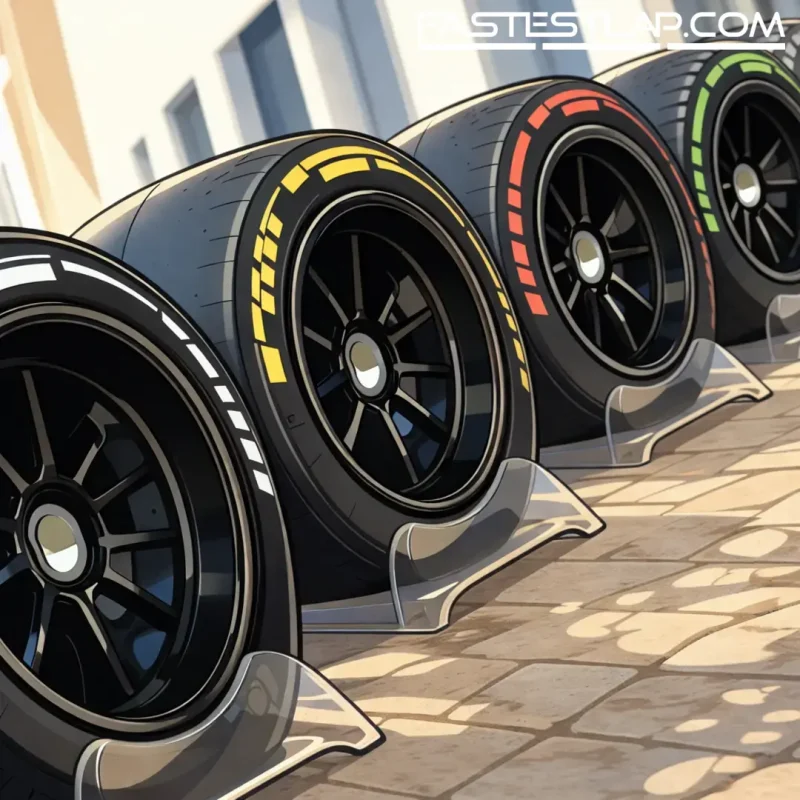
Pirelli has quietly offered the first proper clue of 2026’s pre-season priorities, and it’s sitting in a spreadsheet rather than a lap time.
Ahead of the five-day Barcelona test at Circuit de Barcelona-Catalunya — the first extended, meaningful look at the all-new 2026 cars — the tyre supplier has confirmed how each team has split its allocation across three slick compounds (C1-C3), plus intermediates and full wets. There’s no C4-C5 hero tyre in play here; this is about baseline work, correlation, and getting a handle on how these new cars treat a tyre over a stint.
Even so, the choices are revealing. Tyre requests at a test are never random: they’re a blend of what the engineers need for aero and mechanical mapping, what the drivers want to feel, and what the team thinks its car will allow it to learn.
Red Bull, Mercedes and Williams have all leaned heavily into the softest slick available, C3. Red Bull has gone all-in: 18 sets of C3s, just four sets of C2s, and none of the C1 at all. That’s a very specific kind of confidence — or a very specific kind of question they want answered quickly. Either they’re prioritising short-run performance work (the kind of “is the platform doing what the tunnel said?” probing that needs a tyre that switches on fast), or they’re expecting the car’s balance window to be narrow enough that a friendlier compound will help them get through early programme items without chasing their tail.
Mercedes’ split is the oddest on paper: eight sets of C1 and 12 of C3, and not a single C2. That’s not the usual “cover all bases” approach. It reads like a team intent on bracketing behaviour — hard tyre for long, repeatable correlation runs and the soft for sharper set-up sensitivity checks — without spending valuable time in the middle. If your simulations are trustworthy, you can afford to jump between extremes and fill in the blanks later. If they’re not, you’d usually keep more C2s around as the safer reference tyre.
Williams is even more skewed than Red Bull in one direction, with 17 sets of C3 and only four of C2, no C1s. That points to a programme geared towards extracting quick understanding from a car that might need a bit of help finding a workable balance early on. The soft tyre can be a magnifying glass: great for highlighting instability, but also great for masking it. Which of those Williams is aiming for will become apparent once the running starts.
McLaren and Ferrari, by contrast, look like the adults in the room — or at least the teams planning to spend most of the week on method rather than theatre. McLaren’s 4/10/6 split across C1/C2/C3 is tidy and very test-like, with a clear emphasis on C2 as the workhorse. Ferrari has leaned even harder into that “do the homework” posture: 12 sets of C2, just three sets of C3, and four sets of C1. If you’re planning big chunks of long-run work and want to keep variables under control, that’s exactly what you do. It’s less glamorous, but it’s how you build a reliable picture of degradation, thermal behaviour and set-up direction — especially with new-reg cars that can throw up nasty surprises when the fuel load goes on.
Aston Martin and Alpine sit somewhere in the middle, with sensible, rounded allocations that suggest broad programme coverage rather than a single obsession. Aston has 3 C1, 10 C2, 7 C3; Alpine has 2 C1, 9 C2, 9 C3. In other words: plenty of tyre to do both correlation and performance work without painting themselves into a corner.
Racing Bulls and Haas have both favoured C3s but kept enough C2s in reserve to avoid being trapped in short-run mode. Haas’ choice stands out for another reason: six sets of intermediates, the most of any team. That’s either a hedge against winter weather in Barcelona or a deliberate plan to spend meaningful time understanding the new car’s behaviour in low-grip conditions. Teams don’t ask for inters in those numbers unless they think they might actually use them.
Audi has taken the largest wet tyre allocation, with three sets of full wets, and a fairly even slick spread (2 C1, 6 C2, 10 C3). That’s a pragmatic “cover everything” order — exactly what you’d expect from a team still building its reference library. Cadillac, another team operating in fresh territory, has opted for a similarly balanced approach: 4 C1, 6 C2, 10 C3, with a single wet.
A word of caution, though. Tyre numbers can hint at intent, but they don’t guarantee it. Teams will swap programmes around if the weather dictates, if a part fails, or if the car’s early behaviour forces them to re-plan. And in 2026, with brand-new cars and a new competitive landscape, the first two days of testing could be less about chasing laptime and more about simply finding a stable operating window.
Still, the patterns are hard to ignore. Ferrari and McLaren look set to grind through the fundamentals. Red Bull and Williams have stacked the deck for C3-heavy running — more peaky, more performance-angled. Mercedes’ no-C2 gamble is the kind of thing that makes sense only if the team truly believes its model is strong enough to skip the “middle tyre” reference.
Barcelona will do what Barcelona always does: strip away the marketing and force everyone back to engineering. These tyre choices won’t tell us who’s quickest, but they do tell us who thinks they already know what they’ve built — and who’s arriving ready to learn fast.