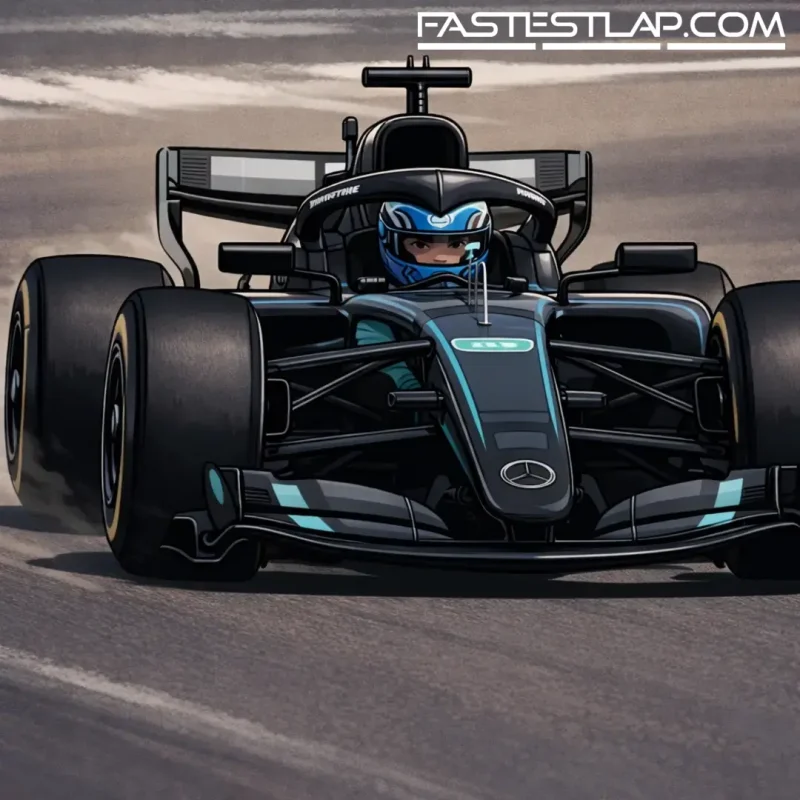
Mercedes have spent the winter doing their best to look relaxed about 2026, which in Formula 1 is usually a tell. Everyone in the paddock knows the reset has been brutal: new chassis rules, new power unit rules, and a competitive order that’s still more rumour than reality after Bahrain. Yet inside the Mercedes camp there’s a quiet confidence that goes beyond lap times — the sense that, early in a new era, being a works operation still counts for something even when the regulations insist the hardware must be the same for everyone.
Hywel Thomas, the man running Mercedes AMG High Performance Powertrains, didn’t pretend otherwise when asked about it. The engines, on paper, are equal across the manufacturer’s pool — Mercedes, plus its customers McLaren, Williams and Alpine — but Thomas argued the advantage comes from everything wrapped around the power unit rather than the power unit itself.
“As a works team, 45 minutes down the road [between HPP and the F1 factory], there are just more links,” Thomas explained. More connections between engineering groups, more touchpoints between management layers, more opportunities for the inevitable last-minute problem-solving that defines the opening phase of any regulation cycle. It’s not that a customer gets a “worse” engine. It’s that a works team can align its entire car concept around the power unit with fewer friction points, fewer delays and, crucially, fewer compromises.
That last part matters. The sport has spent years trying to kill off the old assumption that customers are destined to be second-class citizens. McLaren already did plenty of the heavy lifting there by winning the last two Constructors’ titles as a Mercedes customer, and with Lando Norris taking the 2025 drivers’ crown in a Mercedes-powered car. The idea that you *can’t* win without building your own engine is dead and buried.
But 2026 isn’t 2025 with a fresh coat of paint — it’s a ground-up restart. The top four from the last cycle are still widely expected to be the reference group (McLaren, Mercedes, Ferrari, Red Bull), but the order within it is a guessing game until everyone finally turns the wick up in Melbourne.
Even McLaren boss Andrea Stella has been careful in how he frames it. He noted it’s “no coincidence” that the main rivals being spoken about are works teams — Mercedes and Ferrari, plus Red Bull now running its own power unit project for the first time under the Red Bull-Ford banner. That’s not a slight on McLaren’s own achievements; it’s simply an acknowledgement that the first few races of a new ruleset tend to reward the organisations that can make the fastest, most integrated decisions.
Stella even reached for a football metaphor, describing the opening stretch as a period of playing “a bit defensively”, looking to “exploit the counterattack”. Translation: don’t expect anyone to show their full hand immediately, and don’t expect clean, linear development paths when the regulations are this fresh.
Bahrain testing offered just enough to keep the intrigue alive. Red Bull’s new power unit drew attention for its reliability, while Mercedes and Williams were bullish about energy deployment — an area likely to be decisive given the 2026 balance between combustion and electrical power. Ferrari, meanwhile, caught the eye on pace and long-run performance, enough for Stella to point to both Ferrari and Mercedes as early benchmarks.
Then came the inevitable paddock noise about who is running what spec. Alpine, another Mercedes customer, hinted it hadn’t yet accessed the full power of the new Mercedes package and was expecting a step in Australia. Stella, asked where he stood on that, leaned into diplomacy: he didn’t want to get drawn on “specification of hardware”, saying only that what mattered was having “the right specification” ready for race one.
That comment landed with a raised eyebrow because it nods to a very real grey area in modern F1: timing. A manufacturer must supply the same engine specification to all its teams, but “same” doesn’t always mean “same day, same minute, same integration status”. The practical reality is that getting a new power unit to work optimally is an ecosystem job — calibration, cooling layouts, packaging trade-offs, software, deployment maps, and the endless back-and-forth between chassis and PU departments. Thomas’ point is that the works team is always going to have the shortest feedback loop.
He put it bluntly: when chassis groups are aligned, it’s easy. When there’s a fork in the road — when a customer wants to go one way and the works team goes another — “it will always be the works team that you follow.” Not because anyone’s being punished, but because the manufacturer has to pick a direction to develop efficiently, and it tends to pick the path most closely tied to its own factory team’s concept.
There’s also a delicious tension here given McLaren’s recent success: the reigning double champions are walking into a new era still as a customer, still needing to win while sitting slightly further from the centre of Mercedes’ decision-making universe than the team painted silver.
And yet, none of this means Mercedes will automatically start 2026 on top. Thomas was refreshingly honest about how little anyone truly knows right now. Melbourne qualifying, he said, is the first moment “everyone will turn up and give their best.” Until then, fuel loads, run plans and the usual sandbagging games make testing a hall of mirrors.
He also captured the cruelty of this sport’s relativity: you can do a great job and look awful if someone else has done better; you can scrape together something you think is barely acceptable and suddenly be “the heroes” if the field is in worse shape.
The one certainty is that Melbourne will feel like a hard reset in more ways than one. If Mercedes do have an early works-team edge, it won’t be because they’ve slipped a forbidden advantage into the crates bound for their customers. It’ll be because, in the frantic opening weeks of a new era, proximity and alignment still buy you lap time — and in F1, that’s the oldest “innovation” there is.