Racing Bulls have had points on the board at every round so far, but nobody in Faenza is mistaking that for comfort. Seventh in the Constructors’ Championship after three races is a decent start in a brand-new rules era; it’s also a reminder of how tight and unforgiving the 2026 midfield looks. The margins are small enough that the next few update cycles could decide whether you’re leading the scrap or just surviving it.
That’s why the team’s plan for the restart in Miami matters. Team boss Alan Permane has laid out a development run that isn’t so much a single “big package” as a sequence of hits — and the calendar disruption has effectively given Racing Bulls a free extra week in the wind tunnel war.
“We had a pretty decent upgrade planned for Bahrain, which we will see in Miami,” Permane explained during the spring break. “We had another upgrade planned for Montreal. So we will have a sort of quick double hit there.”
The slightly awkward part is timing. The Montreal specification can’t be accelerated, so Racing Bulls will introduce a sizeable step in Miami and then, in Permane’s words, “almost replace it straight away” at the next major update point. In a cost-capped world, “replacement” sounds wasteful; in practice it’s often the only way to keep the pipeline moving when parts, freight and manufacturing schedules are already committed.
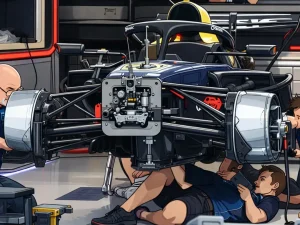
What’s changed is opportunity. Bahrain and Saudi Arabia coming off the schedule due to unrest in the Middle East has left an unusual five-week gap this early in the season. With all the freight back from Japan, Racing Bulls has been able to do work it hadn’t expected to fit in until later in the first flyaway stretch — including some “unplanned work on the chassis”.
It’s not that the team’s upgrade roadmap has been rewritten from scratch. Permane was clear the cycle was already set. The big gain from the enforced pause is volume and readiness: instead of arriving at Miami with limited quantities — “one or two, two or three sets” is how he put it — the team expects to have “three/four sets” available. In other words, more of the garage can run the new kit immediately, and you’re not playing that familiar game of splitting spec across cars while you wait for parts to catch up.
For a midfield outfit trying to control its narrative, that matters almost as much as the raw performance gain. A single upgraded car can create the illusion of a breakthrough; two upgraded cars that can both qualify and race properly on the new spec is where points totals start to move.
Permane is bullish about Racing Bulls’ ability to keep pace in a development race that, historically, has been brutal for teams who don’t nail the first few iterations.
“I’m very confident that we can keep up, if not do better than the other midfield teams,” he said, adding the team is “starting from a little bit further back than some of them”.
He framed the competitive picture as a four-team cluster: Alpine, Haas and Audi as the immediate reference points. It’s a realistic read of the paddock’s current geometry — and a more honest target than the kind of early-season talk that pretends the front is within touching distance.
“To race the top guys, I’m not sure that’s going to be so easy,” Permane admitted. “Certainly, fighting for podiums looks like it will be tough this year.”
The early results underline why Racing Bulls are pushing so hard. Arvid Lindblad’s debut eighth in Australia was the headline, partly because it was unexpected and partly because it announced him as a serious operator straight away. Liam Lawson then backed it up with seventh in China — matching his Sprint result — before ninth in Japan. That’s 14 points banked already, but it’s also a points haul built on executing weekends well rather than having a car that can cruise to the top of the midfield on pure pace.
Permane’s own assessment of the VCARB03 is telling: no nasty traits, a solid baseline, but it needs “more load”. That’s classic early-cycle language — the platform behaves, the correlation is decent, and now the task is simply to keep adding performance without tripping over balance. Teams love that situation because it’s straightforward, even if it isn’t glamorous.
There’s also an undercurrent here about how Racing Bulls have been scoring. Permane credited the squad’s operational sharpness in Shanghai and Suzuka, rounds where the car wasn’t quite quick enough to be comfortable but still came away with points. He also pointed to qualifying as a relative strength, with races being the area where the package hasn’t consistently held up against the direct competition.
That matters heading into Miami and beyond. A development “double hit” only transforms your season if it improves the car over a stint, in traffic, across varying temperatures — not just over a single lap. Racing Bulls believe they understand why Melbourne suited them more than China and Japan, and why Montreal was a weakness last year. That’s the kind of detail teams often keep guarded; Permane at least hinted that the engineering group has done the homework to avoid repeating it.
The break has also allowed the human side of the operation to breathe. Permane spoke about encouraging the travelling crew to take time off, while much of the factory has actually ramped up. There’s a quiet acknowledgement there of what the back end of 2026 could look like if cancelled races get reinstated later: a congested calendar and an endurance test for personnel.
For now, though, Racing Bulls’ season is defined by what happens when the lights go out in Miami. They’ve put themselves in the mix, they’ve shown they can execute, and they’ve got a development plan that’s more aggressive than their early championship position might suggest. If the upgrades do what the numbers say, that “group of four” Permane mentioned may not stay a group for long.