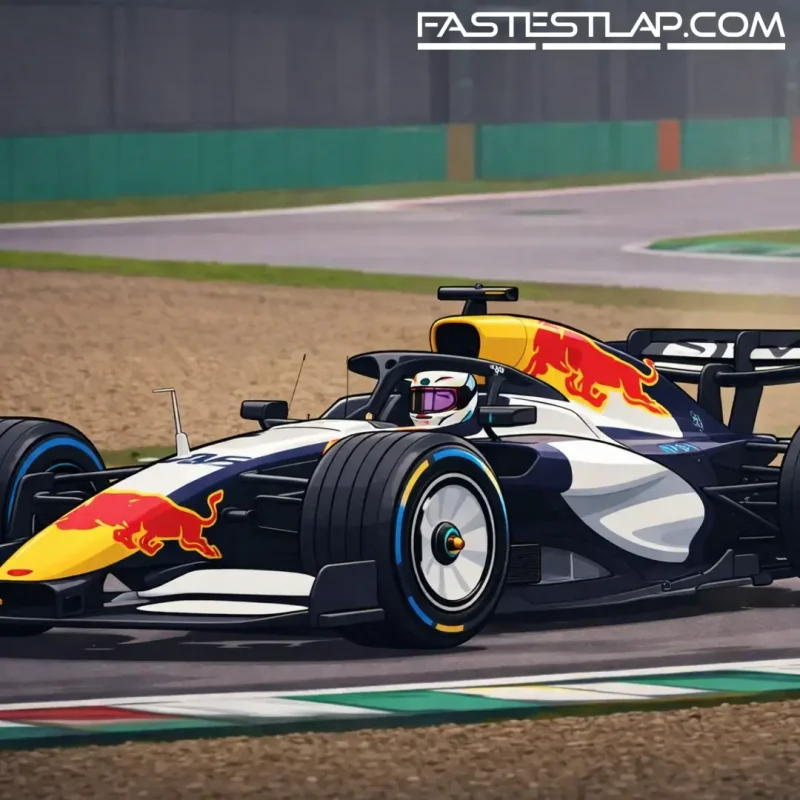
Racing Bulls have kicked off their 2026 campaign the way a lot of teams prefer to: quietly, methodically, and a long way from the noise of a launch stage. The VCARB03 has turned its first laps of the season at Imola, with the Faenza outfit using the first of its two permitted demonstration events to shake the car down and make sure the basics are in place before the serious mileage begins.
As ever with these early outings, the team’s kept the detail to a minimum. But the helmet on board strongly suggested Liam Lawson was the one doing the initial systems checks as the new car ran at the Emilia-Romagna circuit on Tuesday. It’s not about lap times, and it’s certainly not about showing off. This is the day you’d rather be bored than excited: oil pressures behaving, hydraulics happy, gear shifts clean, no gremlins hiding in the wiring loom. The kind of running you don’t notice when it goes well, and definitely notice when it doesn’t.
Racing Bulls will stay on at Imola on Wednesday, switching from a demonstration event to one of the two filming days teams are allowed each year. That matters because the rules now give teams up to 200 kilometres for a filming day — doubled from the old 100km allowance — which makes it far more useful as a proper pre-season “wake-up” for a brand-new car, not just a few slow laps for a camera crew. Like everyone else, Racing Bulls will have to use the specific Pirelli compounds mandated for these days, so there’s only so much genuine performance reading you can take. But 200km is enough to cycle through procedures, verify cooling margins, and start calibrating the correlation between what the wind tunnel promised and what the track is willing to give.
And that’s the point: 2026 isn’t a normal winter. With a new rules cycle, the paddock’s heading into the season expecting development to come thick and fast — not just from race to race, but almost from test to race. Racing Bulls team boss Alan Permane has already been blunt about the reality of it: what turns up for the official test won’t be what turns up for the opening round in Melbourne.
“I’m pretty sure most people, us included, will [bring] an update [to Australia],” Permane said late last year. “The car we test with in Barcelona won’t be the car we take to Melbourne. I’m sure there’ll be a significant update.”
That’s not a throwaway line, either. It’s a window into how teams are thinking about this whole pre-season. The five-day official test in Barcelona (January 26-30) is the first time anyone will see extended, representative mileage under the new regulations. But the subtext is clear: a lot of cars will arrive there not as “finished products”, but as the earliest viable versions of the concept — complete enough to run properly, yet still carrying compromise in areas teams would ideally keep evolving right up to the last possible deadline.
Permane’s explanation lays out why. The later you lock the car down, the quicker it can be — but only if you can stomach the risk that comes with leaving decisions late. “You want to keep it in the wind tunnel as long as you can. You want to finalise the mechanical designs as late as you can,” he said. That’s the knife-edge every technical group is walking into 2026: chase the last chunk of performance, but don’t leave yourself so little time that a packaging issue or cooling misjudgement forces you into an ugly compromise.
The interesting bit is how interconnected those compromises are now. Permane pointed to the installation of the engine and radiators as a domino effect that feeds directly into sidepod shape, which feeds into the floor, which feeds into downforce. That’s the sort of chain reaction that can define the first half of a new rules era. You don’t just “bolt on” performance later if the early architecture paints you into a corner.
For a team like Racing Bulls — one that lives in that tight midfield space where details decide whether you’re scrapping for Q2 or flirting with Q3 — the early-season agility is often as important as the baseline. If the car is fundamentally sound and the development pipeline is healthy, you can pick up momentum quickly while others are still unpicking problems. If it isn’t, you can spend a painful stretch throwing updates at symptoms rather than causes.
That’s why these low-key days at Imola matter more than they look. Nobody’s winning anything in January, but plenty of seasons can be made harder than they need to be. Racing Bulls’ priority this week is to ensure the VCARB03 is ready to do the real work in Barcelona — and, just as importantly, to ensure the team has the confidence to keep pushing the design without fearing every extra tweak will cost them reliability.
Permane summed up the mindset as teams head into the first year of a new cycle: “Everything, everything you do is geared up for performance, so you kind of define that [timeline] yourselves.” Racing Bulls have started defining theirs at Imola. The rest of the grid will be doing the same — some in public, some very much out of sight — because by the time Melbourne comes around, the “launch spec” will already feel like ancient history.