Ralf Schumacher has taken aim at what he believes is Ferrari’s early direction for the 2026 rules reset, warning the team it’s sleepwalking into a familiar trap: trying to please two lead drivers with two different answers.
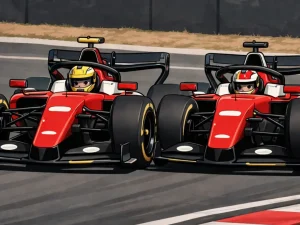
Speaking on Sky Deutschland’s Backstage Boxengasse podcast, Schumacher said Ferrari appears to be splitting its development thinking to accommodate Lewis Hamilton and Charles Leclerc, a move he calls “a disaster from the outset” if it’s truly playing out that way inside Maranello.
“Disaster already seems to be looming again, at least reading between the lines,” Schumacher said. “They appear to be developing two different cars. I can almost imagine that it’s because Charles Leclerc and Lewis Hamilton have completely different opinions on the car. If that’s the case, it’s a disaster from the outset.”
It’s the sort of warning Ferrari has heard in various forms for years — that the Scuderia’s biggest opponent isn’t always Red Bull, Mercedes or McLaren, but its own tendency to overcomplicate. And Schumacher’s point, stripped of the blunt delivery, is simple: the 2026 overhaul is too big, and the margins too fine, to spend winter chasing two philosophies at once.
The context makes the anxiety understandable. Ferrari effectively pulled the plug on SF-25 development early last season to throw resources at the all-new 2026 car and power unit project. That decision didn’t pay off in the short term. As the year wore on, Ferrari drifted away from the front and slid from second to fourth in the Constructors’ Championship across the final eight races, overtaken by Mercedes and also losing ground to Red Bull in a season where it scored less than half the points of champions McLaren.
There’s a logic to taking that pain, if it buys you a head start when the regulations reset and everyone starts over. Ferrari will also point to a practical upside: finishing fourth last year grants it more aerodynamic testing time than McLaren, Mercedes and Red Bull under F1’s sliding scale restrictions. If you’re going to bet on a long game, you may as well do it when the rulebook is being rewritten.
But a head start only matters if you’re running in a straight line. Schumacher’s critique is that Ferrari may already be zig-zagging — and in a year where the car concept and the power unit are being rebuilt together, that kind of internal divergence can quickly become expensive. Two drivers can want different things; that’s normal. Two parallel development directions is where it turns into organisational noise: duplicated work, mixed signals to the factory, and a car that ends up being “fine” for everyone and deadly for no one.
Schumacher also suggested Ferrari team boss Fred Vasseur has hinted at the same underlying issue, adding: “I’ve always said you can’t develop two cars and Fred Vasseur has hinted at it himself as well, so it all seems far from ideal.”
Vasseur, for his part, has been publicly focused on process rather than personality. At Ferrari’s end-of-season press conference last year, he outlined a deliberately conservative opening to 2026 pre-season: Ferrari will arrive at the January Barcelona test with a baseline “Spec A” car — not a mule, as he was careful to stress, but a first iteration designed to rack up mileage and validate fundamental technical choices before chasing performance later in the test programme.
“I think everybody will do it,” Vasseur said. “In this situation, the most important is to get mileage. It’s not to chase performance. It’s to get mileage to validate the technical choice on the car in terms of reliability. And then to get performance.”
His reasoning is rooted in the shape of the winter. With nine test days available — a very different rhythm to the three-day sprints teams have had in recent seasons — Vasseur sees the early running as a reliability and correlation exercise, not a one-lap shootout.
“We are not used to having nine test days anymore,” he said. “It’s an advantage, but it’s also a completely different programme. It means that the first target in this kind of season is to get the reliability.
“The first races [in 2014’s engine overhaul] you had a huge percentage of DNFs. It means that the first focus in Barcelona will be to get mileage with the car, to understand the reliability of the car, where we have to improve and what we have to react. Because if you understand something in Bahrain, by the second test, you won’t have time to react for Australia.”
In other words, Ferrari wants a robust starting point it can trust — a sensible stance when you’re introducing new cars, new power unit architecture and the inevitable cascade of “unknown unknowns” that comes with a major reset.
Where Schumacher’s warning lands, though, is in the space between that outwardly tidy plan and the murkier reality of a team with two elite drivers, both strong-minded, both accustomed to being listened to. If Ferrari’s “Spec A” is truly a neutral baseline, fine. If it’s already reflecting compromises to keep two sets of feedback moving in parallel, then Schumacher’s “two cars” line becomes less metaphorical and more operational — and that’s when timelines start slipping.
Ferrari’s 2026 car will be unveiled on 23 January in Maranello, followed by a shakedown at Fiorano. Vasseur has admitted the schedule is tight to the point of discomfort.
“This will be aggressive for sure, because we will finish the assembly of the car the day before the launch,” he said. “The launch will be the 23rd of January in Maranello. It means that we’ll finish the car on the 22nd. And this is aggressive, but everybody will do the same.”
That’s true — everyone will be sprinting. The difference is that not everyone will be trying to juggle the expectations attached to Hamilton’s pursuit of a record eighth world title and Leclerc’s determination to finally build his own championship campaign around a car he can lean on.
Ferrari doesn’t need to win January, or even February. It does need clarity: one development direction, one set of priorities, one car that gets faster with every update rather than more confused. Schumacher’s message, blunt as it was, boils down to that. In a season of sweeping change, the quickest way to waste an advantage is to argue with yourself.