Red Bull has blinked first at Spa, and not because the stopwatch forced it.
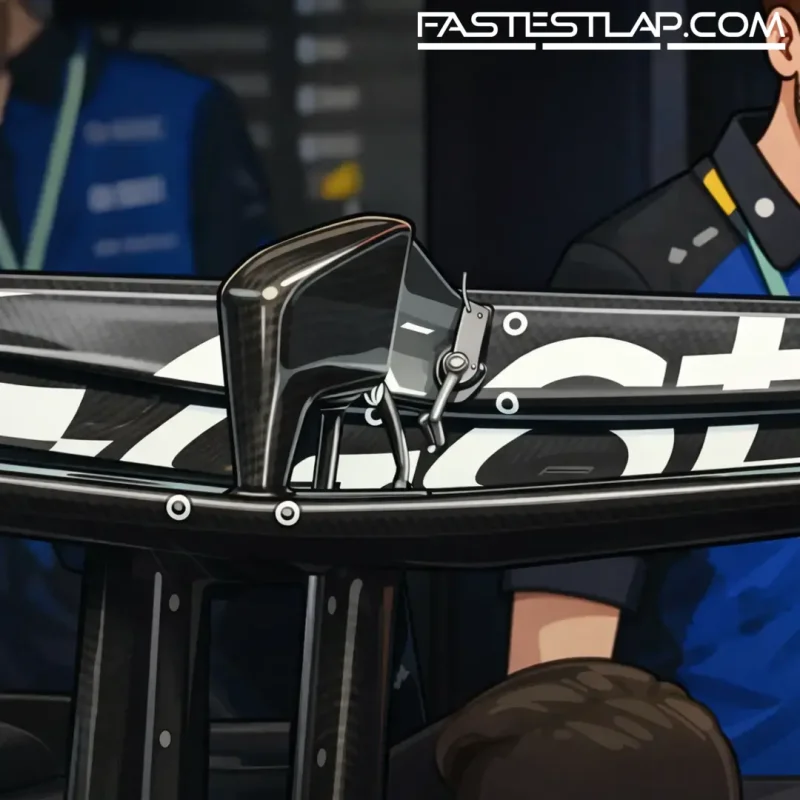
After Max Verstappen’s second high-speed spin in two race weekends, the team has parked its headline-grabbing “Macarena” rear wing for the Belgian Grand Prix and bolted on an older-spec design instead. It’s a straight admission that, right now, a couple of kilometres per hour on the Kemmel Straight aren’t worth the risk of a rear wing that doesn’t reliably do the one job it absolutely has to do: come back when it’s told to.
Verstappen didn’t dress it up. He was blunt after Silverstone, where he spun at Stowe and ended up beached in the gravel when the rotating rear wing failed to reattach properly after a straight-line mode zone. Eight days earlier, he’d already had a near-identical moment in Austria, spinning on the approach to Turn 9 in qualifying. Two scares, same theme, and the patience was gone.
“It’s super dangerous because you can really hurt yourself two times,” Verstappen said. “I was lucky in Austria, I was lucky here, but that’s why you get really fed up with it.”
That’s not a driver complaining about “feel” or a marginal balance issue. That’s a four-time world champion telling his team the fundamentals have slipped, and it’s hard to overstate how corrosive that is inside a top outfit. Drivers will tolerate experimental set-ups, they’ll tolerate upgrades that don’t land, they’ll tolerate a car that’s tricky. What they won’t tolerate for long is hardware that turns a braking zone into a lottery.
So Red Bull’s call for Spa is conservative by design: back to the pre-Macarena rear wing. Verstappen accepts it might be slower, but he’s effectively arguing that it’s the only adult decision available this weekend.
“I think it’s maybe a little bit slower, but it won’t turn the world upside down,” he said. “It was pretty clear to everyone that this is maybe the wisest choice for this weekend.”
Spa is a circuit that punishes indecision. You’re either committing to low drag and living with the compromises, or you’re not. Red Bull’s situation is messier because the Macarena concept is not just about speed; it’s about a new mechanism doing something it can’t occasionally afford to get wrong. If it fails to reattach as you tip into a fast corner, you’re not losing tenths — you’re losing the car.
Verstappen insists the wing will return, but only once the fix is properly understood and implemented.
“Eventually, yes,” he said. “They just have to figure out… I actually think they do know [what’s caused the problem]; you just have to look at how you’re going to find the solution. Hopefully the wing is back on as soon as possible.”
There’s a telling nuance there: he believes Red Bull knows what’s behind it, but knowing isn’t the same as having a repeatable, race-proof remedy. In modern F1, mechanisms can “work” in the garage and still let you down in the mess of a race weekend — heat cycles, vibration, kerb strikes, the cumulative wear you only see after a handful of sessions. Spa’s long straights and heavy braking zones are a brutal place to test anyone’s confidence in a system that’s already bitten.
Isack Hadjar, meanwhile, has been spared the drama — not because his wing is different, but because F1 can be cruelly random. His Macarena wing has functioned as expected, yet he’s also reverting to the older rear wing for safety.
“Visually, it’s obviously a big change, but in the car, it’s not, it’s less than you might think,” Hadjar explained. “It’s hard even for us to measure the loss, going back to it.
“So we still reckon to have like similar competitiveness to last weekend, for example, even though it’s definitely a less impressive rear wing. But we’re making sure the other one comes back to us as soon as we can and in a safer way as well.”
Asked why Verstappen seemed to be the only one hit by the failure, Hadjar shrugged it off as fortune — or misfortune, depending on your seat.
“I guess I got quite lucky for two rounds in a row,” he said. “It could have happened to none of us and it could have happened four times to the both of us. So, on this one, he took it for me unfortunately and to be honest, he’s probably his problem is my problem as well, and we need to fix it.”
That’s the key line from the other side of the garage. Hadjar might not have suffered the failure, but he’s not pretending he’s immune to it, either. If the mechanism can stick once, it can stick again — and Red Bull can’t afford to split its weekends between one driver rolling the dice and the other staying conservative. Unity of spec is the sensible play until the team is sure the Macarena wing is more than an idea with great upside and occasional terrifying downside.
In the short term, this is an unusually public rollback from a team that typically prefers to project certainty. In the longer term, the bigger question is how quickly Red Bull can regain trust in what it’s building. The performance cost of the older wing might be manageable. The cost of another “super dangerous” moment, in Verstappen’s words, isn’t.