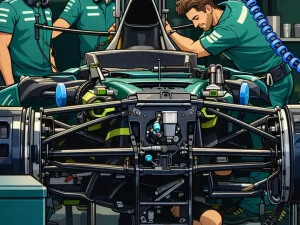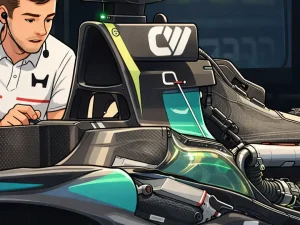
Red Bull says it’s found – and fixed – the root cause of the rear wing drama that twice pitched Max Verstappen into what he called a “super dangerous” situation, and the team is already eyeing a quick return for the upgraded package as soon as next weekend in Hungary.
The saga has been one of the more awkward subplots of the early 2026 active-aero era: a performance-focused rear wing concept that, when it worked, offered clear upside — and when it didn’t, left the car doing something drivers simply can’t accept at racing speed.
After Verstappen’s crashes in Austria and at Silverstone, Red Bull quietly rolled back to a previous-spec rear wing for this weekend’s Belgian Grand Prix. The concern wasn’t theoretical. Verstappen made it plain in the aftermath of the Silverstone incident that he felt he’d been “lucky” to get away with it, and he didn’t hide how fed up he was after consecutive weekends of the same scary-looking failure mode.
At Spa, technical director Pierre Waché confirmed the team’s post-Silverstone investigation has identified a mechanical issue connected to the wing’s operation, and that a fix is already in place.
“It’s a mechanical problem that we spot after the accident at Silverstone,” Waché said. “We fixed it. We are trying to prove that we are bulletproof before putting it back on the car and it should be ready for Budapest.”
Red Bull’s updated wing had been suffering an airflow reattachment problem as it switched between its straight-line and cornering configurations under the new 2026 active aero system, with the aero disruption at the rear proving enough to trigger Verstappen’s loss of control. Waché wouldn’t get drawn into too much detail on precisely what’s been strengthened — unsurprising given the wing is, by his own admission, a performance differentiator — but he did acknowledge the actuation side is part of the picture.
“Yeah, it’s part of it,” he said when asked about the mechanism. “I don’t want to be too precise on what we are doing because it’s part of the benefit of this wing, because it’s a performance benefit to use it.
“But we take it seriously. We discuss with FIA internally because it’s our duty to make the car safe. But we will make the part stronger and you will see this wing back soon.”
That last line matters. Red Bull isn’t talking like a team shelving a risky idea for the long term; it’s talking like a team that believes it had a solvable failure and is eager to get back to extracting the lap time it thinks the concept can deliver.
Waché also revealed the FIA is already satisfied with the changes Red Bull has made — a notable point, given the scrutiny active aero and moveable bodywork inevitably attracts, especially once it starts appearing in crash investigations rather than just lap time comparisons.
“We’ve proved it to them [the FIA] what we’ve what we done,” Waché said. “I think it’s more on our side that we are cautious now. We don’t want to take any risk and we want to be 100 per cent sure.”
That caution is telling, too. Red Bull has been in this sport long enough to know the FIA being comfortable is only one part of the equation; the other is being able to look a driver in the eye and say, with a straight face, that the thing won’t bite again the moment they hit the button mid-corner.
Hungary now looks like the pivotal decision point. Waché didn’t commit to a race return, but he certainly didn’t cool expectations either. Asked whether it might be more realistic to reintroduce the wing after the summer break at Zandvoort, he replied: “It could be interesting for Budapest.”
That phrasing leaves the door wide open to a cautious reintroduction in practice first — the most politically and technically sensible route when the alternative is bolting it on for qualifying and hoping the data you’ve gathered in the factory tells the whole story. Red Bull could run it on Friday, build confidence that the fix is genuinely “bulletproof”, and then decide whether it’s worth taking into parc fermé conditions for the rest of the weekend.
There’s even a recent precedent. Ferrari took a similarly conservative approach earlier this season with its own rotating rear wing concept, trialling it in practice in China before pulling it from both cars ahead of qualifying, only bringing it back later in the year for a race debut in Miami — the same weekend Red Bull first unleashed its version.
Red Bull’s situation is more urgent because the team has already lived the nightmare scenario: a high-profile driver calling the behaviour “super dangerous” after two incidents in quick succession. That sort of language tends to linger in the paddock. It sharpens questions, it hardens internal attitudes, and it makes the next failure — if there is one — far harder to manage.
But if Waché is right, and the issue is now understood, contained and strengthened, then the interesting part of this story becomes less about damage limitation and more about what Red Bull is willing to risk to regain a performance edge in a season where active aero is quickly separating the teams who’ve nailed robustness from those still learning where the cliff edge sits.
Budapest will tell us whether Red Bull truly believes it’s stepped back from that edge — or whether Spa was simply the pause before another push.