Red Bull’s churn in 2026 isn’t confined to the top floor. One of Max Verstappen’s most senior mechanics, Ole Schack, has handed in notice and is expected to leave the team in the coming months as he looks for a new challenge.
Schack isn’t just another name on a staffing list. He’s been embedded in the fabric of Red Bull’s race team since the very beginning of the project, dating back to before the Jaguar buyout and then working every single Grand Prix since Red Bull’s first race under its own name at the 2005 Australian Grand Prix. In an era where F1 careers are built on relentless travel and brutal hours, that kind of unbroken attendance is almost unheard of — and it’s why his impending exit lands with a particular thud inside the garage.
Talks are ongoing around the precise timing, with negotiations understood to be centred on Schack’s preferred reduced notice period. Either way, the direction of travel appears set: a veteran who has spent two decades as part of Verstappen’s trackside operation is preparing to walk away.
There’s an emotional footnote to Schack’s story that has long been quietly respected within the paddock. At the 2012 Singapore Grand Prix he was the Red Bull mechanic sent to the podium to collect the constructor’s trophy, nominated by then-team boss Christian Horner in recognition of Schack’s dedication after the death of his father around the time of that year’s Hungarian Grand Prix. Even then, he didn’t miss a race. In a sport that prizes the machine, those human moments still matter — and they’re part of why Schack has been so closely associated with Red Bull’s identity.
That identity, though, is exactly what’s been shifting. The team has undergone a series of heavy changes since Horner was axed last July. Schack is understood to have referenced a changed atmosphere and working environment as factors in his decision to look elsewhere — a sentiment that fits a broader pattern at Red Bull since the leadership reset.
Laurent Mekies has been promoted from Racing Bulls to run Red Bull, reporting to Oliver Mintzlaff in his role as CEO of Corporate Projects. Mekies and Mintzlaff also made the call to part ways with Helmut Marko, ending the long relationship between the team and the man who had been Dietrich Mateschitz’s right-hand figure for more than two decades. Marko departed over the winter break.
The exits since then have kept coming. Chief designer Craig Skinner stepped down. Matt Caller, another member of Verstappen’s crew, left over the winter to join Audi. Jon Caller, who moved across to fill his twin brother’s role on Verstappen’s car, is also understood to have tendered his resignation.
And it hasn’t just been trackside names. In February several senior administrative figures departed too: Joanna Fleet (long-time HR director), Julia George (director of partnership), Simon Smith-Wright (group marketing director), and Alice Hedworth (senior communications manager). On their own, any one of these departures is manageable; stitched together, they paint a picture of a team shedding experience and continuity at the exact moment stability is usually the most valuable commodity.
What makes Schack’s pending move feel especially symbolic is the timing. Red Bull’s start to the new regulation cycle has been rough by its own modern standards, with Verstappen — a four-time world champion — yet to get near the podium. After three race weekends he has 16 points, and Red Bull is scrapping around what looks like fourth in the early championship picture with Alpine and even Racing Bulls, its sister team.
Sources close to the situation suggest morale at the factory has dipped, and that’s hardly a surprise. F1 teams can absorb political reshuffles when the car is quick; when it isn’t, every new face and every empty desk gets felt more sharply. The RB22 has been described internally as a car that needs answers quickly, and the “next version” is already being framed as a potential turning point rather than just an update.
Isack Hadjar didn’t try to sugarcoat the mood when asked in Japan.
“It’s not good,” he said. “But everyone’s got their heads down to understand what’s going on. Hopefully, the next version of the car really makes an effect. That’s it.”
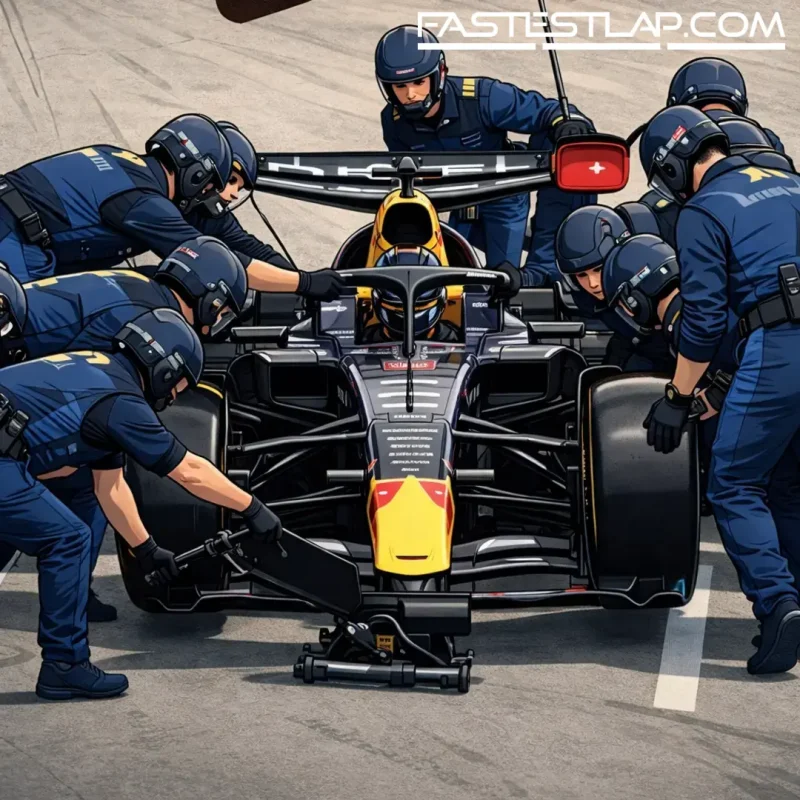
In other words: the working culture is under strain, the results aren’t offering any relief, and the personnel changes keep stacking up. In that environment, losing a long-serving figure like Schack isn’t simply about whether pit stops get a tenth slower; it’s about the less measurable things teams rely on when pressure mounts — trust, routine, and the quiet competence that stops little issues becoming big ones on a Sunday.
Red Bull has the resources to recover, and a sport as cyclical as Formula 1 rarely allows any one storyline to dominate forever. But right now the team’s transformation is happening in full view, and Schack’s decision to seek a fresh start is another sign that the Red Bull of the last decade is continuing to recede in the rear-view mirror.