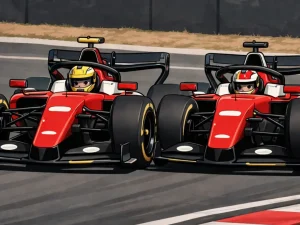
Christian Horner might no longer be the man on the Red Bull pit wall, but his fingerprints are all over the most important project in the company’s F1 history. As Red Bull rolls out its 2026 look with Ford in Detroit, Oliver Mintzlaff has credited the former team principal for building the engine operation designed to carry the team into F1’s next era.
Horner’s 20-plus-year run ended after last year’s British Grand Prix, a brutal stop to a tenure that yielded six constructors’ titles and eight drivers’ crowns. Yet even in his absence, the new power unit programme he championed — Red Bull Powertrains, created for the 2026 rules and partnered with Ford — is the center of gravity in Milton Keynes.
“It was Dietrich Mateschitz’s big dream that we build our own engine,” Red Bull GmbH executive Oliver Mintzlaff told De Telegraaf. “I remember thinking, what does that even mean — and how much will it cost? Credit to Christian Horner for finding the right people for that department. Now we just hope we can make Dietrich’s dream come true.”
The stakes are clear. From 2026, Red Bull will be racing with its own power units for the first time, with the RBPT–Ford programme joining Audi as a new manufacturer on the grid. Honda, Red Bull’s previous partner, returns officially with Aston Martin. It’s a reshuffle that could redraw the competitive map, and Red Bull’s leadership isn’t pretending otherwise.
Asked what happens if the world champions aren’t world-beaters straight out of the box, Mintzlaff batted away the doom scenarios. “No one knows — maybe we’ll be the second or third team. I know we have extremely talented people working for us. And it’s not just about the engine, but also the chassis. Christian brought a lot of good people on board in recent years, just look at the engine department.”
The message internally is stability and belief, even as rivals circle and staff turnover remains part of the game. “There will always be people leaving if a competitor makes a good offer,” Mintzlaff added. “But many see there’s a different atmosphere here now. Red Bull is a winning, cool team that gives talent the chance to grow.”
Today’s livery unveiling for the 2026 RB22 — to be driven by Max Verstappen alongside Isack Hadjar — offers the first public signal of a fresh chapter. The team’s sister outfit, Racing Bulls, will also show off its 2026 colours, with Red Bull positioning the Faenza squad as the proving ground for two young drivers next season. It’s very much the Red Bull way: promote, challenge, and see who swims.
None of this, of course, guarantees a soft landing in 2026. Engine-chassis integration is a famously unforgiving art, and even powerhouse operations have stumbled when the rules reset. That’s why Mintzlaff’s nod to Horner matters — not as some sentimental coda, but as recognition that Red Bull’s competitive future was set in motion years ago, when the team chose to take control of its own destiny.
Horner himself called the power unit build “by far the biggest challenge we’ve taken on in Formula 1.” Now it’s over to the people he hired to make it sing — and to a driver line-up that blends the sport’s most relentless finisher with a rookie stepping into the spotlight.
Red Bull has spent 21 years instituting the kind of pipeline that feeds a project like this. The difference in 2026 is that there are no safety nets. If it works, Red Bull becomes a fully-fledged works giant with the agility that’s defined its modern era. If it doesn’t, the margin for recovery shrinks fast.
For Mintzlaff, the tone is set: no trepidation, no apologies, just an eye on the scoreboard. “I think this is going to be a great story,” he said. “We want to win again in the new era and write new success stories.”
A new car, a new engine, and a familiar target. However you feel about the changing of the guard, the next Red Bull chapter still starts with Horner’s last big bet. Now we find out whether it pays off.