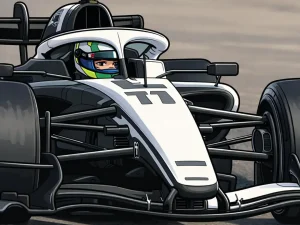
Red Bull’s 2026 car is already shaping up to be a clean break from its ground‑effect dominance. Word from Italy suggests the RB22 will ditch the team’s signature front pullrod in favour of pushrod suspension at both ends — a wholesale shift that fits the sport’s new brief: less floor trickery, more mechanical honesty, and a power unit architecture that’s about to turn everything upside down.
If you’ve been keeping score since 2022, you’ll know Red Bull made that front pullrod layout work better than anyone, unlocking the airflow Red Bull’s aero group prized in the ground‑effect era. But from 2026, flat floors, active aero and a 50/50 split between engine and electric power change the priorities. Packaging and predictable kinematics move to the top of the list. A double‑pushrod layout neatly serves both.
There’s logic behind the rumour. The new power unit — Red Bull Powertrains’ first full in‑house effort, developed with Ford — imposes different cooling, weight distribution and installation demands, all while teams chase stability through active aero phases. A pushrod arrangement typically frees up space low in the chassis and can simplify the geometry teams want as the car transitions between low‑ and high‑drag modes. Simpler to read, quicker to iterate, cleaner to package. That’s a compelling cocktail when the rulebook resets.
Ferrari, for what it’s worth, is said to be pointing the same way with its 2026 project. If both heavyweights converge on double pushrod, it’s as strong a tell as you’ll get that the design winds have shifted.
The bigger unknown isn’t the suspension. It’s the engine. Red Bull and Ford are about to take on Mercedes, Ferrari and the rest at their own game with a brand‑new power unit concept, and nobody inside the paddock pretends that’s anything but brutal. Mercedes is widely believed to be well advanced with its 2026 package. The FIA has even created a safety‑net mechanism — Additional Development and Upgrade Opportunities — to help manufacturers who find themselves behind the curve catch back up once reality bites.
Publicly, Red Bull’s leadership has played both sides of the line. Earlier this year, Christian Horner couldn’t resist a jab, saying it would be “embarrassing” for the established players if a first‑timer like Red Bull‑Ford turned up and out‑gunned them straight away. In the same breath, Laurent Mekies — speaking with his characteristic straight bat — likened the challenge to climbing Everest and warned it’d be foolish to assume parity with Mercedes or Ferrari from day one. That’s the balance in Milton Keynes right now: swagger tempered by the scale of the job.
The calendar has its own tells. Red Bull and sister team Racing Bulls are expected to share the stage at Ford’s season‑launch event in Detroit on January 25, a neat bit of theatre ahead of pre‑season running and a chance to show how closely the car and power unit projects have been knitted together. If the double‑pushrod gossip is on the money, that’s when we might catch the first hard evidence.
And the drivers? Verstappen remains the constant at the sharp end of Red Bull’s plans, while the second seat for the new era has been the subject of steady paddock chatter, with Isack Hadjar among the names linked internally. Red Bull being Red Bull, don’t expect confirmations until they serve the bigger narrative.
What does this all add up to? Even for a team that’s lived off aerodynamic genius, 2026 rewards clarity over cleverness. A pushrod‑pushrod RB22 would signal Red Bull’s intent to keep the tricks where they matter — in integration: chassis, aero, and a brand‑new PU singing from the same hymn sheet. The stopwatch will still write the verdict, but the direction of travel makes sense.
If you’re looking for early markers of the 2026 pecking order, watch three things:
– Who nails the mechanical platform out of the box. Active aero only helps if the car behaves when you ask it to.
– Who stays within the energy budget without strangling performance. Fifty percent electrification isn’t just a slogan; it’s a constraint.
– Whose packaging is neatest. Hotter, heavier, more complex PUs reward tidy solutions everywhere else.
Red Bull’s dominance since 2022 was built on conviction and execution. Choosing a double‑pushrod layout now — if that’s where they’ve landed — feels like more of the same. Different tools, same philosophy: make the car easy to understand, then develop it faster than anyone else. The hard part this time? Everyone’s starting from zero.