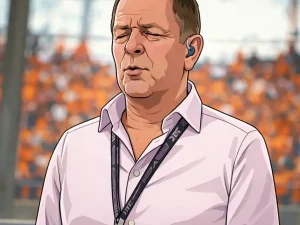
Red Bull may have turned the page on Helmut Marko’s day-to-day presence, but it hasn’t shut the book. Months after the Austrian stepped away at the end of 2025, the team is still leaning on him quietly — not for garage-side theatrics or headline-grabbing soundbites, but for something far more valuable inside that organisation: institutional memory.
Marko’s two-decade grip on Red Bull’s junior programme was never just about signing teenagers and delivering brutal one-liners. He was the connective tissue between Red Bull’s long-term driver pipeline and the present-tense urgency of winning races. Even now, with Laurent Mekies running the operation, that influence hasn’t evaporated simply because Marko no longer turns up in the paddock with a pass around his neck.
Mekies has been candid about it: conversations are still happening, advice is still being sought, and Marko has made it clear he’ll pick up the phone.
“Helmut has remained very open and available to us,” Mekies said on the *Beyond the Grid* podcast. “I am [talking to him], they are, I’m sure we are all having chats with him and getting guidance from him, even though you don’t see him turning up at the racetrack.
“You can’t turn the page of Helmut that has been building this young driver programme for two decades with incredible success. You don’t turn that page quickly. So we are living on his legacy right now… he’s behind the corners if we need him.”
That’s the key line: *behind the corners*. Red Bull isn’t outsourcing decisions to a retired powerbroker, but it also isn’t pretending it can instantly replicate the instincts of the man who shepherded a production line that fed Formula 1 with Sebastian Vettel, Max Verstappen, Daniel Ricciardo and Carlos Sainz. Marko reported directly to the top of Red Bull GmbH rather than Red Bull Racing itself, which always made his role unusual — part talent scout, part internal political force, part standards enforcer. Removing that presence changes the air inside the team, whether Red Bull wants to admit it or not.
Verstappen, for one, has never hidden how personal that relationship became. He joked at the season-opening weekend in Australia that the garage could do without “a few less Austrian-sided jokes,” but the point wasn’t the punchline — it was the admission that the relationship continues, just in a different lane.
“I’m in touch with him anyway,” Verstappen said. “Maybe not so much about details of the car, but just life.
“I shared so many moments with him so, of course, it will feel a little bit different in the garage, but you also have to just look ahead, right?”
It’s a telling distinction. Verstappen doesn’t need Marko to explain a front wing or second-guess set-up calls. What Marko has offered him, historically, is something else: clarity, loyalty, blunt truth when needed, and a kind of protective influence within a famously ruthless structure. Verstappen has previously described Marko as a “second father” in racing terms, and the two had what Verstappen called a “very emotional” call when Marko informed him he was leaving.
The more intriguing aspect is how Marko’s shadow plays across Red Bull’s next wave — because 2026 isn’t just another season, it’s a reset moment across the grid, and Red Bull is trying to thread the needle between immediate performance and long-term driver planning without the man who built the framework.
Isack Hadjar’s story sits right in the middle of that. Now Verstappen’s team-mate for 2026, Hadjar arrived at Red Bull’s sharp end carrying the baggage of an ugly first impression: a formation-lap crash on his F1 debut in Australia last year. Marko’s reaction at the time — branding Hadjar’s emotions “embarrassing” — drew backlash, not because it was out of character, but because it was so perfectly, unflinchingly Marko.
Hadjar has since rebuilt his reputation the hard way: on track, with resilience, and with enough promise for Red Bull to put him alongside the sport’s most demanding benchmark. Asked in China whether Marko had been impressed by his start to life at Red Bull, Hadjar delivered the kind of line that will land in the team’s debrief rooms as much as in its press clippings.
“He’s never impressed,” Hadjar smiled — an acknowledgment of Marko’s standards as much as his personality.
Then there’s Arvid Lindblad, another product of the programme Marko shaped. Lindblad has already spoken publicly about how Marko backed him when others weren’t convinced, crediting him as “a massive reason” he’s even on the F1 grid. That relationship, Lindblad says, hasn’t ended with Marko’s resignation either.
“Obviously, I have a very special relationship with Helmut,” Lindblad explained in China, revealing they spoke after the Australian opener. “He brought me onto the Red Bull programme when I was 13… So yeah, it’s sad for me not to have him in the paddock.”
For Red Bull, this ongoing contact isn’t nostalgia; it’s risk management. Marko’s gift — and sometimes his curse — was that he made decisions fast and lived with the fallout. He was prepared to be unpopular internally if it meant the programme kept moving. In a team built on momentum and ruthless clarity, losing that edge can create hesitation, and hesitation is where top teams start making “safe” choices that slowly turn into expensive ones.
Marko, of course, hasn’t gone quiet. He’s still offering opinions through Austrian and German media, which means Red Bull gets the full experience: private counsel when requested, and public commentary when it’s not. That duality may be awkward at times, but it also feels very Red Bull — a team that has never been overly concerned with neat storylines, so long as the stopwatch stays kind.
For now, Mekies and his leadership group are keeping Marko close enough to benefit from his experience without reopening old power structures. It’s a delicate balance. But in a season where every team is recalibrating, Red Bull knows better than most that continuity isn’t only built in the factory. Sometimes it’s a phone call to the person who put half your driver roster on the grid in the first place.