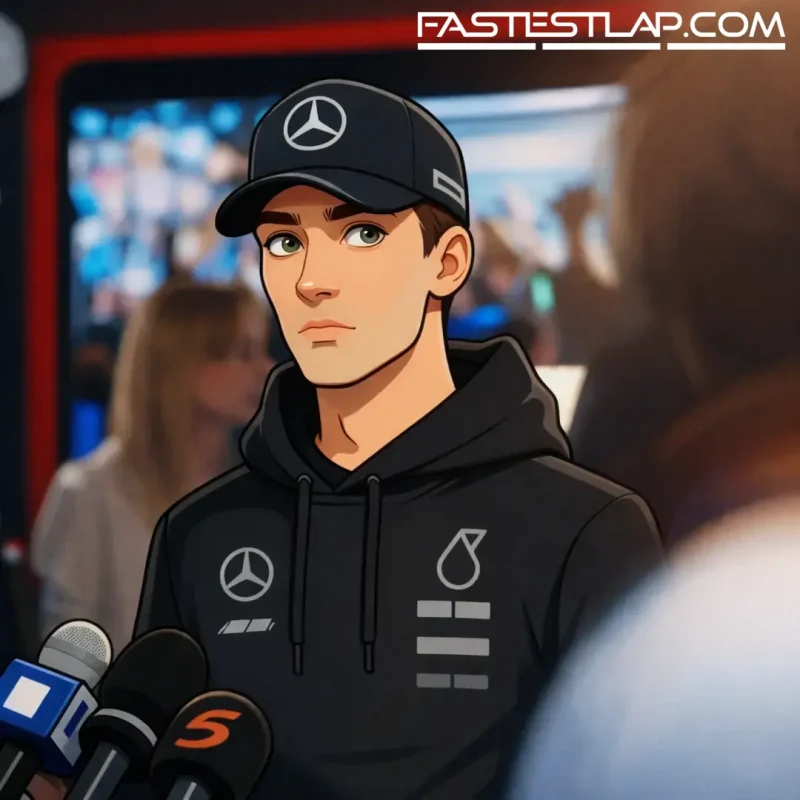
George Russell isn’t doing much to fuel the silly season, and in 2026 that’s almost become a story in itself.
With Mercedes opening the year as the benchmark — three wins from three starts — Russell says the “performance metrics” written into his deal are more formality than cliff-edge. The contract he signed last year is understood to be a one-plus-one arrangement, with the second year effectively hinging on targets that, in the current shape of the championship, look well within reach.
“It’s pretty much, you hit the metrics and move on,” Russell said when asked about the clause and what it means for his 2027 seat. “I will be here next year with the team.
“Not very much more to say. It’s a multi-year deal, it’s numerous years. And often in a lot of these contracts, even if metrics aren’t hit, if things are happy, then you continue. But as I said, metrics will very likely be hit.”
Russell’s tone was as revealing as the words: matter-of-fact, slightly dismissive, the sound of a driver who knows he’s in the middle of the paddock’s most obvious power position and doesn’t intend to blink first.
Because the subtext here isn’t really about Russell at all. It’s about the gravitational pull of Max Verstappen, Red Bull’s downturn, and the way Mercedes — even while denying any courtship — remains the one destination that keeps coming up when the grid starts imagining what a Verstappen exit could look like.
Last year, Russell’s own renewal dragged on long enough to invite a wave of reading-between-the-lines, helped along by Toto Wolff’s well-documented admiration for Verstappen and a background hum that Mercedes would be willing to make room if the chance ever became real. This season, the speculation has returned with sharper edges: Red Bull is no longer the default answer for “best car”, and Verstappen is no longer insulated by an unassailable points buffer.
The key detail doing the rounds is a clause in Verstappen’s contract that would allow him to leave if he is not in the top two of the drivers’ championship at the mid-season break. Last year it didn’t feel like a live grenade; this year, with Mercedes running the table early on, it suddenly does. Add in the broader sense of Red Bull being in a fight — and the noise around personnel movement — and you can see why paddock imaginations have kicked into overdrive.
Wolff, for his part, has tried to stamp on the idea that Mercedes is actively circling.
“There are not any Max discussions,” he said. “I could not be happier with the two drivers that we have. The positioning of the two, with the age gap and how it aligns well with our strategy, means there are not any discussions.”
That’s a strong denial, and it’s also a useful one. Mercedes has something it didn’t always have in recent years: a clean narrative. Russell as the established spearhead, Kimi Antonelli as the long-term project, and a car that makes both look good. It’s coherent. It’s marketable. And, crucially, it’s calm.
But Formula 1 doesn’t stay calm for long, and Verstappen’s situation is the sort that can rewrite a team’s plans overnight. Jolyon Palmer, speaking on the F1 Nation podcast, framed it bluntly when discussing the impending departure of Verstappen’s race engineer GianPiero Lambiase — a relationship widely viewed as central to the way Verstappen operates at his best.
“I think we’re already talking about Max probably leaving the team at some point,” Palmer said. “You’ve got Red Bull not being competitive, and not having the easiest route back to being competitive, given where they’re at when you factor in all the personnel who have left.
“For me, GP is such a linchpin for him; it sort of connects the driver to the team. I see this news as offering a more in-depth understanding of another reason why Max isn’t particularly happy in the team… I just don’t see him sticking around particularly long, probably beyond the end of this year, unless they have a concrete plan in place and a clear sign of progress.”
The Verstappen market, though, is far narrower than the hype suggests. McLaren won both championships last year and appears in no hurry to disturb a settled pairing of Lando Norris and Oscar Piastri. Ferrari will always be linked with any superstar — Fred Vasseur even joked back in 2023 that every team boss would love to have Verstappen — but nothing concrete has been confirmed between the two sides.
Aston Martin, at one point, looked like the romantic “new era” move. Yet the reality is harsher: until that team shows it can consistently offer a winning package, it’s difficult to square with Verstappen’s priorities. In other words, the list of places that make sense shrinks quickly.
Which brings the conversation back to Mercedes — and to the awkward part of Wolff’s denials. It isn’t hard to say you’re happy with your drivers in April. It’s harder to keep the same line if the championship picture tightens, Verstappen’s clause becomes actionable, and the sport’s most complete driver is suddenly available.
That’s where Russell’s performance clause becomes more than contractual housekeeping. If he’s hitting the metrics — and with Mercedes currently setting the pace, he should — then Mercedes can’t simply hand-wave him away without an obvious fight. Russell isn’t just “good enough”; he’s delivering in a car that’s winning, and he’s doing it with the air of someone who believes Mercedes is his team now, not a seat he’s borrowing.
Antonelli adds another layer. He’s under contract for 2026, but his future beyond this season hasn’t been publicly confirmed. Even so, he’s embedded in the Mercedes plan, his recent rise in form only reinforcing the assumption that Brackley sees him as part of its next cycle. If Mercedes is genuinely committed to that strategy, the door for Verstappen is not wide open — it’s jammed by two drivers who are doing what Mercedes asked of them.
So Russell’s “not very much more to say” lands with a bit more weight than he probably intended. It’s a message to the market as much as the media: if Verstappen’s camp is scanning for leverage, Mercedes has a driver in place who thinks he’s contractually — and competitively — protected.
In modern F1, nothing is ever fully secure. But right now, Russell looks less like a man bracing for an uncomfortable phone call and more like one holding the phone himself, watching the rest of the grid decide what to do about it.