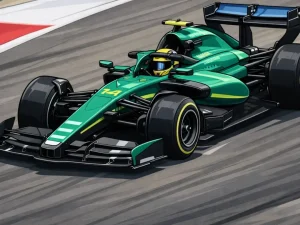
George Russell has gone from spooked to cautiously impressed by what he’s seen in Bahrain — not because Red Bull has suddenly looked vulnerable, but because Mercedes’ biggest early weakness appears to be shrinking fast.
Through the first days of 2026 pre-season running, the chatter in the garage and the paddock centred on one thing: Red Bull’s energy deployment looked savage. Russell himself had previously described it as “pretty scary”, and even Toto Wolff had talked in terms of a potentially massive lap-time swing in that area. A week later, Russell’s tune is notably different.
Red Bull, he insists, is still the benchmark for how effectively it can deploy battery power. But the gulf Mercedes-powered cars were staring at on day one isn’t the same gulf being discussed now.
“Their deployment definitely still looks the best on the grid, which is kudos to them,” Russell said in Bahrain. “I think it was a bit of a surprise to everybody, so let’s see come Melbourne how things shake up.
“I think the Mercedes-powered teams have made a lot of improvements since day one of Bahrain last week, so that gap has closed drastically.”
That “drastically” is doing a lot of work — and it’s worth pausing on why. The first races of a new rules cycle tend to be sold as an aero story, because it’s visible and because it’s what the eye catches when a new car looks planted, nervous, efficient or draggy. But the early shape of this season may be dictated just as much by what’s happening invisibly: how consistently teams can harvest and deploy energy, how aggressive they can be without tripping into compromises elsewhere, and how quickly engineers can refine control strategies once they’ve got meaningful mileage.
In that context, Russell’s point about the calendar matters. Bahrain testing gives you time to try things, evaluate them, and circle back — six days of running is a luxury compared to what the teams will have once the circus arrives in Melbourne. When it’s three hours of practice and you’re expected to nail it, the car that’s already in a stable operating window can look like it’s playing a different sport.
“But we’re obviously [on] day six of Bahrain testing now,” Russell added, “whereas in Melbourne, you’ve got three hours of practice, and that’s the main point of concern.”
The broader paddock read-out from Bahrain is that Mercedes has left testing with a bit of momentum. There’s a sense the Silver Arrows — alongside Ferrari — have set the early benchmark, with Red Bull and McLaren grouped as the closest challengers. Those four, in turn, are seen as a cut above the rest for now.
Even Red Bull team principal Laurent Mekies has acknowledged Mercedes and Ferrari look slightly ahead at this stage, which is notable not because it locks in the pecking order — it doesn’t — but because it hints at where Red Bull thinks its to-do list sits between now and the opening flyaways.
Russell, meanwhile, is framing 2026 as a year where the racing picture won’t simply be a rerun of “DRS trains” versus “dirty air”, but something more dynamic and, frankly, more chaotic: drivers and teams managing energy differently from one another, with the consequence that performance swings won’t always be tied to who has the best high-speed platform.
“You definitely can [follow], because there’s less aero on the cars, so there’s less disturbance,” he said when asked about the ability to run close in the new regulatory era. “I think the big difference this year compared to the previous era is the variability in energy deployment between cars and drivers, depending on driving styles, will probably far outweigh the aero turbulence.
“So, I think we will see different racing, and I think tracks like Melbourne and Jeddah, where there are numerous long straights, I think the racing could be quite intriguing.”
It’s a telling answer, because it hints at a new kind of cat-and-mouse. If one car’s deployment allows it to defend down straights with less compromise, or attack without burning its resources too early in the lap, then overtaking becomes less about whether you can stick within a second through the final corner and more about whether you’ve got the energy profile to actually complete the move.
And unlike aero performance — which can often be diagnosed from onboards and sector patterns — deployment advantages are harder to quantify from the outside, which means they can linger as “feel” in the paddock long before the lap times fully ratify them.
For Mercedes, Russell’s comments amount to a quiet vote of confidence: whatever they saw on day one, they’ve reacted. For Red Bull, it’s equally a compliment and a warning shot — the advantage is still there, but it’s no longer assumed to be untouchable.
Melbourne will be the first proper audit. Testing can suggest who’s got the best cards, but the race weekend forces you to play them under pressure, with parc fermé, limited running, and rivals actively trying to expose your weak spots. If Russell’s right and the deployment gap has narrowed, the opening rounds may come down less to who has the headline-grabbing “best” system, and more to who can operate theirs with the fewest compromises when it actually counts.