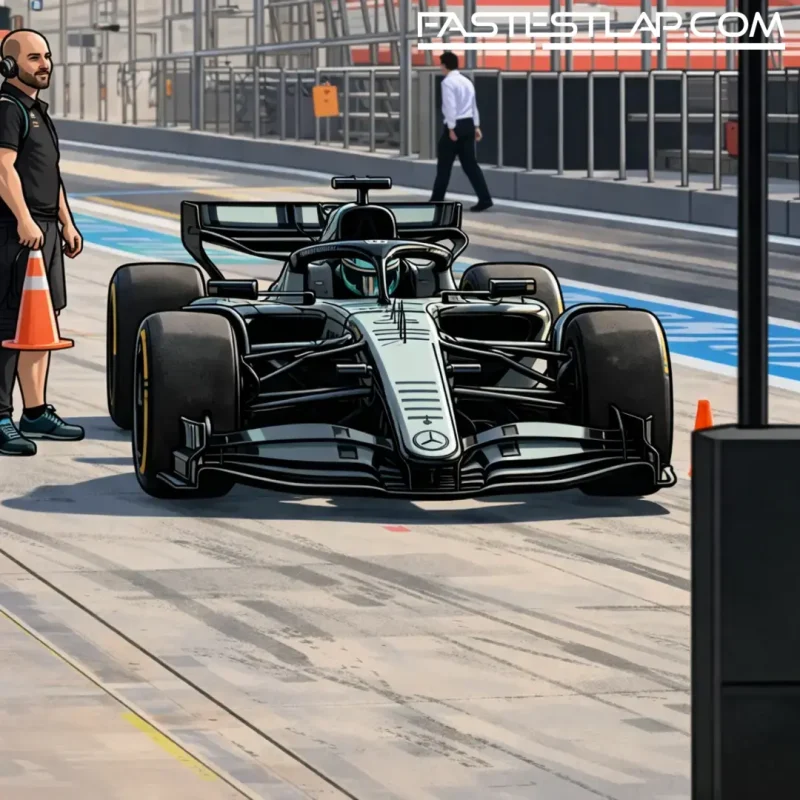
George Russell left it late, but he left it clear: if Mercedes have arrived in 2026 with a car that’s immediately usable, he looks ready to make that count.
On the first day of the second official Bahrain test — day four overall of the winter programme — Russell’s 1:33.459 in the final half-hour nudged Oscar Piastri off the top by a miserly 0.010s. It’s pre-season, it’s February, and lap times come with all the usual caveats, but the way Russell went about it felt familiar: tidy work, no theatre, just a clean, decisive punch when the track was there to be taken.
The day had been split in tone as much as in sessions. Charles Leclerc was the early pacesetter, quickest in the morning running, before the afternoon evolved into something closer to a proper performance run for the leading teams. That’s where it got interesting: not because anyone’s “won testing” — nobody in the paddock bothers with that — but because the front of the order was busy enough to hint at cars that are broadly doing what their drivers ask.
Piastri’s 1:33.469 had looked set to stand as the benchmark, McLaren putting together another quietly efficient day with 70 laps from him and 54 from Lando Norris, who finished fourth. The McLaren, at least on the evidence of mileage and the absence of drama, appears in that sweet spot engineers love at this stage: a platform you can work with, rather than a mystery you spend three days arguing with.
Mercedes, too, banked serious running. Russell’s 76 laps were the most among the outright front-runners and Kimi Antonelli added 69 on his way to fifth, 0.699s back. The times don’t tell you the fuel loads or engine modes, but the lap counts tell you something else: the car is staying on track, and the team is gathering the kind of data you only get when you’re not constantly peeling bodywork off in the garage.
Ferrari’s day was messier. Leclerc’s 70 laps and third-fastest time (+0.280) read well enough. Lewis Hamilton, though, spent a significant chunk of the day in the pitlane and ended up with 44 laps, seventh on the sheet at +0.840. He did at least reappear in the final hour, which matters — with brand-new regulations for 2026, every lost stint is a missed chance to build references that won’t come easily once the season starts and everyone’s hiding their real work.
Behind the headline trio, the timing page had a pleasingly scrambled look that only testing can produce. Isack Hadjar was the only driver to log a full day for Red Bull, but his programme was compromised early: just 13 laps in the morning. That left him with an afternoon of hard graft simply to get the basics covered, and he finished sixth (+0.801) with 66 laps. It’s not the sort of day that prompts panic, but it’s the sort of day that forces you to reshuffle your plan and hope you don’t pay for it later in the week.
Williams popped up with Carlos Sainz eighth (+1.654) from 56 laps and Alex Albon 11th (+2.231) with 55. Alpine, now with Franco Colapinto and Pierre Gasly both getting decent mileage, placed ninth and 14th respectively, and Audi’s new-era operation had Gabriel Bortoleto 10th on 71 laps, with Nico Hulkenberg down in 18th after 49.
Further back, Racing Bulls racked up substantial distance through Arvid Lindblad — 75 laps, 19th — while Liam Lawson’s entry was listed without a time but with 61 laps completed. Haas had a split day in terms of mileage: Esteban Ocon ticked off 65 laps, while Ollie Bearman managed 42.
At Aston Martin, the story wasn’t the stopwatch either. Lance Stroll and Fernando Alonso recorded 26 and 28 laps respectively, leaving the team with one of the lightest totals of the day. When a test day ends with that kind of mileage, you don’t need radio snippets to know it wasn’t straightforward.
Cadillac’s new chapter continues to take shape in public view, but with limited running on this particular day: Valtteri Bottas completed 35 laps, Sergio Perez 24, both ending up at the bottom of the classification.
One small procedural note also slipped into the final part of the afternoon: the last 10 minutes included a trial of a new start system, adding an extra five-second warning before lights out. It’s the sort of tweak that seems minor until you consider how relentlessly teams (and drivers) have optimised their start routines; even a small change in cadence can have knock-on effects when the margins are measured in reaction times and clutch bite.
Day four, then, delivered the kind of testing narrative that feels more useful than dramatic: a tight top three, strong mileage for McLaren and Mercedes, Ferrari showing speed but living in the garage too often, and a few teams already doing the familiar early-season dance of trying to catch up on a plan that’s been interrupted.
The lap times will be forgotten by the time the freight leaves Bahrain. The shapes of these days — who’s running, who’s not, and who can execute a plan without firefighting — tend to stick around a lot longer.