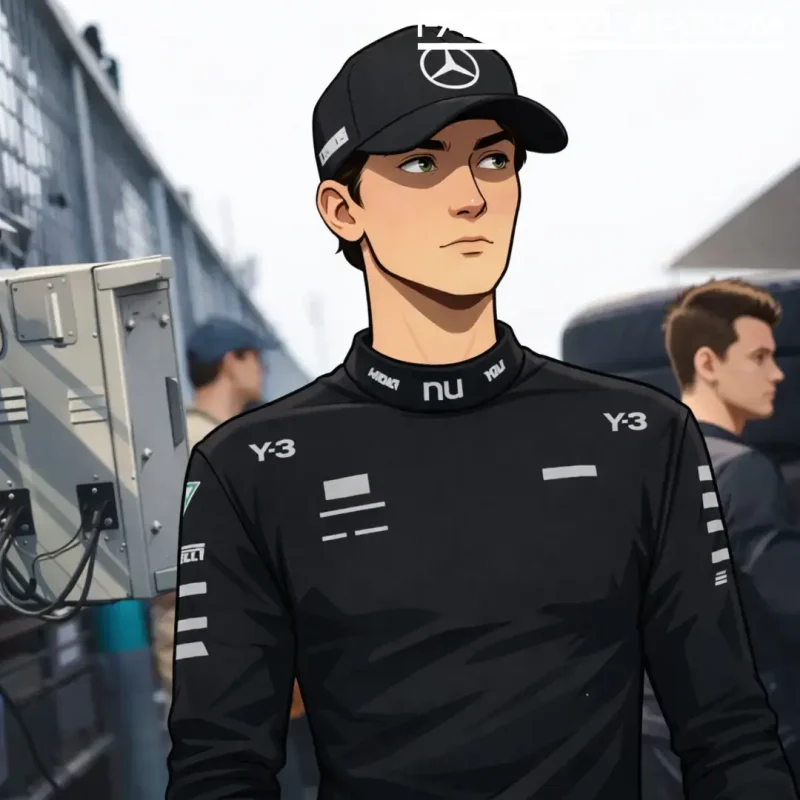
George Russell isn’t pretending the early shape of Mercedes’ 2026 title fight has been fair.
Two races ago he looked like the obvious reference point: the senior driver in a W17 that, when it behaves, has set the pace. Now, after difficult weekends in Shanghai and Suzuka, he’s watching Kimi Antonelli lead the World Championship on the back of consecutive wins — and Russell’s annoyance is less about being beaten in a straight fight than about feeling like the rough edges of a still-young package keep finding him first.
“I’m not feeling too lucky,” Russell admitted after the Japanese Grand Prix. “This is racing. Over the course of a year, sometimes it goes for you, sometimes it goes against you.”
Suzuka, in particular, sounded like a case study in how quickly a modern grand prix can unravel even when the core performance is there. Russell pointed to the safety car restart as the moment his day tipped away, saying he couldn’t harvest and deploy energy properly — a battery charging issue that left him exposed and allowed Lewis Hamilton to get by. Then there was another battery-related complication in the scrap with Charles Leclerc, tied to what Russell described as a software glitch.
That combination cost him the sort of clean, points-rich Sunday a title favourite expects to bank early in a season. And it’s brought the internal Mercedes narrative into sharper focus: Antonelli is taking the headlines, Russell is taking the bruises.
“It’s annoying that I missed out on the podium because at the safety-car restart I couldn’t charge my battery, so we got overtaken by Lewis,” he said. “And then another problem with Charles, with the battery.
“It’s still very complicated, these cars, it’s still very early, and you have to make these mistakes to learn. But it feels like at the moment all the issues are coming on my side, so that is pretty frustrating, to be honest.”
The sting, for Russell, is that none of it reads like a deficit in speed or execution so much as death by a few well-timed cuts — the sort that don’t show up in a single lap time trace, but swing races all the same.
He also highlighted the safety car timing as a pivotal blow. Russell had pitted, only for the neutralisation to arrive one lap later — the kind of timing that turns a normal stop into an instant strategic handicap and, in this case, handed Antonelli a cheaper route through his own pit sequence. In the tight margins of Suzuka, where track position and clean air remain currency even with all the tools at a team’s disposal, that was effectively the afternoon gone.
In footage shared on Mercedes’ social channels, Russell was seen debriefing with Toto Wolff and circling that lap as the inflection point.
“One lap later for that pit stop, and probably we’re here talking about what a great day,” he said. “So it’s swings and roundabouts, it’s gonna come at some point.
“Then all the other little niggles we had after, like the battery not charging at the safety car restart, and then the thing with Charles, when we had that glitch with the software, and just like somebody from above was not gonna let us.”
What makes Russell’s mood interesting isn’t the frustration itself — every title contender has those Sundays — but the timing of it. This is the phase of a season where teams want to establish internal order without having to declare it. Mercedes doesn’t need to say there’s a lead driver when one of them is leading the championship and the other is publicly listing the ways his race keeps being compromised. The optics start to do the work for you.
Russell did at least frame it as part of a broader bedding-in period, arguing the team is still learning how to live with the car’s complexity and the way small systems issues can cascade into big results. That’s a reasonable position, and it’s the sort of comment that signals he’s still onside — irritated, not alienated. But the subtext is obvious: if Mercedes keeps finding problems, Russell can’t keep being the one to discover them at 300km/h.
There’s also a subtle driver dynamic in his closing reflections. Russell noted that both he and Antonelli found it difficult to make early progress through traffic — a nod to how races can now hinge on getting through the opening phase without losing control of your energy management and tyre life. Antonelli still emerged with the win and the points, which is precisely why momentum has swung his way.
“I think both Kimi and I struggled to get through people at the beginning of the race, didn’t we?” Russell said. “And then at the end, it was not easy at all. Anyway, could have been a much worse.”
That’s the last line that matters. Russell knows he’s not out of anything in 2026 — not with the speed Mercedes has shown and not with a season still in its infancy. But when the car’s quickest, the clean weekends count double. Antonelli has been cashing those cheques. Russell, right now, is watching them bounce for reasons that feel just outside his control.
And in a championship fight that’s suddenly inside the same garage, that kind of irritation tends to build faster than the points gap.