Nigel Mansell doesn’t tend to sit on the fence, and his take on Formula 1’s early-2026 pecking order is delivered with the familiar blunt logic of a world champion who’s lived inside a title fight: if you want a team to revolve around you, you don’t ask for it — you make it inevitable.
Three rounds into a 22-race season, the story at the sharp end has been as much about authority as outright pace. Mercedes has produced a car that, once it’s clear of the messy first-lap theatre, can disappear. Ferrari, meanwhile, has made a habit of landing the first punch off the line — only for the W17 to lean on its strengths once “overtake mode” is out of the equation and the race settles.
The numbers have backed up that pattern. George Russell ended Australia 15 seconds up the road from the nearest Ferrari. In China, Kimi Antonelli finished 25 seconds ahead of Lewis Hamilton, and in Japan he was 13 seconds clear of Oscar Piastri. With an extra eight points available from the China Sprint, Antonelli has converted that early momentum into a championship lead: 72 points, nine ahead of Russell and 23 clear of Charles Leclerc, with Hamilton a further eight back again.
So when Mansell was asked for his verdict on Britain’s two headline names — Russell at Mercedes and Hamilton in his new Ferrari colours — he didn’t just praise them. He shifted the spotlight to the teenager currently turning Mercedes’ internal dynamic into the season’s most interesting subplot.
“George is a great driver, and it’s sometimes how the chips fall,” Mansell told Sky News, framing Russell’s position as one of performance that still needs to harden into something more permanent. His point, really, was that speed isn’t the full job description when you’ve got a garage next door capable of taking the same car and making it look like it belongs to them.
Mansell reached back to his own 1992 experience with Riccardo Patrese — and the old suspicion that the other side of the garage must have had “a special car”. He recalled swapping qualifying cars at São Paulo to settle it, and instantly being quicker in Patrese’s machine. The lesson, as Mansell tells it, was simple: you “stamp your authority”.
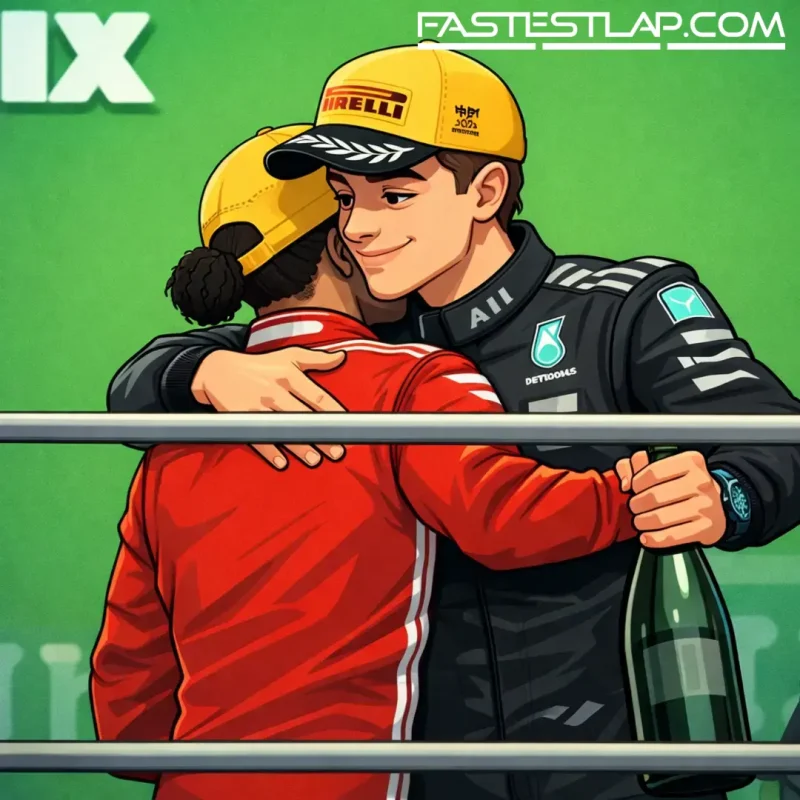
It’s a timely analogy, because Mercedes in 2026 doesn’t look like a one-driver team and, right now, it doesn’t even look like Russell’s team. Antonelli isn’t just racking up points; he’s generating that subtle gravitational pull that changes how people talk in briefings and how a paddock starts to narrate a season.
“And getting back to the Mercedes team, you have to stamp your authority,” Mansell said. “And obviously Kimi has done a great job. He’s young. Everyone’s pulling for him.”
That line — “everyone’s pulling for him” — is revealing. It’s not an insult to Russell, nor is it a slight on Hamilton. It’s an acknowledgement of what Formula 1 does when it senses a new centre of attention: it tilts. Fans do it, the media does it, and teams are never as immune as they claim. A driver who becomes the emotional favourite can quickly become the organisational default, particularly if the results keep arriving.
None of this means Russell can’t flip it. Mansell’s whole thesis is that authority can be seized, and that the season is long enough for momentum to change hands more than once. But the opening phase has given Russell a very specific problem to solve. He isn’t chasing an established champion who’s nearing the end; he’s managing a rising team-mate whose confidence appears to be inflating race by race, with the pace to justify every extra inch of it.
Hamilton, though, remains a live wire in the background of all this. Mansell made a point of noting the change in tone around the seven-time champion since switching to Ferrari.
“Lewis is fired up again,” he said. “Lewis has had a brilliant career and it’s fantastic what he’s doing. He’s now reinvigorated.”
It’s not hard to see why Mansell zeroed in on that. Ferrari has been “there or thereabouts” from the off, and in the early laps — where launches and positioning matter most — it’s looked ready to fight. The intrigue is what happens as the year develops, because 2026 isn’t just about the usual chassis development race; it also carries the FIA’s Additional Development and Upgrade Opportunities (ADUO) programme, designed to address engine disparity. The first round of updates is reportedly permitted after the Miami Grand Prix, a detail that matters because it offers a structured chance for the competitive order to shift without the sport pretending it’s all organic.
Mansell’s view is that Ferrari’s winter work has already put it on the doorstep, and he expects the familiar cast to keep crowding the stage.
“Ferrari has done a fabulous job over the winter,” he said. “They’re there or thereabouts, Mercedes are the forerunners and McLaren is going to be there too.”
Right now, the championship picture is oddly clean: Mercedes versus Mercedes at the top, with Ferrari close enough to be a threat if its early-race bite can be matched by late-race stamina, and with McLaren hovering as the third act Mansell expects to join the main plot. But the more compelling tension is inside the leading team itself — not because the relationship is exploding, but because it’s evolving.
Russell has the experience, the standing, and enough raw speed to win any weekend. Antonelli has the points lead, the feel-good current, and that most dangerous of assets in a young driver: the sense that the car will do what he asks of it, and that the season is bending his way.
Mansell’s message to Russell — even if he didn’t frame it as advice — is that none of this is decided by polite parity. If Russell wants Mercedes to be his, he’ll have to take it. And if Antonelli keeps doing what he’s done so far, he won’t be waiting around for permission.