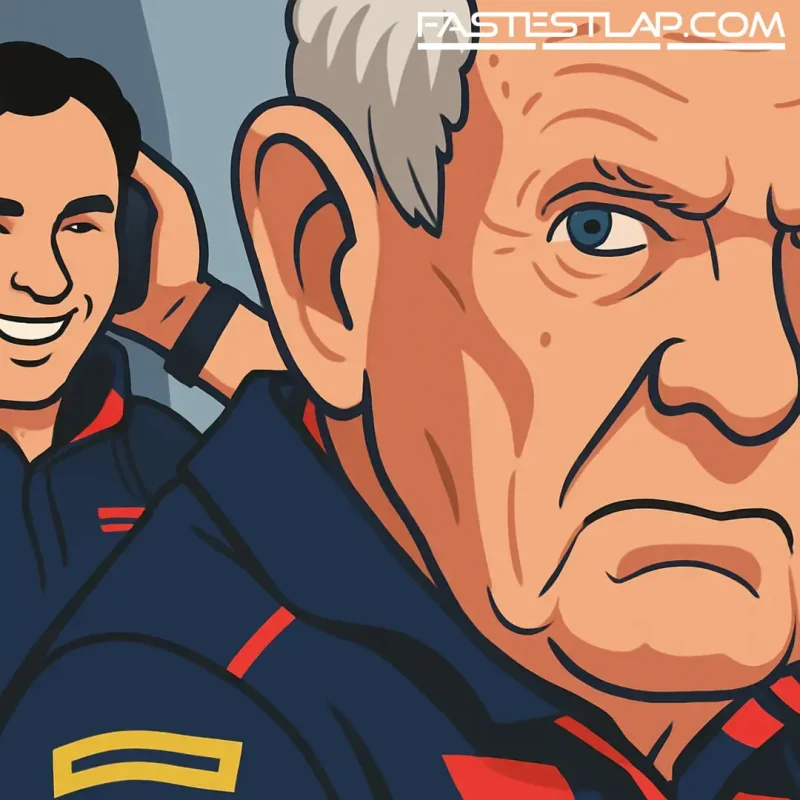
‘Send it to Helmut’: Perez says Red Bull pushed him to a psychologist — and the first bill was £6,000
Sergio Perez has lifted the lid on one of his more surreal early moments at Red Bull, revealing the team steered him toward a psychologist after his slow start in 2021 — and that Helmut Marko ended up footing a £6,000 tab for a single session.
Speaking on the Cracks podcast, Perez said that after failing to score a podium in his first five races with the team, he was urged to seek help. “As soon as I arrived at Red Bull, in the first races, when I didn’t deliver results, [the team said]: ‘What you need is a psychologist,’” Perez recalled. “One day I arrived at the Red Bull factory and they tell me: ‘Hey, there’s a bill for you: £6,000 from the psychologist.’ I tell them: ‘Ah, can you send it to Helmut? He’ll pay it.’”
According to Perez, Marko later checked in — “‘Hey, how did it go?’” — and the Mexican couldn’t resist the punchline: “Perfect. With this session, we’re all set.” He added, with a laugh, “And that’s how we went on for three years. Already cured by the psychologist, the results started to come. The call worked.”
The results did arrive. Perez took his first Red Bull win at the sixth time of asking in Baku 2021, and five more career victories followed during his four-year stint with the team from 2021–24. But the soft-focus memory masks a harder truth: life alongside Max Verstappen is a blender set to puree.
Perez’s final season with Red Bull in 2024 ended without a win and, eventually, without a seat. He and the team split at year’s end, with Liam Lawson and Yuki Tsunoda drafted in for 2025. Both have learned the same lesson that caught out Pierre Gasly and Alex Albon before them: the bar next to Verstappen is sky-high, and the margin for error is measured in microns.
Perez said he “looked for help everywhere” in 2024 to salvage form, including work with respected driver coach Rob Wilson, whose client list reads like a paddock roll call. But the Mexican suggests the atmosphere compounded the struggle. “When you have a car where you’re thinking about what’s going to happen, what it’s going to do, in which corner you’re going to crash, you can’t go fast,” he said. “And on top of that, you have your whole team against you. Publicly, it was very difficult. I think only someone very mentally strong can withstand something like that.”
He’s previously claimed he was told early in his tenure that the Red Bull “project was created for Max,” a framing that, fair or not, tallies with the Verstappen-centric reality that’s delivered the team an era of dominance.
Marko, the long-time powerbroker of the Red Bull system, exited at the end of 2025. He’s set to receive his full annual salary for 2026 — believed to be around €10 million — a golden handshake after two decades shaping the driver pipeline and steering the team’s sporting direction. Love him or loathe him, Marko’s fingerprints are all over Red Bull’s modern history, from backing a young Verstappen to the ruthless churn of junior drivers fighting to keep their place.
The next name stepping into the fire? Isack Hadjar. The Frenchman’s approach to sharing a garage with Verstappen in 2026 is strikingly pragmatic. “If anything, the goal is to accept that I’m going to be slower the first month,” he said late last year. “Everyone thinks they’re special… and then you get stomped over. If you come in, you’re like: ‘I’m nowhere near…’ We’re talking about the best driver on the grid, so the chance that I’m slow at the start of the year is very high. So I might as well accept it now and just work towards getting there.”
It’s a refreshingly honest stance — part self-preservation, part realism — and maybe the only sane way to start life against a driver who turns every team-mate comparison into a weekly audit.
Perez, for his part, is plotting a return in 2026 with Cadillac, partnering Valtteri Bottas. It’s an intriguing pairing: two veterans with deep playbooks, a brand-new project, and an American manufacturer eager to make a statement. After a season in the wilderness, Perez sounds like a driver ready to reset the narrative — psychologist invoice optional.
Strip the noise away and the Perez anecdote lands on a familiar theme in modern F1: high-performance environments trying to engineer mental resilience as aggressively as they engineer downforce. Sometimes it’s data. Sometimes it’s a driver coach in a rental car on B-roads. Sometimes it’s a £6,000 phone call. And sometimes, as both Perez and Red Bull’s revolving door have shown, even that isn’t enough.