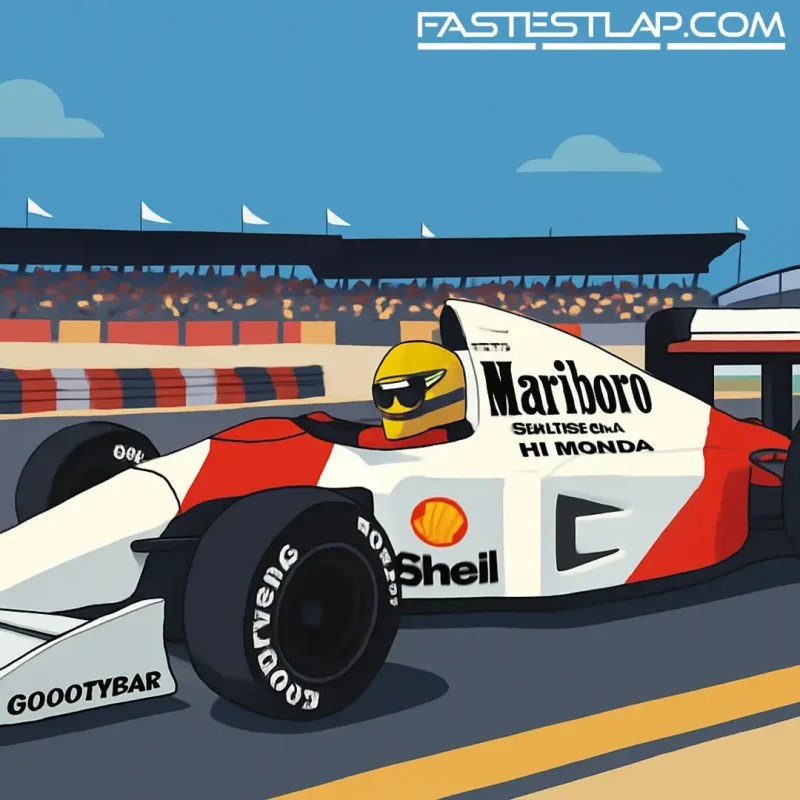
Senna’s heroic 1991 Brazilian GP-winning McLaren heads to auction — and it could fetch $15m
Some racing cars are collectibles. This one is a crescendo. McLaren’s MP4/6 chassis MP4/6/1 — the car Ayrton Senna nursed to an almost mythic home victory at Interlagos in 1991 — is going under the hammer next month, with estimates up to $15 million. If the number lands where many expect, it’ll sit among the most expensive Formula 1 machines ever sold.
The story is etched into F1 folklore. Senna arrived in São Paulo having won the season-opener in Phoenix and put the McLaren on pole. Nigel Mansell muscled past mid-race, a slow stop later dropped the Williams and put Senna back in command. From there, the gap swelled, then everything started to shrink: the McLaren’s gearbox began to die.
Over the final laps, Senna fished for any gear he could get and grabbed sixth. That was it — top gear only, no engine braking, lap after punishing lap as the rain began to spit. He slipped the clutch through the slow stuff to keep the V12 alive, his arms and shoulders seizing under the strain and an over-tight harness. Riccardo Patrese closed, the stopwatch biting chunks from Senna’s lead. Four seconds at the start of the last lap. Then two. Then the flag.
He won by 2.991s.
What followed is as famous as the drive: Senna slumped in the cockpit, needing help to climb out, then fought to lift the trophy on the podium before the Brazilian flag finally rose above it all. It wasn’t his most perfect performance — he said as much — but it was the one that demanded everything.
“I noticed Patrese getting closer and actually thought I wasn’t going to win,” Senna admitted afterwards. “However, I thought I had an obligation to win in Brazil… I also had muscle spasms and cramps in my shoulders and neck… I only came back to reality when I saw the chequered flag. It wasn’t the greatest win in my life, but it was the hardest-fought one.”
The car at the center of it is no ordinary McLaren, even by Woking’s standards. Designed by Neil Oatley, the MP4/6 ushered in McLaren’s final title of the Senna era with an all-new Honda V12 that sang to 13,800rpm and around 720bhp. This very chassis was shaken down by Gerhard Berger at Estoril in February 1991, then handed to Senna to put the Interlagos legend on the books — and help launch his third and final world championship campaign.
McLaren kept MP4/6/1 in its heritage collection until 2020, when it was sold privately. Before that deal, the car was put back into running condition, and it remains that way now — a proper, living grand prix winner rather than a static sculpture. RM Sotheby’s will offer it next month with an estimate up to $15m.
That number would place it in rare air. Earlier this year, a Ferrari F2001 driven by Michael Schumacher — the car that bookended his first title with the Scuderia — commanded $18.5m. And the benchmark remains Juan Manuel Fangio’s 1955 Mercedes W196, which changed hands for close to $60m. Add in the reported $650m sale of Bernie Ecclestone’s 69-car trove, and you’ve got a market that’s not so much buoyant as downright bullish.
Even in that company, Senna’s Interlagos winner makes a particular kind of sense. Provenance matters in this game, and nothing validates a chassis like a race etched into a sport’s collective memory. This isn’t simply “a 1991 McLaren.” It’s the one that crawled, clawed, and somehow sprinted home in sixth gear, the car most people picture when they hear the words “Senna” and “Brazil.” You’re buying the image, the story, the audio track — and yes, the ability to fire it up and make it sing again.
As ever with blue-chip F1 cars, the real question is where it ends up. A private collection? A museum with a sense for good theatre? Or back on a circuit, where a brave soul might once again feel what a genius did with one gear and a nation on his shoulders. Wherever it lands, MP4/6/1 is rolling history — and soon, very expensive history at that.
Auction paddles at the ready.