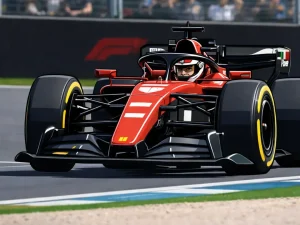
Aston Martin didn’t arrive in Melbourne so much as limp into it.
Two practice sessions into the 2026 Australian Grand Prix weekend, the headline isn’t lap time or upgrades but whether the AMR26 can be run often enough to learn anything at all. The culprit is Honda’s new power unit package – specifically battery-related vibrations severe enough to shred confidence, chew through hardware, and leave Aston Martin talking about durability before it can even begin the usual early-season chase for performance.
Adrian Newey, speaking in the FIA press conference on Friday, laid out just how quickly the situation has turned from worrying to acute. Aston Martin turned up with four batteries. Two were pulled from circulation after first practice due to conditioning issues, leaving the team with only the two units currently fitted to its cars and, crucially, no additional supply available. Newey called that rate of consumption “quite a scary place to be in”, and it’s hard to argue. In a weekend where everyone else is already trimming and optimising, Aston Martin is doing the kind of arithmetic teams hate doing: how many laps can we afford to run?
The vibrations themselves have become the paddock’s most surreal talking point. Newey said the shaking is so intense that both drivers believe there’s a risk of nerve damage if they complete too many consecutive laps – Lance Stroll putting the threshold at around 15, Fernando Alonso at roughly 25. Privately, some in the paddock have played down the idea of any lasting harm, suggesting the messaging is at least partly tactical: keep the pressure on Honda to move faster and treat driveability as a crisis, not an inconvenience. Even if you strip away the theatrics, though, nobody disputes the core point. This is not how a manufacturer wants to launch a new regulation cycle.
Honda’s trackside general manager and chief engineer Shintaro Orihara offered a sliver of encouragement after second practice, where the team finally managed to put meaningful laps on the board. Alonso completed 18 laps and ended the session 20th, 4.9s off the front, while Stroll did 13 before returning to the pits with another issue. Combined, 31 laps gave Honda enough data to say its first countermeasures are doing something.
“FP2 today was valuable for us, as we were able to see the effects of our countermeasures,” Orihara said. “With Lance and Fernando completing a combined 31 laps, we were able to gather the necessary data to determine that the items we implemented first on the dyno at HRC Sakura are working at the track. As a result, there are less battery vibrations occurring according to our analysis gathered during the session.”
That’s progress, but it’s also a brutally low bar. Aston Martin had just 400 laps of testing data across pre-season running, a figure that tells its own story. Teams can survive a slow car in March; they can’t survive a car that can’t be exercised.
What makes this situation particularly combustible is how openly the accountability is being discussed. The finger is pointed squarely at Honda, and Honda has broadly accepted that reality. Yet there’s also an undercurrent: the suggestion that late chassis-related changes requested by Newey may have contributed to the “unprecedented” level of vibration. That’s the sort of nuance that quickly becomes political, because it shifts the story from simple supplier failure to an integration problem. In modern F1, those distinctions matter. They shape how a partnership behaves under stress, and how it explains itself when points start bleeding away.
Newey’s most revealing comments, though, weren’t about what Aston Martin is fighting this weekend. They were about when it realised it had a fight on its hands at all.
Asked whether Honda had indicated why it appeared under-prepared, Newey sketched a picture of a manufacturer trying to rebuild momentum after stepping away, and doing so at the worst possible moment: as budgets tightened and rivals continued with continuity.
“Honda pulled out at the end of 2021,” Newey said. “They then re-entered the sport, kind of, at the end of 2022, so over roughly a year, a year and a bit, out of competition. When they reformed, a lot of the original group had, it now transpires, disbanded… and so a lot of the group that reformed are actually fresh to Formula 1.
“Plus, when they came back in 2023, that was the first year of the budget cap introduction for engines, so all their rivals had been developing away through ’21, ’22 with continuity… They re-entered with, let’s say, only, I’m guessing, 30 per cent of their original team, and now in a budget cap era, so they started very much on the back foot, and unfortunately, they’ve struggled to catch back up.”
The kicker is Aston Martin’s timeline. Newey insisted the team wasn’t aware of Honda’s lack of readiness when the deal was agreed in 2023. It only became clear late in 2025, when rumours from Japan began circulating that Honda wouldn’t hit its initial performance targets for the first race of 2026.
“We only really became aware of it in November of last year when Lawrence, Andy Cowell, and I went to Tokyo to discuss rumours…,” Newey said. “And out of that came the fact that many of the original workforce had not returned when they restarted.”
That admission lands with a thud because it reframes Aston Martin’s current problem as much as it explains it. If the team genuinely didn’t grasp the depth of Honda’s rebuild until the end of last year, then Melbourne isn’t a surprise in the usual sense – it’s the first public consequence of a private discovery that came too late to properly mitigate.
And mitigation is all this weekend is really about. A reliability fix has been introduced in Australia aimed at reducing how the vibrations transmit through the chassis. Parc fermé looming from the start of qualifying only tightens the screws: Aston Martin has to choose a configuration that gives it the best chance of simply finishing, even if that means compromising other priorities.
Chief trackside officer Mike Krack, trying to locate something usable in an ugly Friday, pointed to the effort behind the scenes. Aston Martin spent Wednesday building up the cars after the FIA removed initial curfew limitations due to travel disruptions linked to the conflict in the Middle East. It’s a reminder that the operational side has done its job; it’s the hardware that’s betraying them.
“We knew, coming here, that it was going to be difficult,” Krack said. “But we are racers and want to have the cars ready in the morning.”
There’s an edge to the situation that won’t go away quickly. Newey, looking beyond the immediate firefight, urged Honda to start focusing on its 2027 power unit, arguing it’s “very clear” a “very large step in combustion engine power” is required. It’s an extraordinary thing to say at the first race of a new era: not “we’ll fix it,” but “we already need the next one.”
For now, Aston Martin’s weekend hangs on a grimly simple question: can it keep the remaining batteries alive long enough to race? Because if Melbourne becomes a story of retirements – and Newey’s own prognosis is bleak, with a double DNF expected – then the team’s 2026 campaign risks being defined not by the promise of Newey’s influence, but by how quickly Honda can stop the car shaking itself apart.