
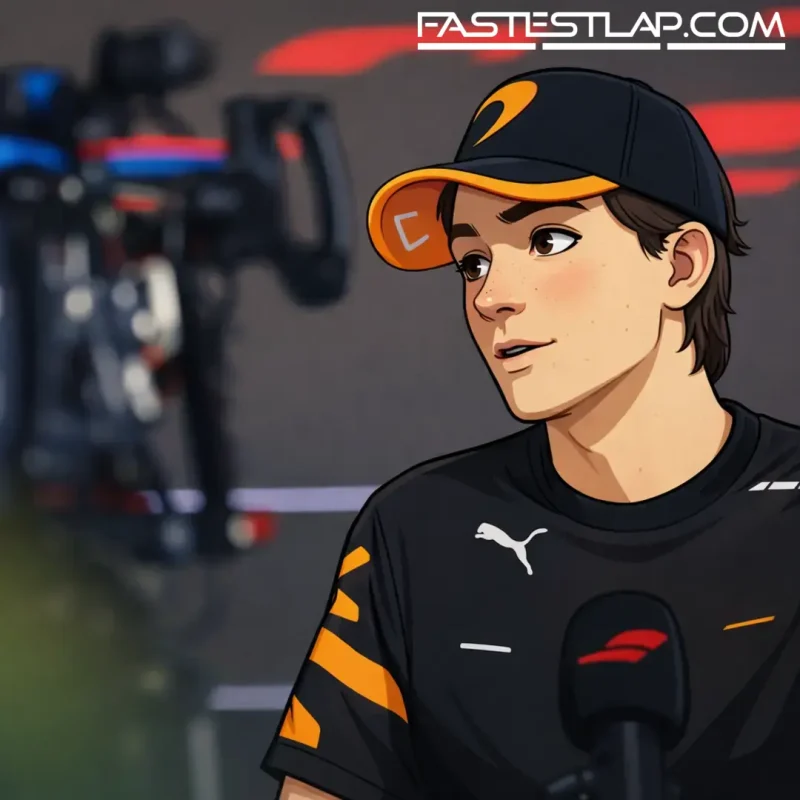
Oscar Piastri didn’t come out of Spa looking for a courtroom win. What he couldn’t square was the message the sport sends when wheel-to-wheel contact at 300km/h is effectively waved through.
The flashpoint came early in the 44-lap Belgian Grand Prix, with Piastri’s McLaren and Charles Leclerc’s Ferrari disputing position on lap eight. Piastri launched an ambitious move around the outside into Les Combes, committed enough to put his car right on the white line on entry. Leclerc held his ground, the cars touched at the start of the braking zone, and while the Ferrari escaped unscathed, the McLaren didn’t: Piastri picked up floor damage that blunted his afternoon.
On the radio, Piastri was immediate and blunt. “He didn’t leave enough space,” he said, warning it could’ve been “a massive crash”. Race Control noted the incident, but it didn’t take long before the verdict landed: no further action.
That, more than the contact itself, is what left Piastri scratching his head.
“From where I was sat, I was on the white line and got squeezed,” he told media afterwards at Spa. “We were firstly very lucky not to have a bigger crash because we touched wheels at the start of the braking zone.
“I don’t really know where I was supposed to go.”
Piastri was careful not to turn it into a demand for a slam-dunk penalty. His argument was subtler — and, in its own way, more damning. If the stewards didn’t want to go down the road of time penalties or points, fine. But at least acknowledge the risk.
“I was not saying that it needed to be a penalty necessarily,” he said, “but at least a black-and-white flag, or something like that.
“Because if we think that is fine… even just the incentive of knowing that you can leave anyone the absolute bare minimum of space and get away with it, that’s not the nicest place to be.”
That line will resonate up and down the grid, because it goes to the heart of what drivers actually care about in these moments: consistency and deterrence. A warning flag is motorsport’s equivalent of an informal yellow card — it doesn’t rewrite the result, but it tells everyone where the boundary is. When nothing happens at all, the boundary moves.
The stewards’ explanation, issued later, leaned heavily on the idea that Piastri was never realistically going to complete the move from where he was placed. The incident was investigated under Appendix L, Chapter IV, Article 2(d) of the FIA International Sporting Code, but after reviewing video and onboard footage they concluded there was “no possibility” of the overtake being completed and that Leclerc did not “deliberately” crowd Piastri off the track.
Their written verdict described Leclerc as following the racing line on the approach to Turn 5, moving slightly left to open the corner, with “side-to-side contact” ensuing. In those circumstances, they said, no further action was warranted.
It’s a familiar logic in modern stewarding: if the attacking car hasn’t earned enough of the corner, the defending car’s obligations are reduced. But what Piastri is really pushing back on is the practical reality of how these situations unfold in a braking zone. Drivers don’t experience “overlap” as a neat diagram; they experience it as a rapidly narrowing corridor with carbon fibre and tyre sidewalls inches apart. When the margin is that slim, the sport either discourages the squeeze or tacitly encourages it.
And Spa’s Les Combes isn’t a gentle place to test that philosophy. It’s fast, the braking is heavy, and the consequences of wheel-to-wheel contact can escalate instantly. Piastri’s point wasn’t that Leclerc tried to take him out — it was that the squeeze created a risk level that, in his view, should at least trigger a warning.
The irony is that the stewards’ “no possibility” wording can be read two ways. One interpretation is purely legalistic: Piastri wasn’t far enough alongside to demand racing room. Another is more uncomfortable: because the pass was unlikely to stick, the defender is effectively permitted to run the attacker right to the limit, even if it produces contact, as long as it doesn’t look intentional. That’s the incentive structure Piastri is talking about — and it’s the sort of grey area that drivers exploit until they’re told not to.
In the end, the incident had consequences anyway, just not for the car that emerged ahead. Leclerc went on to finish second. Piastri, compromised by the floor damage, came home fifth — 16 seconds behind the Ferrari.
McLaren will understandably feel it paid twice: first in lap-time, then in the absence of even a formal warning. And for Piastri, there’s a bigger frustration simmering under the surface. Drivers accept that split-second judgement calls happen in combat. What they don’t accept — not for long, anyway — is uncertainty over what the rulebook is trying to incentivise.
Spa, as ever, didn’t just test the cars. It tested the limits of what the sport is willing to call “racing”.









