Cadillac’s first Formula 1 season hasn’t even begun and Dan Towriss is already trying to steer the conversation away from the lazy scoreboard watching that tends to swallow new entrants whole.
Yes, points are the headline currency in this sport. But Cadillac’s CEO is pitching a different yardstick for 2026: how quickly the team can turn up with something incomplete in Melbourne, then out-develop the cars around it once the real information starts flowing.
That’s not spin so much as a realistic reading of what’s coming. The 2026 reset is brutal—new chassis rules, new tyres, new power units, and cars that will demand a different style because they carry less load than the ground-effect generation everyone’s been leaning on. In that environment, “what you are” at the first race matters less than “how fast you become something else”.
Cadillac arrives as F1’s 11th team and the first outfit built from scratch to join since Haas a decade earlier. Its debut car has already been through early mileage: a Silverstone shakedown, then running at the unofficial Barcelona test. Just getting to that point, Towriss insists, felt like a win in itself given the sheer scale of assembling an F1 operation from nothing—every system, every component, every process created for the first time.
And that’s where the tone of Cadillac’s winter becomes revealing. Towriss describes Barcelona not as a performance barometer but a systems exam: steering column, fuel system, the whole plumbing of an F1 car that has to work flawlessly before lap time even becomes a conversation. Reliability first, because nothing stalls a development curve like a car that can’t stay on track long enough to produce usable data.
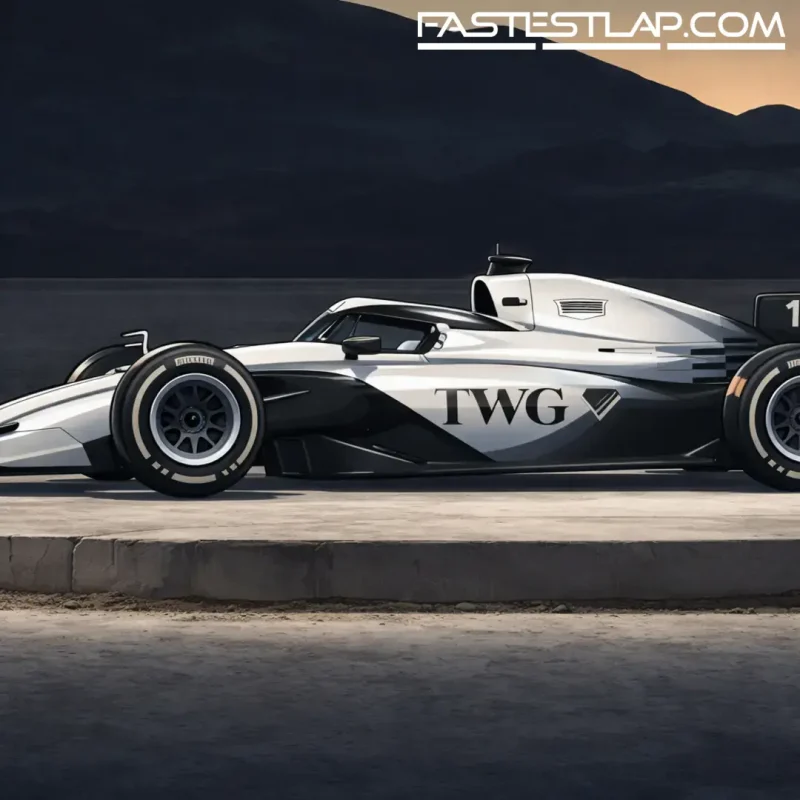
The next phase is Bahrain. Cadillac completed a filming day at the Bahrain International Circuit—also the backdrop for its first proper look at the black-and-white livery that’s already gone down well in the paddock—and now the team is primed to start stretching the car rather than simply validating it.
Towriss doesn’t hide from the likely pecking order at the season opener. He expects Cadillac to be “behind from an aero standpoint” when the circus rolls into Melbourne. That’s not exactly a shock: aerodynamic development is where established teams can weaponise their infrastructure and their understanding of the regulations. A new outfit, even with serious resource behind it, is always playing catch-up early on because correlation—getting windtunnel, CFD and track behaviour to line up—is learned, not bought.
But Towriss’ key point is what happens once Cadillac has real data. He’s banking on the rate of development being the story of Cadillac’s rookie year: get the car on track, understand the platform, then bring upgrades quickly and relentlessly in what he expects will be a season-long arms race.
That emphasis on development pace also explains why Cadillac has made such a deliberate choice with its first driver pairing. Sergio Perez and Valtteri Bottas aren’t there for potential or marketing sizzle; they’re there because they’ve seen enough versions of F1 to know what matters when a team is trying to find itself.
Between them, Perez and Bottas bring more than 500 grand prix starts and 16 wins—six for Perez, 10 for Bottas. Towriss says Perez has had more seat time so far, and that’s reflected in his influence on early feedback, but he’s clear that both drivers are central to the loop Cadillac needs to accelerate its learning.
There’s a telling little undercurrent in Towriss’ comments about driver adaptation too. The experienced guys aren’t being treated as the finished product. 2026 is a new generation of cars with less downforce than the current era, and Towriss acknowledges that everyone—his veterans included—is going to have to recalibrate their instincts. That matters, because in a season where the cars will move around more and reward different cornering techniques, a driver’s ability to articulate what they need from the platform can be as valuable as outright pace.
So what counts as success for Cadillac in 2026?
Towriss doesn’t want the team obsessing over a points number, calling it an “arbitrary” and short-term target. His preferred measure is more visceral: beating cars, beating teams, making passes, moving up the grid as the year goes on. It’s the language of a team that expects to start on the back foot—and is determined not to stay there.
It’s also a subtle attempt to frame the inevitable rough weekends that come with a first season. If Cadillac starts the year short of aerodynamic efficiency, there will be Sundays where the only visible progress is that the car is harder to pass, or that it’s racing a different cluster of rivals than it did a month earlier. For a newcomer, that is progress, even if it doesn’t always cash out in points immediately.
All of this sits within a broader arc: Cadillac will run Ferrari power initially, with General Motors developing its own power unit for a planned move to works status. That long-term view colours everything. If you’re building a programme designed to mature into a full manufacturer operation, then year one is as much about creating the habits of a competitive team—development velocity, clean execution, honest feedback loops—as it is about the occasional opportunistic result.
The hard truth is that Cadillac’s first Melbourne will almost certainly be humbling in at least one dimension. Towriss is effectively admitting that upfront, while also setting a sharper expectation than the usual “learn and grow” newcomer cliché: Cadillac didn’t come to simply circulate. It came to pick fights, even if it has to earn the right to do that first.
Bahrain testing will begin to reveal whether that confidence is justified—or whether Cadillac’s early months are going to be defined by catching up rather than clawing forward. Either way, the team’s benchmark won’t be a number on Sunday night; it’ll be how many rivals it can drag into its orbit by the time the season has found its rhythm.