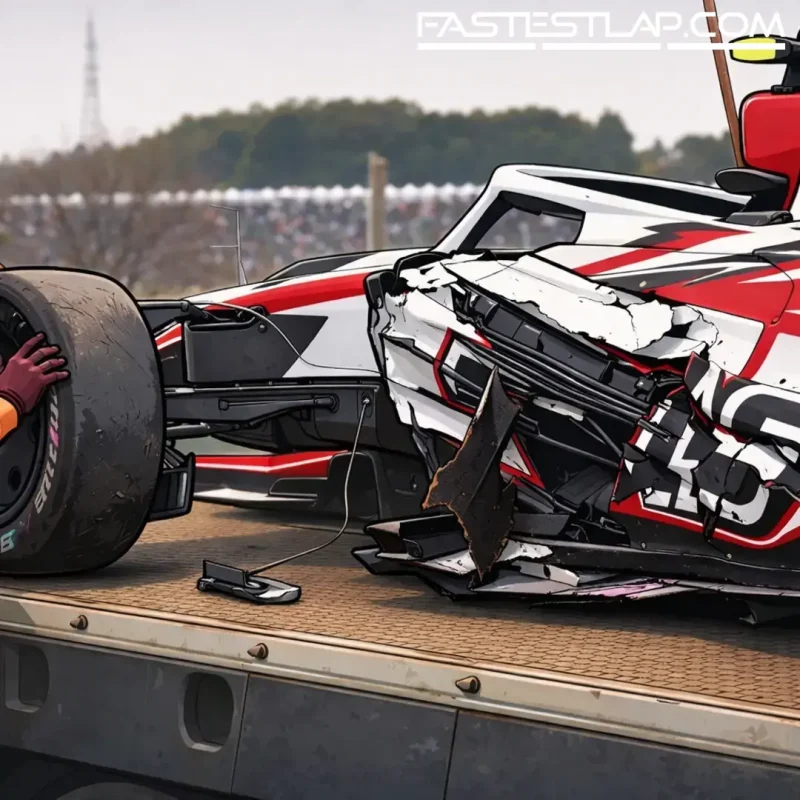
Oliver Bearman climbing out of a destroyed Haas at Suzuka with little more than a bruised knee should be filed under “lucky” rather than “acceptable”. The 50G hit in the Japanese Grand Prix was violent enough to reset the paddock’s tolerance levels — and, inevitably, to drag the sport’s new power unit behaviour back into the spotlight.
This is the first season of Formula 1’s revised power regulations, with the headline shift to a 50/50 split between combustion and electrical power. The performance target has been one thing; the way that performance arrives — and disappears — has been another. Drivers were flagging it before anyone had even raced in anger: battery harvesting, sudden deployment, and the dreaded “super clipping” at the wrong moment can make cars unpredictably quick one second and oddly sluggish the next, particularly near the end of straights.
That matters because F1 is built on assumptions. A driver commits to a corner expecting the car ahead to be roughly where it “should” be. But at Suzuka, midway through the race, Bearman arrived at Spoon to find Franco Colapinto moving at a dramatically different pace to what the Haas driver had closed on moments earlier. The reported delta was stark — around 50km/h — and Bearman was suddenly a passenger to the kind of chain reaction drivers have been warning about: evasive action, a wheel onto the grass, and then a sickening cross-track slide that ended with the barriers.
Bearman limped away, helped by marshals, then went to the medical centre for X-rays and was later cleared, with a badly bruised knee the main consequence. The car, though, looked like it had been through a war. And the incident has given the drivers’ safety argument a fresh, uncomfortable piece of evidence: closing speeds aren’t just about DRS anymore; they’re being shaped by energy management patterns that can change abruptly and, crucially, invisibly to the car behind.
Alex Wurz, GPDA president and former F1 driver, is now pushing for a specific fix — not another round of hand-wringing, but a software intervention aimed at smoothing out those sudden shifts in deployment at high speed.
“For safety reasons,” Wurz said on the ‘Lift and Roast’ podcast, “we simply have to ban sudden deployment spikes at top speed.”
His proposal is direct: mandate a standard piece of power unit software across all teams to prevent abrupt, non-linear changes in acceleration that create “surprise” scenarios like Bearman’s. It’s an argument that goes to the heart of modern F1 governance — teams can innovate within the rules, but the FIA has long standardised systems when safety demands it. Wurz is effectively saying this is one of those moments.
“That would require a piece of software that is standard across all teams, one that perhaps factors in speed and distance so we just don’t see these situations anymore,” he added. “The danger arises if the speed does not develop linearly, but changes abruptly, as in the case of Bearman.
“Then you’ll have a surprise, and you can’t calculate that because you don’t know what the person in front is doing in terms of energy management.”
The key word there is “calculate”. Drivers don’t need identical cars, but they do need predictable behaviour in the zones where they’re committed — corners taken at over 250km/h with limited sightlines and no time to renegotiate reality. If a car ahead suddenly hits a harvesting phase or runs out of deployment in a section where the following driver expects steady acceleration, the closing speed becomes a trap.
Wurz’s view is that the sport shouldn’t be relying on drivers to guess who’s about to “fall off” their electrical cliff.
“That’s where they need to come in to say this should never happen with the software,” he said. “The software knows I’m running out of energy, I mustn’t let myself get into a kind of super clipping at this speed in this section of the track.”
It’s also telling that, in Wurz’s telling, the drivers aren’t quietly grumbling in briefings and moving on. They’re actively workshopping solutions among themselves. Wurz revealed that the drivers’ WhatsApp group has been unusually busy since Suzuka — not just with emotion, but with technical ideas and proposals for how to force the issue.
“In that famous WhatsApp group, which we set up in 2015 or 2016, it’s really going off now, it’s exploding,” he said. “I’ve rarely seen it so active.
“That group is overflowing with emotions, possible solutions, technical proposals and ideas on how to still convince everyone that the drivers should be listened to… the drivers are so emotional and purely interested in the product, that politics doesn’t really matter to them.”
That last line is the tell. Drivers will tolerate plenty in F1 — complex steering wheels, evolving tyres, shifting aero maps — but they’ve never had much patience for avoidable risk dressed up as “the new normal”. And while the paddock can laugh about “Mario Kart boosts” and throw around accusations of “brake testing”, the Bearman crash was a reminder that the consequences aren’t meme-friendly.
The politics, as ever, will sit in the background: who gives up what, how much standardisation is too much, and whether teams will resist anything that smells like a performance constraint. But Wurz is framing this as a safety problem with a software-shaped solution, and that’s a hard argument to ignore when someone has just taken a 50G hit because the car in front didn’t accelerate the way the car behind expected it to.
Suzuka may not be the first time the 2026 power units have spooked drivers. It’s just the first time the sport has had such a clear warning shot — in carbon fibre, gravel, and a battered knee.