Bahrain testing has barely warmed up and already the 2026 season has found its first fault line: not downforce, not tyres, but the simple act of getting off the line.
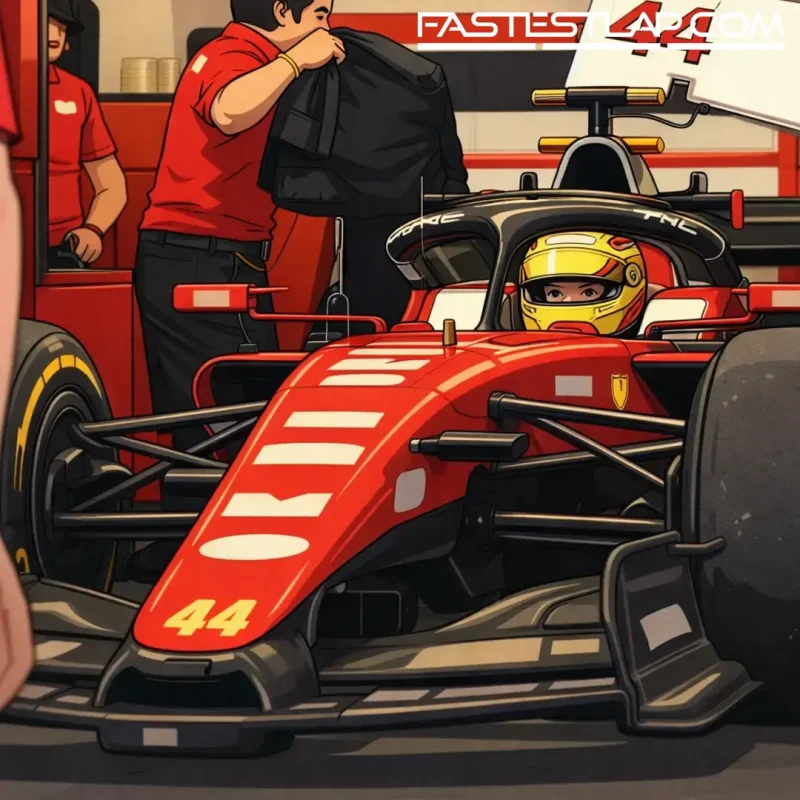
A short clip doing the rounds from the opening test shows Lewis Hamilton in Ferrari’s SF-26 holding the revs for an eyebrow-raising 22 seconds during a practice start. It’s the sort of thing that looks odd even to seasoned eyes, and it’s landed in the middle of a growing paddock conversation about how unforgiving these new, MGU-H-less power units can be when it comes to launch preparation.
The key point is that this isn’t just internet noise. With an F1 Commission analysis of start procedures looming ahead of Melbourne, anything that hints at teams “finding a way” — or drivers having to resort to unconventional methods to avoid bogging down — is going to get scrutinised.
Technical analyst Sam Collins suggested Hamilton’s unusually long build-up may not have been a mistake at all, but something done deliberately. That interpretation fits the broader theme emerging from the first Bahrain running: these cars are trickier to stage for a clean getaway, and what used to be a routine sequence is now another variable teams are wrestling into a repeatable process.
It’s also why the Ferrari spotlight is so intense. George Russell’s recent comments about Ferrari have already nudged the Scuderia to the centre of the start-safety discussion, and Hamilton — by virtue of being Hamilton, and now being in red — doesn’t get to do anything quietly. When a seven-time world champion is apparently needing that much time on the throttle before dropping the clutch, it fuels exactly the kind of “is this safe, is this sustainable, and is this going to decide races?” debate the FIA would rather not have boiling over once the lights come on for real.
Alex Brundle has gone a step further, calling for the FIA to intervene before the season opener. His argument is rooted in a fear every driver understands instinctively: a stalled car on a packed grid is one of the worst scenarios in racing, and if the new start characteristics are increasing that risk, it’s not something you politely monitor until it bites you.
The tension here is obvious. The sport doesn’t want to legislate away legitimate engineering solutions or driver technique — not in an era where manufacturers are selling a new rules cycle as a technological reset. But it also can’t afford race starts turning into a lottery, or worse, a safety problem that everyone saw coming. If the governing body does act, the question won’t just be what changes, but how quickly teams can be expected to adapt with Melbourne on the horizon.
And while race starts are the visible flashpoint, they’re arriving in the same news cycle as a far more political fight: the developing pushback over Mercedes’ 2026 engine.
Rivals, amid claims Mercedes has found a way to increase compression ratio when running hot, are reportedly pressing for an additional hot-temperature test to be introduced. The interesting part isn’t merely the alleged technical angle — it’s the shifting alliances it’s prompting.
Early chatter suggested Red Bull had aligned with Mercedes by exploiting the same loophole. That idea has been slapped down by Red Bull technical chief Pierre Waché, who insists his team hasn’t “changed sides” and is simply arguing for what it views as a fair playing field. Yet the wider picture being painted is of rival manufacturers attempting to present a united front against Mercedes before the season even starts.
This is where the 2026 rules reset begins to look less like a clean slate and more like a familiar arms race. If teams believe a competitor has discovered a legally grey performance lever, the default reaction isn’t admiration — it’s either to copy it, close it, or both. Whether the sport should be altering test procedures on the eve of a new era is exactly the sort of question that can turn a technical dispute into a governance headache.
Alpine’s Steve Nielsen has also sounded a warning that will resonate with anyone who’s watched regulation cycles unfold. Change one thing in a hurry and you risk opening “a can of worms” — not just on engines, but across the regulatory ecosystem that depends on stable interpretation. Alpine, now running Mercedes power through a new alliance, has a vested interest in avoiding a last-minute rule swerve, but the point stands regardless of who benefits: once teams believe the rulebook can be rewritten under competitive pressure, every future disagreement becomes a lobbying campaign.
Meanwhile, Aston Martin’s first steps into its Honda works partnership have been anything but serene. Off the pace in the opening Bahrain test, Lance Stroll and Fernando Alonso were both clear that there’s a lot to do. Honda, for its part, has admitted it’s “playing catch-up” at this stage, though it says last week’s running delivered key learnings.
It’s early, and Bahrain tests can deceive, but the theme across these stories is consistent: 2026 isn’t just new cars and new power units — it’s a reshaping of the margins teams used to take for granted. Getting a launch right. Defining what’s acceptable in hot-running conditions. Deciding whether the rule-makers should step in quickly or hold their nerve.
The second Bahrain test will put more mileage on the board, but it’ll also add weight to the arguments being built in the background. And in a season reset, those arguments can end up mattering just as much as the lap times.