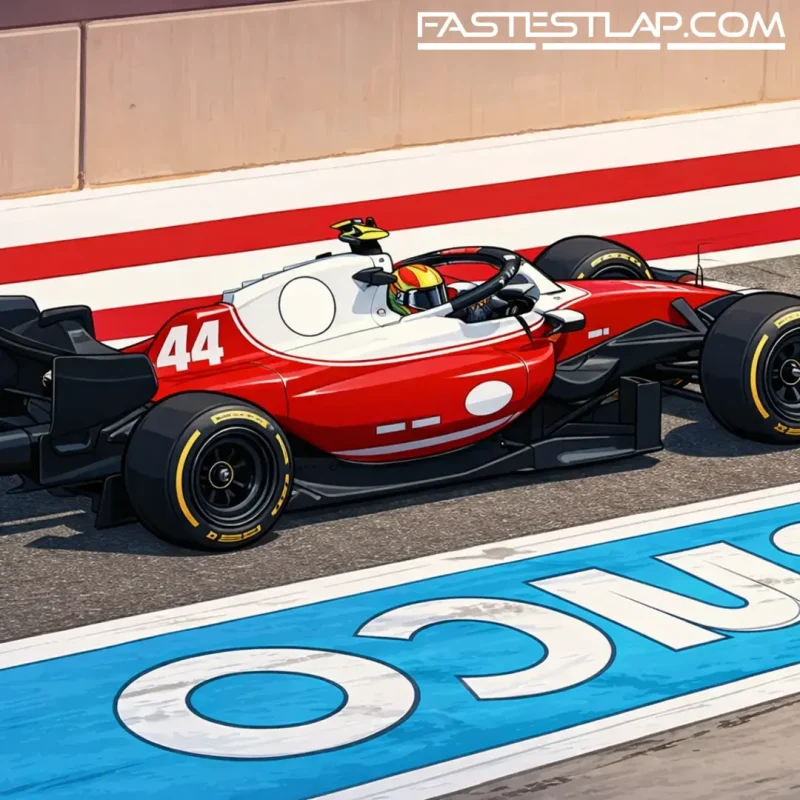
Lewis Hamilton doesn’t do many things in a Formula 1 garage without a reason, which is why one slightly awkward moment at Bahrain testing has grown legs in the paddock.
Down at the practice-start area in the Sakhir pit lane, F1TV technical analyst Sam Collins had been watching teams try to get their heads around one of 2026’s early flashpoints: how you actually launch these new cars cleanly and safely. Engines are now running a 50/50 split between electrical and combustion power, and the removal of the MGU-H has dragged an old enemy back into the frame — turbo lag — right at the point of the weekend where drivers want the car to feel most predictable.
The knock-on is simple: getting the power unit into its “happy place” for a standing start takes longer than it used to. The rev-building, the modes, the timings — it’s all more drawn out. And, as has been quietly muttered since running began, not everyone appears to be suffering equally.
In Bahrain, Mercedes driver George Russell put a bit more shape on the gossip. Ferrari, he suggested, looks able to run higher gears than other manufacturers, which would hint at a smaller turbo and a more manageable launch window.
“I think Ferrari seem to be able to run higher gears than other manufacturers, which probably suggests they’ve got a smaller turbo than other manufacturers,” Russell said in Bahrain. “So maybe they’re in a slightly easier position for their race starts.”
That’s the context in which Collins’ pit-lane clip landed. Standing near the Ferrari end of the lane, he talked through the background noise that some teams have been pushing for tweaks to the start sequence for 2026 — and that Ferrari, understood to be comfortable with the current situation, has been resistant to change.
Then Hamilton rolled up.
Instead of firing off a typical practice start in short order, Hamilton sat there with the SF-26 revving for an eye-catching 22 seconds. Collins’ reaction — half grimace, half disbelief — did the rest. The clip went viral, and the usual social-media split followed: those convinced it was deliberate theatre and those insisting people were reading far too much into it.
Collins, for his part, didn’t dismiss the idea that Hamilton had clocked the camera and made a choice. He suggested Hamilton had pulled up noticeably closer than others while filming was going on, and that alone raised an eyebrow.
Was it a mind game? A bit of mischief? Or just a driver doing a systems check and happening to park in the wrong place at the wrong time?
Here’s the thing: even if you strip out the viral clip and the speculation, the underlying issue isn’t going away. The start procedure is headed for discussion at the F1 Commission after the FIA ran simulations, process evaluations and technical checks during the Bahrain test. Ferrari is understood to have opposed a proposal last year that would have adjusted the start-light sequence, either by enforcing a minimum time or delaying the minimum time for the final car to take its grid slot. If the competitive landscape really has shifted — and if one team is materially less exposed — that’s exactly the kind of detail that turns procedural politics into a proper fight.
Several drivers aren’t hiding their discomfort, either. Oscar Piastri pointed out that last year’s “bad start” tended to be a familiar cocktail of wheelspin or reaction time. This year, he warned, the penalty could be brutal — the sort of bog-down that looks less like a minor loss and more like an F2-style collapse into anti-stall territory.
“This year it could be effectively like an F2 race where you almost go into anti-stall,” Piastri said. “You’re not just losing five metres or so. You can be losing six or seven spots if it doesn’t go well.”
He also raised a wider concern that’s been bubbling away since the first meaningful 2026 running: reduced downforce, tightly packed grids, and a start phase that may require different deployment choices. In other words, all the ingredients for somebody to misjudge it in the thick of traffic.
“It’s whether we use straight mode at the start or not as well, because I think a pack of 22 cars, with a couple hundred points less downforce, sounds like a recipe for disaster to me,” he said.
Pierre Gasly, never one to underplay a moment, suggested the season opener in Australia could deliver a start “everybody remembers” — not necessarily for the reasons the FIA would want.
“I advise you to be sitting with your TV on in Australia, because it could be one that everybody remembers,” Gasly said. “We’ll find out [what happens]. I’m not too sure myself! It is definitely going to be more tricky than it used to be.”
So where does that leave Hamilton’s 22-second rev?
It’s tempting to treat it as a neat, shareable clip and move on. But it has landed because it touches a live nerve: teams are already positioning themselves for an argument about whether the sport should adjust a fundamental piece of weekend choreography to protect safety and fairness — and Ferrari is being painted, fairly or not, as the outfit with least incentive to budge.
If Ferrari really has found a cleaner way through the post-MGU-H launch problem, it’s a genuine competitive asset. And if rivals believe it’s also influencing the rules discussion behind closed doors, every innocent-looking practice start is going to be watched like it’s a statement.
Hamilton might not have been trying to fool anyone. He might simply have been running a procedure. But in a new era where the start itself is becoming a technical differentiator again, perception is almost as valuable as traction — and Bahrain proved the paddock is ready to believe there’s more going on than meets the eye.